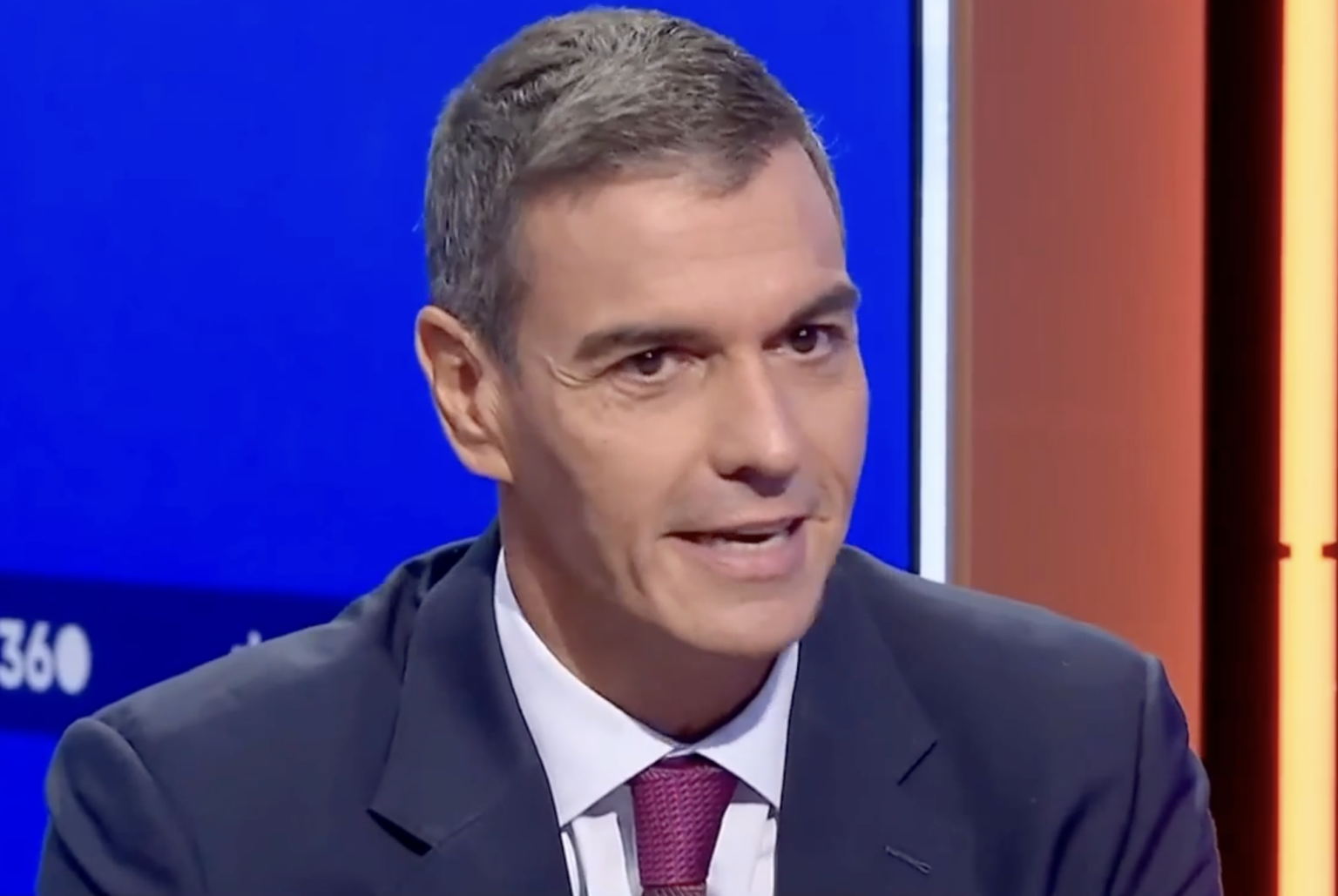

Pedro Sanchez has admitted Spain must be ‘better prepared’ for future ‘hybrid attacks’ following the unprecedented Ceuta migration crisis.
Speaking to TVE’s Mañaneros on Wednesday, the prime minister also claimed Israeli and Russian-linked networks helped amplify disinformation surrounding the mass crossings.
He said Spain must improve its intelligence capabilities to detect threats developing online and prevent a repeat of the events of July 30 and 31, when more than 70,000 migrants entered Ceuta.
But Sanchez strongly defended his government’s handling of the incident, insisting it had been ‘at the coalface from the very first moment’ and rejecting suggestions that authorities had been warned in advance of an influx on such an enormous scale.
‘The state must prepare itself better,’ Sanchez said, pointing specifically to the threat of what he called ‘hybrid attacks of this nature.’
He said Spain also needed to improve its ability to anticipate and prevent sudden mass movements of people by developing more sophisticated intelligence capabilities in the ‘digital world’.
Sanchez maintained that intelligence reports produced before July 30 and 31, which the government is preparing to declassify, did not predict a mass arrival on the scale witnessed.
Officials had detected an increase in people attempting to reach Ceuta by swimming in the preceding days, he said, but nothing suggesting tens of thousands would later cross.
Israeli and Russian-linked ‘disinformation’
Sanchez also levelled serious accusations over the online activity surrounding the crisis.
He claimed networks linked to Israel and Russia participated in the spread and amplification of hoaxes and disinformation about Ceuta.
However, he stopped short of blaming those networks for causing the original migration surge, drawing a distinction between the origin of the crisis and the subsequent amplification of misinformation.
‘Not in the origin, but in the expansion and amplification of the hoaxes and disinformation surrounding the Ceuta crisis, networks linked to Russia and Israel participated,’ Sanchez said.
He described that as ‘evidence’ and ‘a fact’, and claimed far-right think tanks in the US had also participated.
Sanchez went further by accusing what he called the ‘international far right’ of seeking to bring down his government and using the Ceuta crisis to spread ‘hatred, fear and xenophobia.’
Defends decision to let migrants enter
The Socialist leader also defended the actions of Spanish security forces during the mass crossings.
He attacked PP leader Alberto Nuñez Feijoo over his suggestion that he would have invoked Article 8 of the Spanish Constitution in a comparable situation.
The provision establishes the role of Spain’s Armed Forces in guaranteeing the country’s sovereignty and independence and defending its territorial integrity and constitutional order.
Sanchez described Feijoo’s position as an ‘absolute outrage’ and argued that attempting to stop the migrants by force could have produced a far more serious crisis.
‘What would another government have done?’ Sanchez asked.
‘Would it have started shooting at those young people, minors, boys and girls?
‘Or wasn’t it more intelligent to allow them to enter so that subsequently, in 90% of cases, in the following hours or days, they left the autonomous city of Ceuta?’
He said a further 4,500 people had voluntarily left Ceuta since August 10.
Sanchez argued that an armed response could have worsened the situation in Ceuta, damaged Spain’s relationship with Morocco and harmed the country’s international reputation.
King Felipe to visit Ceuta
The Prime Minister also revealed that King Felipe VI is expected to visit Ceuta, with officials already working on dates for the trip.
Sanchez said the monarch’s visit was needed following the crisis, declaring: ‘Today Ceuta needs the affection of all institutions.’
‘It is more necessary than ever for the head of state to visit Ceuta and Melilla,’ he added.
‘We will announce the dates and we are working on dates in the near future. That visit is going to happen.’
His comments followed a meeting on Monday between the King, Defence Minister Margarita Robles and senior military commanders to examine the situation in Ceuta from a defence perspective.
Sanchez described the meeting as ‘normal and routine’, noting that Felipe VI regularly receives such briefings in his role as head of the Armed Forces.
More than 3,000 soldiers and 1,500 police and Guardia Civil officers have been deployed in Ceuta during the crisis.
Bigger migrant centres
Sanchez also refused to rule out distributing migrants currently in Ceuta among Spain’s autonomous regions.
The government has so far provided 3,500 reception places in the enclave and intends to increase that capacity to 6,000.
The PM said the crisis demonstrated that Spain needed much larger reception facilities, arguing that centres capable of accommodating only around 1,000 people were insufficient.
Meanwhile, the government is waiting for Ceuta’s authorities to appoint representatives for unaccompanied migrant children so officials can establish their identities and determine whether they can be reunited with relatives in Morocco or will remain in Spain.
If they stay, Sanchez called on Spain’s regional governments to show ‘solidarity’ by helping accommodate them.