The Spanish government has admitted defeat in the battle to eradicate an invasive algae that continues to wreak havoc on beaches across the country.
The Ministry for Ecological Transition (Miteco) said in a report this week that the rapid expansion of Rugulopteryx okamurae means its complete removal is no longer realistic.
Instead, authorities will work with regional governments to limit the algae’s spread and minimise its environmental, economic and social impacts – likely costing tens of millions of euros per year.
Native to the north Pacific coast of Asia, the algae was first detected in Spanish waters in the Strait of Gibraltar in 2015.
Since then, it has spread to virtually every coastal region of Spain, with the Balearic Islands the only autonomous community yet to officially record the species, although specimens have reportedly already been found among washed-up seagrass.
The invasive seaweed has also reached Spain’s northern coastline, with populations identified near major ports including Bilbao and Santander since 2023.
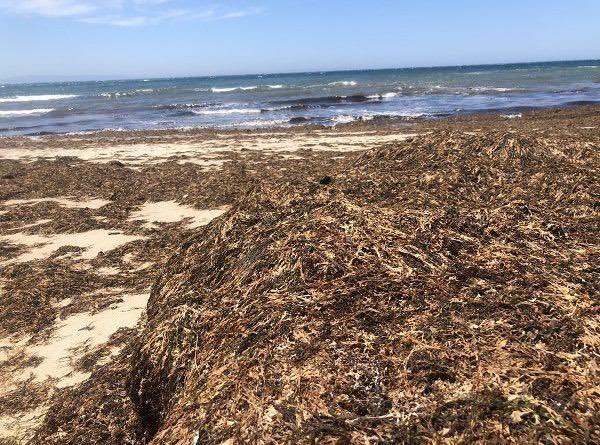
Each year, from May and June onwards, the algae releases huge numbers of fragments that wash ashore, covering beaches, harbours and coastal areas during the peak tourist season and disrupting fishing activities.
The ministry said scientific knowledge currently available makes widespread eradication impossible.
Instead, Spain’s strategy centres on monitoring the species, supporting scientific research and coordinating action between national and regional authorities.
Among the measures are a technical working group established in 2019, the species’ inclusion in Spain’s catalogue of invasive alien species in 2020, its addition to the European Union’s list of invasive species of concern in 2022, and the approval of a national control strategy later that year.
The government has also funded research projects and produced guidance to help regional authorities manage the large quantities of algae washing onto beaches.
One key part of that strategy is the creation of Biomass Management Plans, which allow regions to reuse or recycle algae collected from beaches under tightly controlled conditions.
So far, only Andalucia, Galicia and Melilla have approved these plans, with Andalucia adopting its strategy in July 2025.
Without an approved management plan, regional governments cannot authorise projects aimed at turning the algae into commercial products, such as fertiliser or biofuel.
The ministry stressed that any future reuse schemes would still require individual environmental approval and would remain secondary to the main objective of protecting marine ecosystems and limiting the damage caused by the invasive species.
Read more Andalucia news at the Spanish Eye.