
He changed his phone every two weeks and adopted a new identity at least four times per year.
Trained in martial arts and cybersecurity, Germany’s most wanted drug trafficker had become an expert in covering his tracks.
But there was one weakness the 38-year-old had not taken into account: his own brother.
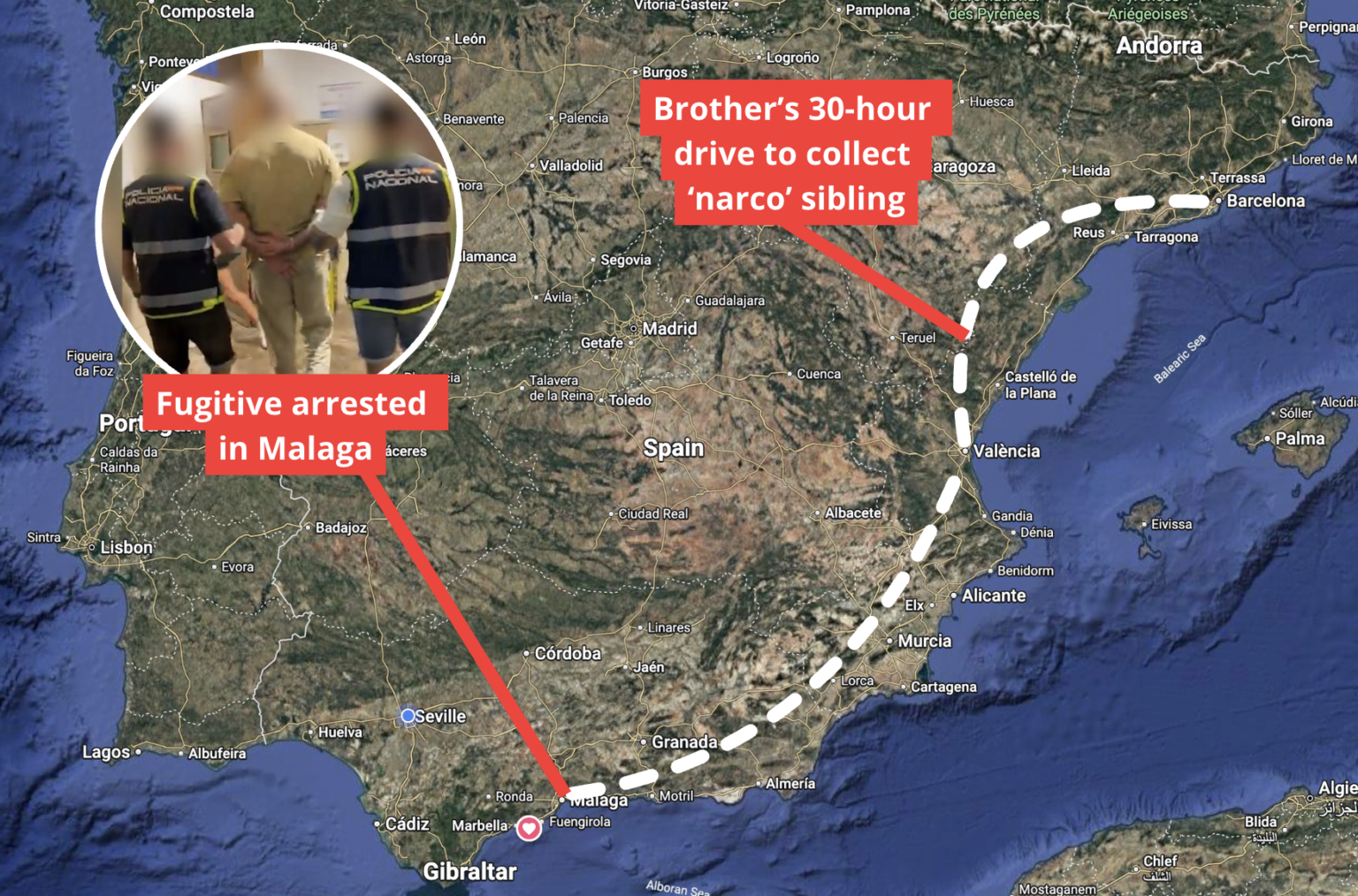
Officers followed the relative on an extraordinary journey from Germany towards southern Spain, tailing him after he entered the country through Cataluña.
The trip ultimately led them directly to the fugitive, reported to be of Pakistani origin, in Malaga.
‘He had driven almost 30 hours from Germany, and we were behind him,’ the head of the operation told Malaga Hoy.
The arrest was carried out by officers from Group II of the Policia Nacional’s central UDYCO fugitives unit.
Investigators had also discovered that the wanted man was an MMA fighter, prompting them to take additional precautions.
Despite his combat training, he was given virtually no opportunity to react.
The plain-clothes operation was described by police as ‘surprising, clean and quick’.
‘He went to the ground and there was no resistance,’ an officer involved in the operation said.
Police deliberately deployed sufficient numbers to ensure they had the upper hand.
‘There was no way in’
The suspect had reportedly spent years developing sophisticated methods to avoid detection.
Police discovered that he had specialised in cybersecurity and taken a course teaching techniques that could frustrate attempts to locate him.
‘We learned that he had a kind of master’s degree,’ the police commander said.
‘There was no way in. He was moving very carefully.’
His methods included changing mobile phones every fortnight and adopting a new name approximately every three months.
Police also discovered photographs of different documents the suspect is alleged to have created or used to conceal his true identity.
Some were linked to Arab identities and others to European ones.
With conventional methods proving difficult, investigators instead turned their attention to the people around him.
Brother leads police to Malaga
Officers identified the suspect’s brother as a potential vulnerability after receiving information that he could travel to Spain.
When the relative drove into the country through Cataluña, police began following him.
He stopped in Barcelona, where he slept for several hours, before continuing south.
Another stop followed in Valencia, where he rested inside the vehicle for around an hour and a half.
All the while, Spanish officers were watching.
The challenge was not knowing whether the brother would actually meet the fugitive after making the lengthy journey.
‘The suspicion, given the good relationship they had, was that they might meet,’ the officer leading the operation explained.
‘We followed the car to see at what point there might be a stop or contact with the target.’
Police described the days spent following the vehicle from Barcelona towards Malaga as the ‘hardest and most complicated’ part of the operation.
But when the car finally reached Malaga, investigators got the breakthrough they had been waiting for when a passenger appeared inside the vehicle and they recognised him as their fugitive.
After five years on the run, his efforts to remain invisible had come to an end.
False identities
Spanish police said fake identity documents are one of the biggest challenges facing specialist fugitive units.
Criminal organisations can provide wanted suspects with documentation allowing them to construct entirely new identities and continue living under the radar.
Officers say some fraudulent documents can be acquired remarkably cheaply.
‘We have seen Colombians with false Venezuelan documents that they buy for $200 – that’s widespread – and Dominicans with Venezuelan documents,’ the police commander said.
Police also stressed that cooperation with the German authorities was crucial to the operation that ultimately led to the suspect’s arrest in Malaga.