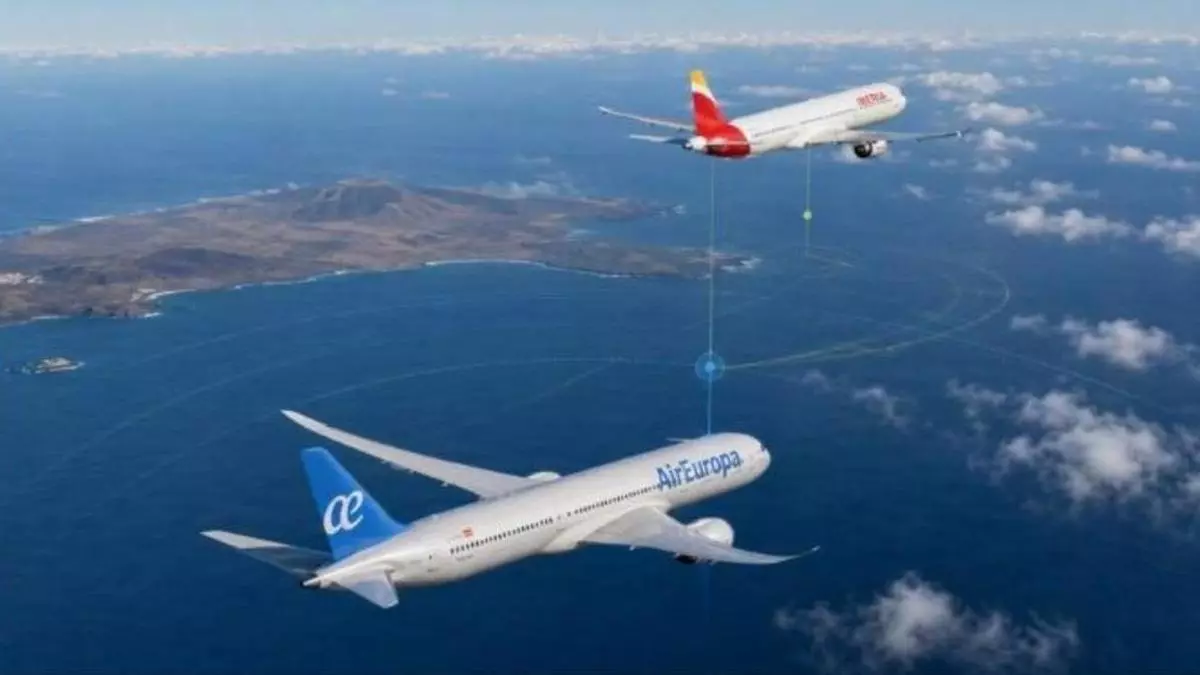

Two passenger jets came dangerously close to colliding over Spanish airspace earlier this month, it has emerged.
The incident involved an Iberia Airbus A321 and an Air Europa Boeing 787-9, which found themselves flying towards each other at the same altitude along the same airway in the Canary Islands Flight Information Region (FIR) during the early hours of July 10.
According to Spain’s Independent Professional Air Traffic Controllers’ Union (SPICA), the aircraft were travelling in opposite directions at 36,000 feet when the Traffic Collision Avoidance System (TCAS) was triggered.
The warning system is considered the last line of defence against a mid-air collision.
The incident, logged under reference IN-017/2026, occurred at 1.23am UTC and ended without injuries or damage thanks to the automatic system and the swift response of both flight crews.
The Iberia aircraft, operating flight IBE0140, first received a Traffic Advisory warning before its TCAS instructed the pilots to descend.
At the same time, the Air Europa Boeing 787-9 received the opposite instruction – to climb.
The Airbus descended by around 500 feet while the Boeing climbed approximately 400 feet until the system announced the conflict had been resolved. Both aircraft then continued their journeys normally.
TCAS is fitted to most commercial passenger aircraft and operates independently of air traffic control. It communicates directly with nearby aircraft and automatically issues coordinated instructions designed to restore safe separation whenever there is a risk of collision.
Pilots are required under international aviation rules to follow TCAS instructions immediately, even if they differ from directions previously issued by air traffic controllers.
Although the incident ended safely, SPICA said the fact that two commercial aircraft reached the same flight level while travelling head-on along the same airway indicates that earlier layers of air traffic management failed to prevent the conflict.
The near miss occurred in the oceanic sector of the Canary Islands FIR, which handles significant traffic between Europe, Africa and the Americas.
Unlike continental airspace, radar coverage is more limited in oceanic sectors, meaning controllers rely more heavily on flight planning, procedural separation and coordination between control centres.
The union has renewed calls for Spain to restore an independent body dedicated to analysing air traffic incidents, arguing that the abolition of the CEANITA investigation committee in 2021 reduced transparency and collaboration across the aviation industry.
The Civil Aviation Accident and Incident Investigation Commission (CIAIAC) has now opened an investigation into the incident.
Investigators will examine flight clearances, air traffic control communications, flight planning and the actions of everyone involved to determine how the two aircraft came into conflict.