The EU has rejected calls to suspend its controversial Entry/Exit System (EES) over the busy summer period.
The bloc insisted it will continue using the biometric system, saying there are ‘only’ around 20 ‘difficult’ border crossings experiencing significant delays – out of more than 1,500.
The decision comes after airlines, airports and the International Air Transport Association (IATA) urged Brussels to postpone the scheme until next summer following lengthy queues at airports in countries including Spain, Portugal, Italy, Greece and Belgium.
The EES requires non-EU travellers – including British and American visitors – to register their fingerprints and facial biometrics when entering the Schengen Area for the first time.
According to The Guardian, EU officials told industry representatives that a full suspension was ‘not possible’ and ‘not needed’.
Officials acknowledged the system is ‘not perfect’, but warned that pausing it in some countries while others continue using it could create even bigger problems.
For example, if a traveller enters the Schengen Area through a country operating the EES but leaves via one that is not yet fully using it, the system could incorrectly record them as overstaying their permitted 90 days in any 180-day period.
That could lead to problems when they try to enter the EU on a future trip.
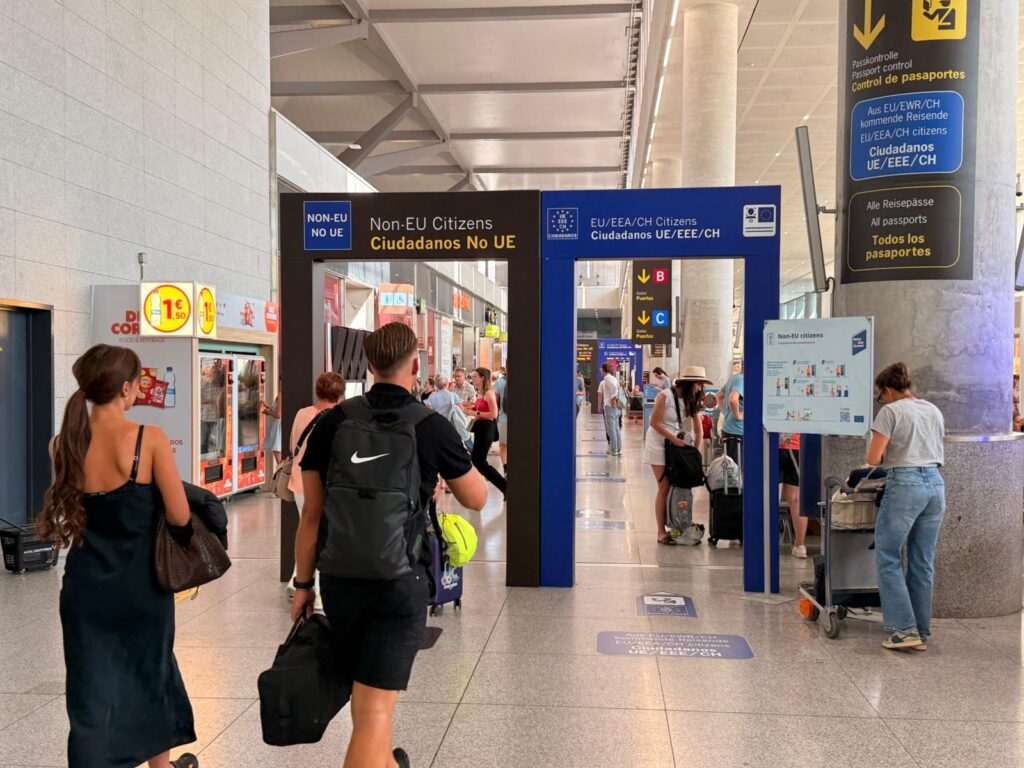
Only 20 border crossings causing major problems
EU officials said the difficulties are concentrated at around 20 of the bloc’s 1,500 border crossing points, with national authorities expected to resolve the issues rather than halt the rollout.
One of the worst bottlenecks reportedly occurred at a small holiday airport where 3,000 passengers arrived within a single hour but only four biometric booths were available.
Officials described this as a seasonal issue linked to peak holiday traffic.
Elsewhere, authorities say queues have already improved after extra staff were deployed.
Lisbon Airport has increased staffing levels, while Brussels Airport is adding 50 Frontex border officers.
ETIAS delayed again
Meanwhile, the EU’s long-awaited European Travel Information and Authorisation System (ETIAS) is now expected to be delayed until 2027, according to the Financial Times.
ETIAS will require visa-exempt travellers, including Britons, to apply online for travel authorisation before entering most EU countries, in a system similar to the US ESTA.
The application is expected to cost €20.
However, following the troubled rollout of the EES, officials have decided to delay ETIAS until the new biometric system is operating more smoothly.
One source involved in the discussions told the newspaper: “Let’s clean up EES first before you put another system that will double the line again.”
Temporary flexibility ends in September
Under current rules, airports and ports can temporarily suspend biometric checks if queues become unmanageable.
However, that flexibility is due to expire in September.
So far, EU officials say no member state has requested an extension, despite continued calls from the aviation industry for a longer suspension.
Travel groups are also urging the EU to accelerate the rollout of the Travel to Europe pre-registration app, which allows travellers to submit some biometric information before arriving at the border in an effort to reduce waiting times.