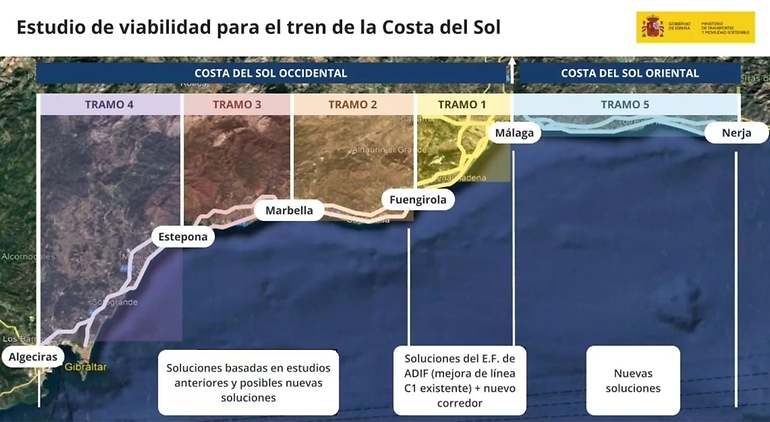
Spain wants to include funding for the long-awaited Costa del Sol train in its next national budget, it has emerged.
Madrid also wants to add measures to tackle chronic congestion between Malaga and the Axarquia region, reports local newspaper Malaga Hoy.
The pledge comes despite the fact that neither project has yet been finalised, with feasibility studies still ongoing.
Government sub-delegate Javier Salas made the announcement after meeting business leaders from Malaga and the Axarquia, who urged Madrid to deliver urgent solutions to the daily traffic chaos affecting the eastern Costa del Sol.
Among their key demands is the introduction of a reversible third lane on the A-7, which they say could provide a quicker fix while longer-term infrastructure projects are developed.
Salas said the government is continuing to work on studies for both the coastal railway and wider transport improvements.
‘We believe it is important that these projects come to fruition, which is why we want them to be included in the next General State Budget,’ he said, describing the proposals as part of a wider ‘Plan Malaga’ aimed at boosting the province.
Earlier this year, Salas said the results of both studies would be published before the summer, although no details have yet been released.
Business leaders call for urgent action
The Confederacion de Empresarios de Malaga (CEM) warned that the region’s rapid population and economic growth has far outpaced investment in transport infrastructure.
They are calling for a combination of immediate improvements to the A-7 alongside longer-term projects, including:
- a reversible third lane on the busiest stretches of the motorway;
- improvements to junctions and access roads;
- better public transport services;
- new road links to reduce dependence on the A-7;
- and a rail connection serving the eastern Costa del Sol.
The organisations noted that the Axarquia is now home to more than 220,000 residents, with thousands travelling daily to Malaga for work, education, healthcare and shopping.
They also highlighted the area’s importance for tourism, agriculture and the agri-food industry, arguing that businesses need faster and more reliable connections to Malaga Port and other transport hubs.
A-7 remains the only major route
Business leaders warned that the A-7 continues to be the only high-capacity road linking the Axarquia with Malaga.
They said the lack of alternative routes means even minor incidents quickly trigger severe delays, increasing commuting times, transport costs and disruption for residents and businesses alike.
As an immediate measure, they have proposed studying the introduction of a reversible lane, allowing an extra lane to operate towards Malaga during the morning rush hour and towards the Axarquia in the evening.
The system would use variable signage and dynamic traffic management while making use of the existing motorway, avoiding the need for major new construction.
The proposal could also be combined with upgrades to some of the corridor’s busiest junctions, particularly around Malaga East, El Palo, La Cala del Moral and Rincon de la Victoria.
However, business leaders stressed that the reversible lane would only be a short-term measure and not a substitute for larger infrastructure projects such as the long-discussed coastal railway.
Read more Andalucia news at the Spanish Eye.