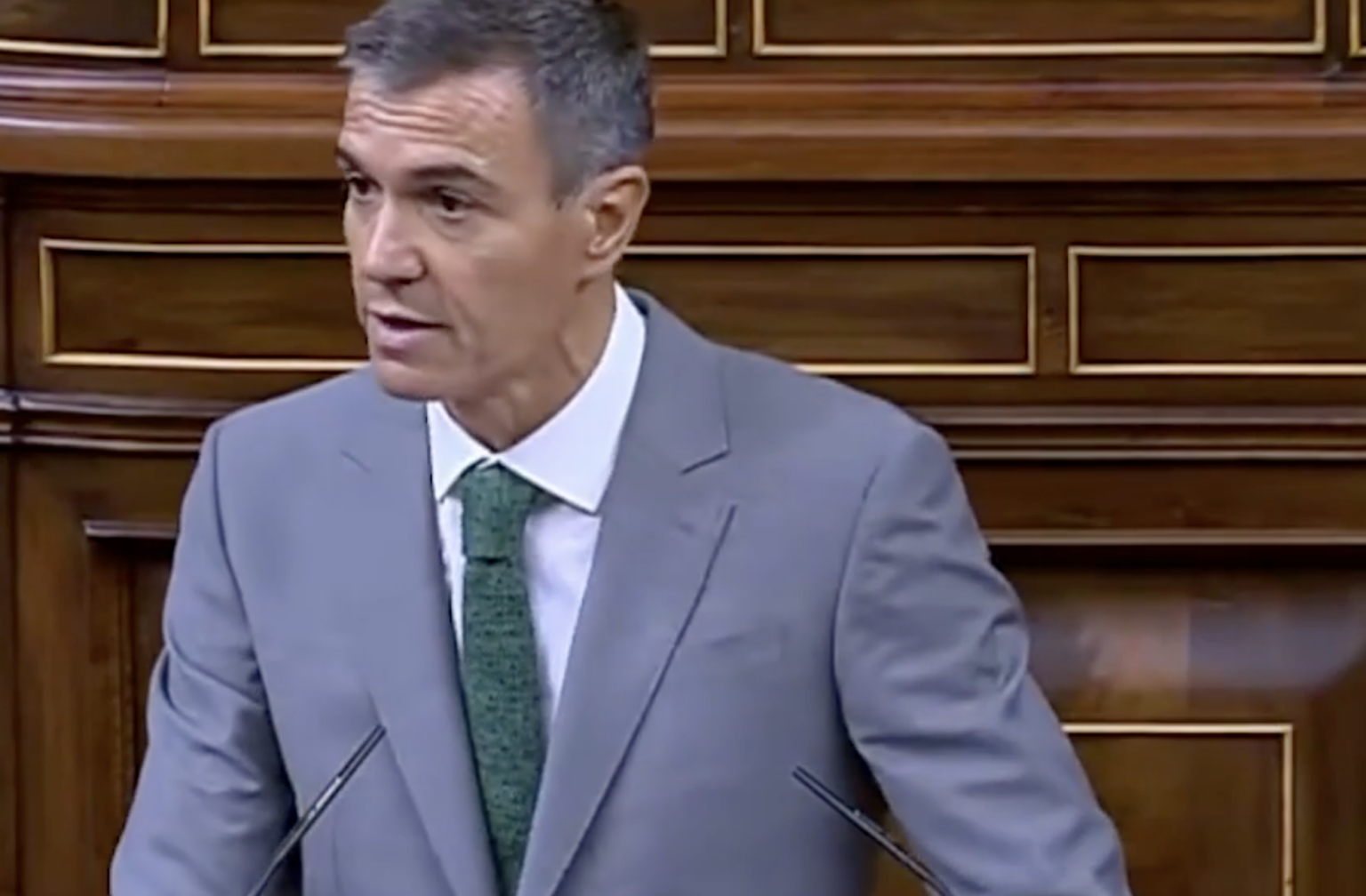

Pedro Sanchez has appeared in Congress for the first time since the mass Ceuta border crossing plunged Spain into a political and humanitarian crisis.
The PSOE leader responded to questions from rivals over his government’s handling of the affair, amid growing scrutiny over what was known about the surge and when.
He promised the residents of Ceuta that his government will never abandon them, while defending the border officers who were faced with an ‘incredibly difficult’ decision when tens of thousands of people crossed into the territory.
On July 30 and 31, around 72,000 people illegally entered the Spanish enclave from Morocco. While most have been returned, around 5,000 still remain, including 1,200 minors.
Sanchez’s appearance came a day after hundreds of thousands of Spaniards took the streets in a series of ‘Por Ceuta’ marches.
Speaking on Thursday, Sanchez declared that Ceuta and Melilla are Spanish ‘in perpetuity’ and will remain so ‘until the end of time’.
He also revealed that Spain summoned Morocco’s ambassador on August 21 over what he described as ‘unacceptable’ comments made by two Moroccan ministers about the Spanish enclaves.
And he promised a ‘forceful’ response if ‘solid evidence’ emerges that Rabat was involved in triggering the crisis.
Meanwhile, he attacked his right-wing rivals for their heavy criticism of the government’s handling of the crisis.
He said: ‘How would the management of a PP and Vox government have differed in this crisis?
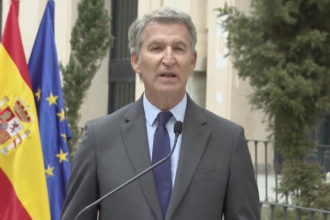
‘Would they have ordered the Guardia Civil and the Policia Nacional to shoot at the civilian population, Mr. Feijoo? I, for one, certainly don’t want a government like that for my country or for any other.’
Sanchez began his address with an unusual reference to the two bronze lions guarding the entrance to Spain’s Congress.
The statues were cast in 1865 using cannons captured from Moroccan forces during the Hispano-Moroccan War and commemorated the Treaty of Wad-Ras, which ended the conflict in 1860.
Sanchez said the treaty served to consolidate Spanish sovereignty over Ceuta and Melilla ‘in perpetuity’.
‘For centuries, these two cities have been Spanish,’ he told MPs.
‘Since that treaty, they have been so by diplomatic agreement. And I assure you that they will remain so until the end of time.’
Spain summoned Moroccan ambassador
Sanchez also revealed that his government summoned Morocco’s ambassador to Spain on August 21 following controversial comments from two Moroccan ministers concerning Ceuta and Melilla.
The revelation comes amid intense scrutiny of relations between Madrid and Rabat following the extraordinary events of July 30.
Sanchez said his government would act with ‘forcefulness’ if investigators uncover solid evidence that Morocco was involved in the crisis.
However, he insisted that such evidence does not currently exist.
His comments come amid controversy over a Policia Nacional intelligence report examining the mass crossing and the conduct of Moroccan security personnel.
While the report has described the crossing as coordinated and detailed apparent guidance or permissiveness by Moroccan officers on the ground, Spanish police chiefs have stressed that investigators have not established who ultimately organised the operation.
Sanchez defends border police
The prime minister also strongly defended the Spanish officers who were confronted with tens of thousands of people attempting to enter Ceuta.
Around 72,000 migrants entered the city, Sanchez told Congress, with four out of every five crossing via the border breakwater.
He said officers faced an extraordinary choice between attempting to physically prevent people from crossing the narrow breakwater and surrounding waters, or temporarily allow them through to prevent an even greater loss of life.
Sanchez said 141 migrants died at sea during the crisis, many of them young people and children.
‘Our officers had to make an operational decision in a matter of minutes,’ he said.
‘They had to choose either to momentarily guarantee the impermeability of the border or to defend human life. And they chose to defend human life.”
Sanchez described their decision as both ‘the most intelligent’ and ‘the bravest’ course of action.
‘No extraordinary warnings’
The prime minister also rejected accusations that his government ignored warnings about what was about to happen.
He said officials had reviewed reports, messages and verbal communications produced by Spain’s security forces and the CNI intelligence service before the crisis.
According to Sanchez, none predicted either the scale or likelihood of the mass crossing.
‘We did not receive extraordinary alerts or warnings anticipating what happened afterwards,’ he told MPs.
He said the information received beforehand went no further than routine warnings or descriptions of the situation.
The issue has become a major political battleground after opposition leader Alberto Nuñez Feijoo accused Sanchez’s government this week of knowing about the threat and covering it up.
Sanchez hit back on Thursday by saying there had been ‘a lot of noise and a lot of hoaxes’ surrounding the crisis that needed to be debunked.