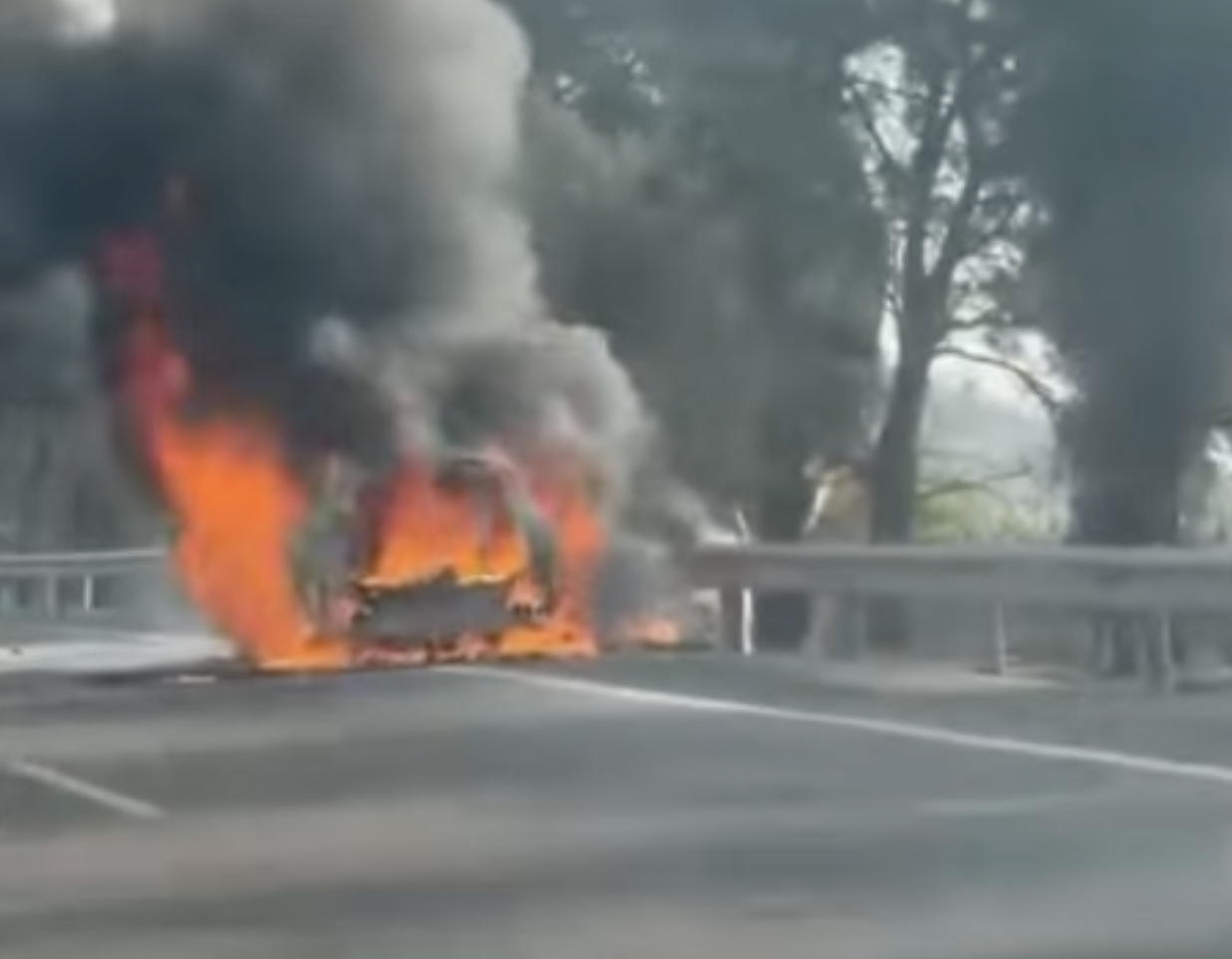

A second car has burst into flames on the Costa del Sol’s A-7 motorway in the space of just two days, sparking major traffic disruption.
The latest blaze occurred on Wednesday morning following a two-vehicle crash on the A-7 in Benalmadena.
Emergency services were alerted at around 9.30am with one person reported to have been left trapped.
One of the vehicles subsequently caught fire, while several kilometres of queues developed on the motorway in the direction of Malaga.
The condition of the trapped person has not yet been confirmed.
The incident comes just a day after another vehicle burst into flames on the same motorway, this time near Las Chapas in Marbella.
Tuesday’s incident occurred shortly after 8.30am and involved three vehicles.
One of them was reportedly a hybrid vehicle, with SUR reporting that the blaze was caused by a problem with its battery.
The incident caused a seven-kilometre traffic jam between La Cala de Mijas and Las Chapas, while firefighters, Guardia Civil officers and road maintenance crews were called to the scene.
No ambulances were required.
Why do cars catch fire after crashes?
There are several reasons why a vehicle can catch fire, and the cause can differ substantially between petrol or diesel cars and electric or hybrid vehicles.
Figures from the US-based National Fire Protection Association (NFPA) show that mechanical failures or malfunctions are the single biggest contributing factor in highway vehicle fires, accounting for around 30% of incidents in its 2018-2022 data. Electrical failures, leaks and breaks are among the other recognised factors.
A collision can also create the conditions for a fire. An impact can damage fuel systems, electrical wiring or other components and provide both combustible material and a source of ignition.
NFPA research has found that although mechanical and electrical failures are major causes of vehicle fires overall, fires resulting from collisions are disproportionately dangerous.
Hybrid and fully electric vehicles present an additional potential mechanism because they can contain high-voltage lithium-ion batteries.
If cells within a lithium-ion battery are severely damaged, they can enter a process known as ‘thermal runaway’, in which uncontrolled heating creates a chain reaction that can result in fire or, in some circumstances, explosion.
Kent Fire and Rescue Service says thermal runaway can be triggered by mechanical damage such as an impact, as well as an internal short circuit, overcharging or overheating.