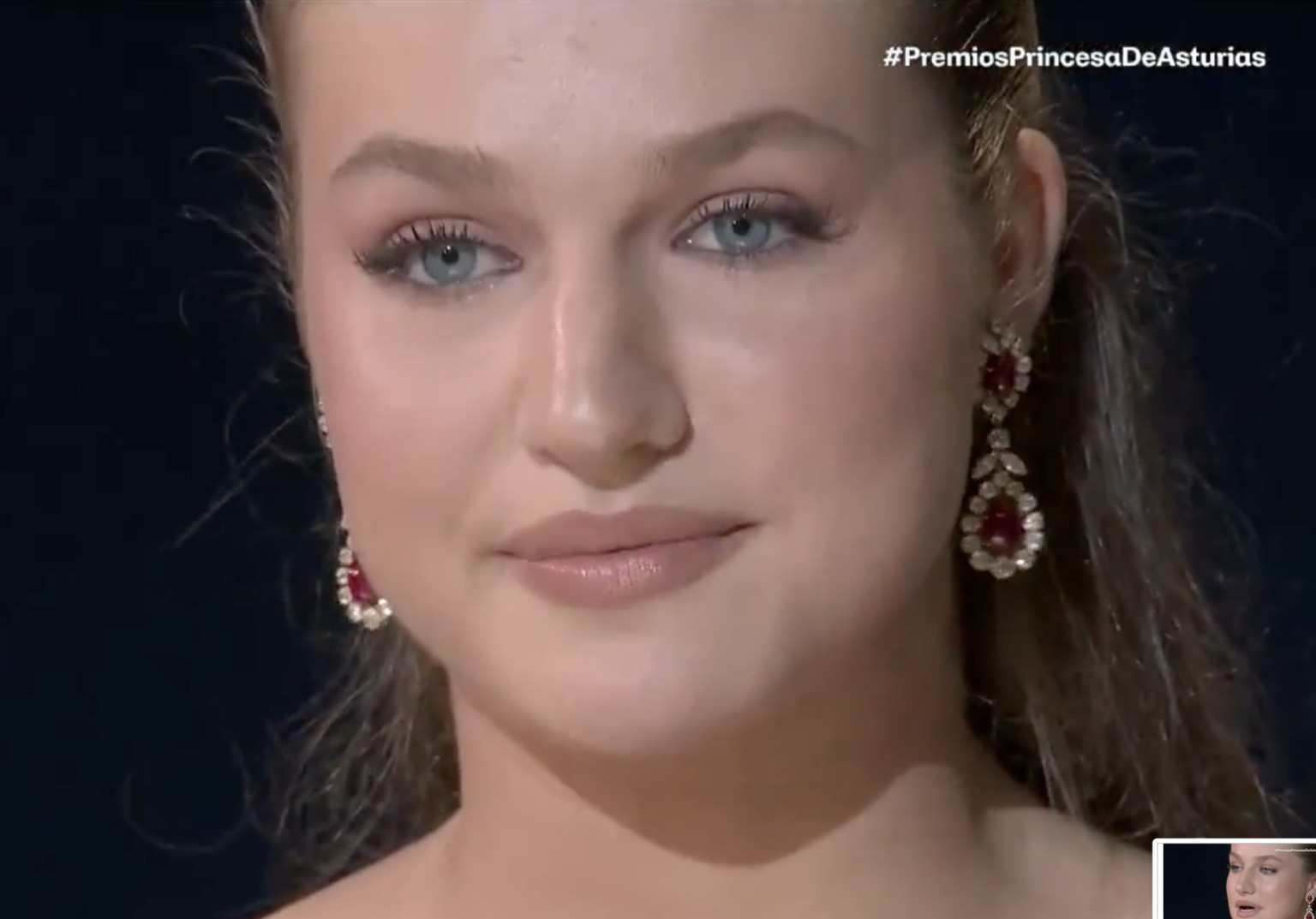

Princess Leonor has spoken of her generation’s struggles, warning that young people face a lack of prospects and difficulty in planning their futures.
Speaking at the Princess of Asturias Awards in Oviedo on Friday, she questioned how people her age could remain hopeful amid inequality, conflict and rapid technological change.
‘How do we maintain enthusiasm in these times of deep social disillusionment, disbelief and inequalities, of conflicts, extremism, populism, technological wars, all amplified on social media?’ she asked.
Leonor opened her address by describing ‘a mixture of trepidation and excitement’, after joking about her father King Felipe VI’s age.
She went on to reflect on the challenges facing young people, including ‘the lack of prospects and the impossibility of planning a life’.
‘How does my generation face such complexity? How do we process the speed and the disillusionment?’ she asked.
The princess also spoke of the search for authenticity in an increasingly virtual world and the debate over ‘the value of human imperfection against the supposed perfection of the machine’.
Her speech sought to balance her concerns with a message of hope, pointing to the award winners as reasons to retain confidence in human achievement.
‘How can I be sincere? Neither naive nor apocalyptic, neither cynical nor dramatic,’ she said.
Questioning whether it still made sense to come to Oviedo each year to honour the recipients, she delivered her own answer: ‘It does.’
This year’s winners included American singer, poet and writer Patti Smith, who received the Arts award, and Argentine football star Lionel Messi, recognised in the Sports category.
British novelist Julian Barnes won the Literature prize, while British historian and commentator Timothy Garton Ash received the Social Sciences award.
Japanese animation house Studio Ghibli was honoured for Communication and Humanities, while astronaut Christina Koch received the Concord award.
The International Cooperation prize went to Norway’s Svalbard Global Seed Vault, and scientists David Klenerman, Shankar Balasubramanian and Pascal Mayer shared the Scientific and Technical Research award.
King Felipe VI also addressed technological change, using his speech to defend the importance of experience, patience and human judgement.
He warned that the speed and apparent efficiency of artificial intelligence could make it seem more reliable than human intelligence, but said the winners challenged that impression.
The king questioned whether AI could acquire the moral understanding that people develop through age, consideration for others and experience.
‘We need to give ourselves time, we need patience,’ he said. ‘Let us give ourselves time, let us give ourselves confidence to become the best version of ourselves.’