British travellers worried about falling foul of the EU’s Entry/Exit System (EES) can now check exactly how many days they are permitted to remain in Europe online.
The official EES website has launched a tool that tells non-EU nationals whether they are currently allowed to enter and how much of their authorised short stay remains.
It follows the full introduction of EES across the Schengen area on April 10, when passport stamps were replaced by electronic entry and exit records for most non-EU visitors.
The system records travellers’ passport details, facial images and fingerprints at the bloc’s external borders.
Under the usual Schengen rules, British tourists and other visa-exempt non-EU nationals may spend up to 90 days within any rolling 180-day period across all countries participating in the system.
Crucially, the allowance is shared between the countries rather than applying separately to each destination.
Time spent in Spain, France, Italy or another participating nation is therefore counted towards the same 90-day total.
The online checker can be accessed through the EU’s official Travel to Europe website here.
Users must enter their type of travel document, passport number, issuing country and the European country they are visiting or planning to visit.
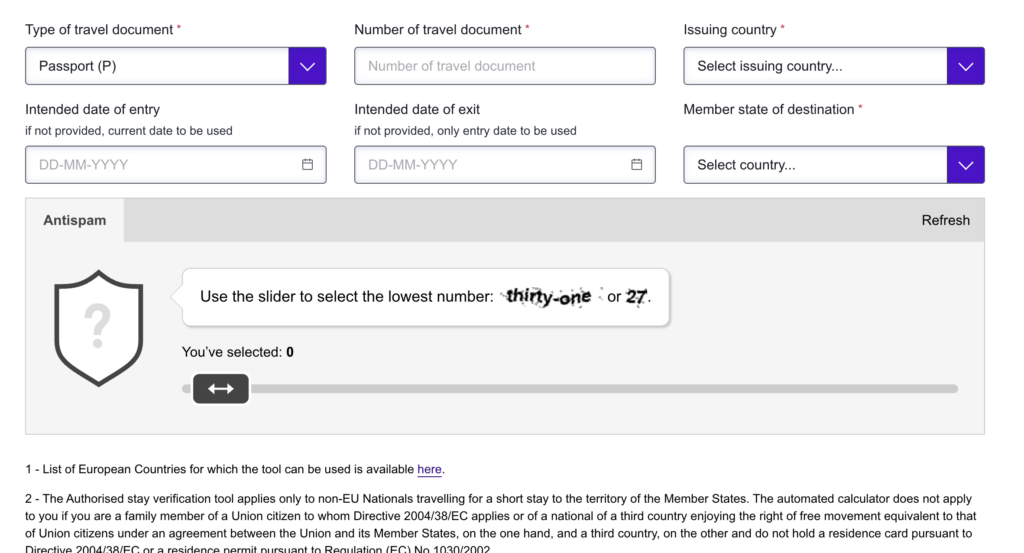
They can then provide their intended dates of entry and departure, depending on what they want to check.
Someone planning a future trip can enter their intended arrival date to see how long they would be allowed to stay.
Travellers already inside a country covered by EES can enter their proposed departure date, while those planning a complete trip can supply both dates to see how many days would remain after it ends.
The tool will return either an ‘OK’ or ‘not OK’ response and state the number of days the traveller is still authorised to spend in the countries using EES.
Border officers can also provide the same information at external passport-control points.
However, travellers should be aware of one important limitation.
The result does not include time spent in the Schengen area on a visit that began before April 10, 2026, even where that trip continued beyond the date on which EES became fully operational.
The EU has also warned that until October 6, 2026, an ‘OK’ result could be unreliable for certain holders of single or double-entry visas who used one of their permitted entries between October 12, 2025, and April 9, 2026, before that journey was recorded in EES.
The calculator applies only to non-EU nationals travelling for short stays. It does not apply to British residents of Spain who are entering with a valid Spanish residence card, such as a TIE, or to other travellers who are exempt from EES.
The checker can be found on the EU’s official ‘Check how long you can stay’ EES webpage.