


Fresh plans have emerged for the total transformation of the Gibraltar border, which are expected to be completed by January 1, 2028.
It comes after Spain and the UK signed an administrative agreement setting out exactly how the new Gibraltar treaty will be implemented over the next 18 months.
The document, signed in Madrid by British ambassador Sir Alex Ellis and Spain’s Secretary General for the European Union Carlos Moreno Blanco, turns the political agreement into a detailed roadmap for removing the traditional frontier while creating new Schengen and customs facilities at Gibraltar Airport.
The treaty has been operating on a provisional basis since July 15, when the historic border fence was removed.
There are now no physical land border checks between Gibraltar and Spain while immigration and customs controls are being relocated to Gibraltar Airport.
A permanent joint working group made up of Spanish and British representatives will oversee every stage of the rest of the project.
Airport expansion
The biggest construction project will be the permanent expansion of Gibraltar Airport.
Two new annexes will be built onto the existing terminal to house immigration and customs facilities.
Spain says the buildings will allow EU authorities to carry out Schengen and customs checks, while the UK describes them as facilities for British authorities in respect of Gibraltar.
Despite the differing wording, both governments confirm the buildings will be constructed jointly by Spain and Gibraltar.


These permanent facilities will replace the temporary installations currently being used.
Temporary controls already in operation
Since July 15, Spain has been operating from a temporary modular building attached to the airport while permanent works are carried out.
Gibraltar has also altered the existing terminal to accommodate temporary Schengen controls, including second-line inspection areas, a dedicated corridor for refused passengers being escorted back to aircraft, and new Schengen signage throughout the terminal.
Freight traffic changes
Spain has already built a new road for heavy goods vehicles to free up space for the airport expansion.
The customs area has also been reorganised, with new vehicle lanes and inspection points designed to meet the requirements of Spain’s tax agency.
Gibraltar has not needed major changes during the first phase because its freight entrance already connects directly with the new Spanish road.
Minor alterations will be made later once sections of the old border infrastructure disappear.

Demolition of the old frontier
The agreement also includes a timetable for dismantling the traditional border crossing.
On the Spanish side, canopies, fencing, cameras and other obsolete infrastructure have already started being removed, although some facilities will remain until the permanent system is operational.
Before January 2028, Spain will demolish the current customs building, associated parking areas and buildings used by the National Police and Guardia Civil at the frontier.
Gibraltar will also progressively remove the physical infrastructure linked to the old border, including shelters, fencing, buildings and the main offices used by its Borders and Coastguard Agency and HM Customs.
The treaty also explicitly provides for the demolition of the historic border fence itself once it is no longer needed for the temporary arrangements.
A completely redesigned gateway
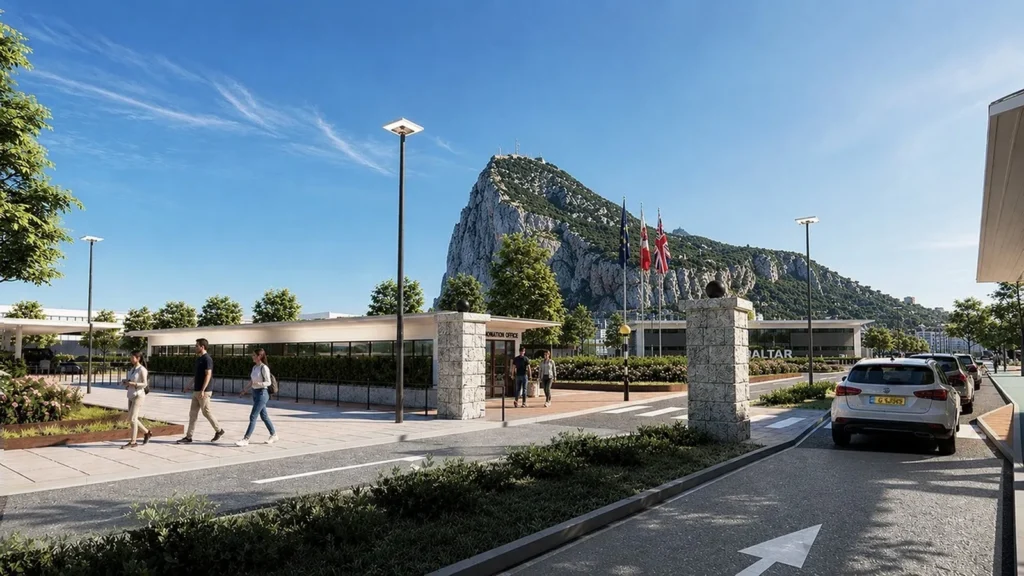
Architectural plans released earlier this month show the dramatic redesign planned for the entrance to Gibraltar.
The current border complex will be replaced by landscaped public spaces, a large pedestrian plaza, a visitor information centre, new traffic roundabouts, solar-powered control buildings and redesigned roads for vehicles and pedestrians.
However, while the famous fence will disappear, Gibraltar has already replaced its perimeter security with a new high-security Category 4 barrier similar to those used at other British facilities.
Chief Minister Fabian Picardo has said the new barrier stretches ‘from sea to sea’, leaving only a 150-metre corridor between the airport and the pedestrian crossing.
That area will be heavily monitored by police, surveillance vehicles, facial recognition cameras and other security technology to prevent unauthorised access.
Read more Andalucia news at the Spanish Eye.