
Portugal and Italy are set to relax the EU’s new biometric border system for British travellers this month, joining Greece in a bid to avoid major disruption during the busy holiday season.
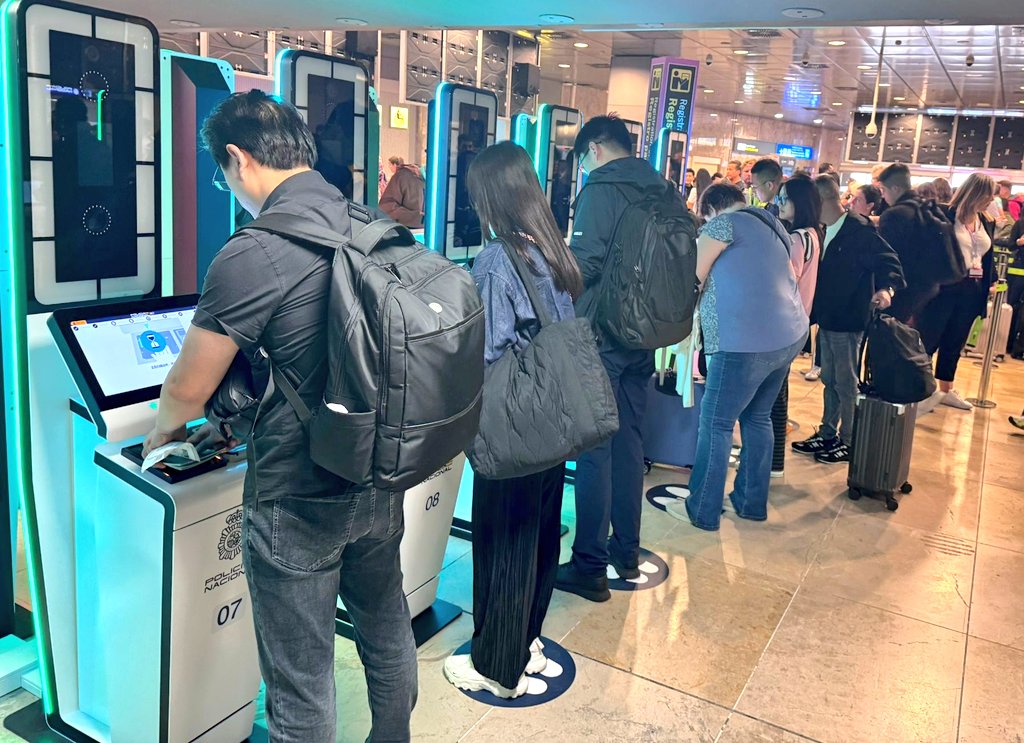
The move comes just weeks after the Entry/Exit System (EES) was introduced across the Schengen zone, requiring all non-EU visitors – including UK tourists – to provide fingerprints and a facial scan when entering Europe.
However, early scenes at airports have raised alarm. In Greece, the process reportedly took up to 90 seconds per passenger, leading to queues stretching over an hour.
With more than 1.5 million UK travellers expected to head to southern Europe during the late-May half-term, tourism authorities have pushed for flexibility to prevent delays from spiralling.
Italy is expected to temporarily revert to traditional passport stamping for UK arrivals until at least September.
Portugal, meanwhile, is likely to continue informally suspending biometric checks when queues exceed 15 minutes.
Greece has already taken similar steps, effectively ‘waving through’ tourists to keep airports moving during peak periods.
Other countries, including France and Croatia, are now said to be considering similar measures.
The decision will come as a relief to British holidaymakers, many of whom feared long waits at border control. But it also creates uncertainty, as airports could switch back to full EES checks at short notice.
Travel experts are advising passengers to be prepared for both scenarios, ensuring passports have enough blank pages for stamps and keeping records of entry dates where possible.
The EES is part of a wider EU effort to modernise border controls and track non-EU visitors more closely.
In the long term, it will also tie into rules around how long travellers can stay in the Schengen zone under the 90/180-day limit.
Full enforcement is still expected later in 2026.
For now, though, southern Europe appears to be prioritising smooth travel over strict rollout, at least for the summer rush.
It is not yet clear if Spain will join its neighbours in suspending the EES rollout to cope with high season.
The Spanish Eye has contacted the Spanish foreign ministry for comment.