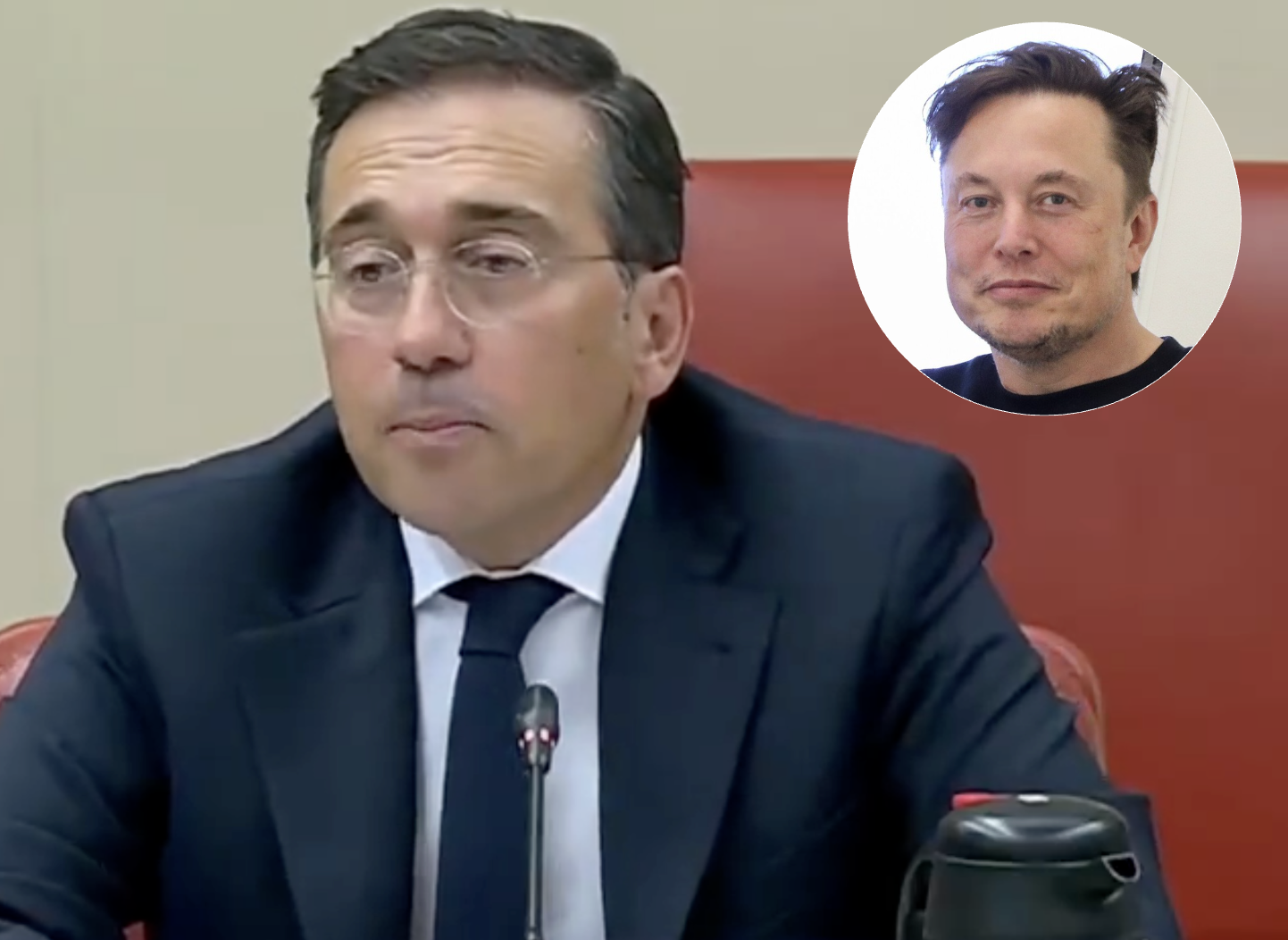

Spain’s foreign minister has accused Elon Musk of helping fuel far-right narratives surrounding the unprecedented migrant crisis in Ceuta.
Jose Manuel Albares said high-profile social media figures amplified content that portrayed the mass crossings of July 30 and 31 as a collapse of Spanish security and a wider ‘civilisational threat’.
Speaking in Congress on Friday, Albares said images and messages circulated during the crisis had become ‘electoral gasoline for the far right’, before specifically pointing to posts made by Musk that achieved enormous reach.
‘What was exported was not information,’ Albares said. Instead, he argued, there had been an attempt to impose ‘the narrative of a collapse in security and the denunciation of a civilisational threat’.
‘These actors share a double objective: to weaken Spaniards and fracture Europe,’ he added.
The foreign minister’s intervention came as several members of the Spanish government appeared before Congress to explain their response to the extraordinary events in Ceuta at the end of July.
Interior Minister Fernando Grande-Marlaska told MPs on Friday that around 72,000 people entered the Spanish enclave during the crisis, with approximately 5,000 still remaining there.
‘Unprecedented virality’
Albares argued that social media played a central role in the scale of the crisis, describing the ‘unprecedented virality’ of messages circulated online as key to understanding what happened.
The government claims false information linked to a Spanish Supreme Court ruling was circulated online and created an efecto llamada, or ‘pull effect’, encouraging people to attempt to reach Ceuta.
Albares said influencers played a significant role in spreading content in Morocco and elsewhere in North Africa, both ahead of the mass crossings on July 30 and before another attempted mobilisation on August 15 that failed to materialise on the same scale.
‘What began as a migration crisis caused by falsehoods was also a battle of ultraconservative and reactionary narratives,’ Albares said.
He argued that the phenomenon could not be understood without examining the role of major digital platforms.
The minister revealed that the European Commission met with Meta and TikTok on August 7 in an effort to speed up the work of accredited fact-checkers following the crisis.
‘Ceuta and Melilla are Spain’
Albares also delivered a forceful defence of Spanish sovereignty over its two North African enclaves.
‘Ceuta and Melilla are Spain and they are the European Union,’ he said. ‘They are part of our territorial integrity and our sovereignty.’
He added that residents of the two cities, regardless of their origins or religion, were Spanish and European ‘not only by right, but in heart and soul’.
‘And it will always be that way,’ he said.
Albares nevertheless acknowledged what he described as the ‘inescapable reality’ of Ceuta and Melilla’s geographical position, calling their borders with Morocco among the most economically unequal in the world and warning that migration pressures would remain a major challenge.
Riot police sent to Ceuta
His comments came as the Spanish government announced further measures to restore order and strengthen security in Ceuta.
Marlaska confirmed on Friday that 40 additional UIP riot police officers from Valencia are being deployed to the enclave.
The Interior Minister also announced plans to reinforce the physical border by extending the breakwaters at Tarajal and Benzu, establishing a permanent system of anchored maritime barriers and increasing surveillance with drones.
Marlaska said more than 100 people have been expelled after committing crimes in Ceuta since the crisis began.
He also revealed that 17 sexual assaults have been reported.
The government’s handling of the crisis has become increasingly politically charged, with thousands taking to the streets of Ceuta this week to demand greater security and criticise Madrid’s response.
Albares, however, insisted that social media disinformation and those amplifying it had played a significant role in turning the events into a wider political and ideological battle.