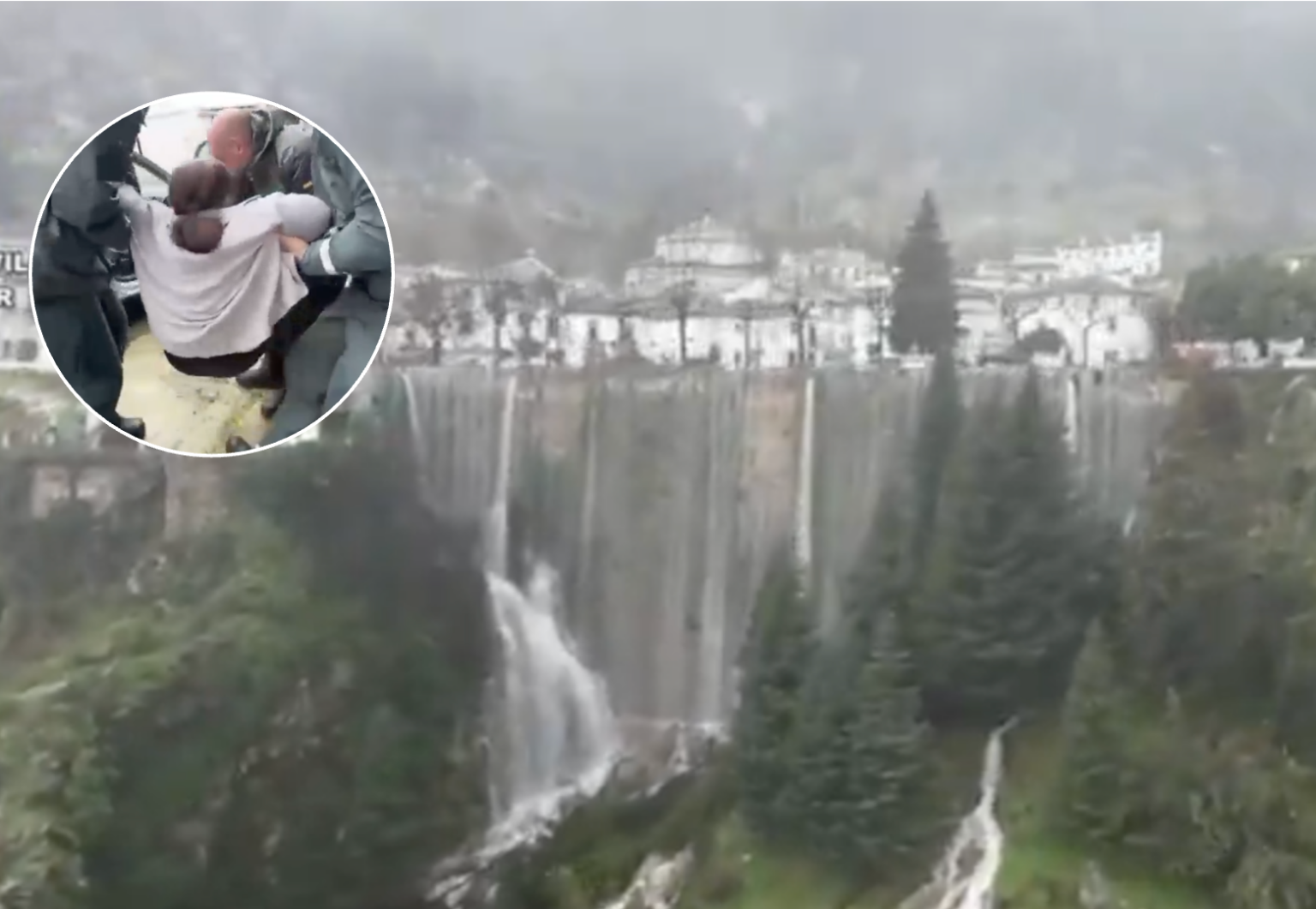

The Cadiz village of Grazalema has received an unprecedented €64million from the Spanish government to rebuild its public infrastructure after the devastating storms that battered the area earlier this year.
Mayor Carlos Javier Garcia announced that €63,971,086.20 has already been transferred into the municipality’s accounts, describing it as a ‘historic’ investment equivalent to around 20 years of Grazalema’s annual budget.
Speaking alongside Benamahoma mayor Mamen Fernandez, Garcia said the funding would not only repair damage caused by the severe storms but also make both communities more resilient to future extreme weather events.
‘This is not just about repairing what the storms destroyed, but guaranteeing the future, safety and resilience of Grazalema and Benamahoma with stronger infrastructure adapted to the challenges of climate change,’ he said.
Of the total funding, €61.7million will be spent directly on rebuilding infrastructure, while €1.64million has been allocated for additional staff and €600,000 for technical experts to oversee and design the projects.
Streets to receive biggest investment
The largest share of the funding – €53.2 million – will be spent on 54 projects to completely refurbish streets and public squares across Grazalema and Benamahoma.
Among the biggest schemes are the renovation of Plaza de los Asomaderos (€3.59million), Calle Nueva (€3.35million) and Calle Real (€2.95million).
A further €14million has been earmarked for flood prevention and water infrastructure, including a new drainage and sewage system, improvements to Presa del Fresnillo, river restoration work and the installation of monitoring equipment designed to provide early warning of future flooding.
The plan also includes €1.6million to restore public buildings, including the municipal library, theatre, sports facilities, market, cultural centre, Benamahoma school and other public buildings.
Another €450,000 will be invested in parks and public spaces, while Spain’s Ministry of Agriculture will separately repair 40 municipal rural roads through the public company TRAGSA.
Six-year rebuilding programme
Given the scale of the works, the town hall has asked the Spanish government to extend the completion deadline to at least six years.
Garcia stressed that the funding is strictly limited to municipal infrastructure and cannot be used to compensate private homeowners, repair regional roads or restore livestock routes, which fall under the responsibility of the Andalucian government.
He added that residents would be consulted throughout the rebuilding programme through the Local Participation Council to ensure the projects are carried out transparently.
The mayor also criticised those who had claimed government funding would never arrive.
‘Some people spent weeks saying the money would never come. Well, the money is already sitting in the council’s bank account,’ he said.
More than 1,100 emergency calls
Garcia also revealed the scale of the emergency response following the storms.
Municipal services handled 1,128 emergency phone calls and 420 WhatsApp messages, while staff provided direct assistance to 310 people, including supplying medication, oxygen, help for pets and vehicle recovery.
The council has also carried out 159 technical inspections, processed almost 50 applications for financial assistance, issued more than 1,000 residency certificates, monitored 10 severely damaged homes and responded to around 300 requests for assistance from residents.
Separately, the Andalucian government has awarded the town a further €2million, which will be used to repair the heavily damaged town hall and restore Calle Las Piedras.
Read more Andalucia news at the Spanish Eye.