
Refuelling drug traffickers at sea has become big business for local gangs across Andalucia and is putting the public at risk, experts have warned.
Speaking to the Spanish Eye, the Guardia Civil police union AUGC (Asociacion Unificada de Guardias Civiles), said the trade is also acting as a gateway to drug smuggling for young people.
A 25-litre container of petrol costs around €38 to fill. Delivered to a drug boat off the Andalucian coast in rough weather, it can fetch €300.
It is the business known as petaqueo: supplying the fuel that keeps the region’s powerful ‘narcolanchas’ running.
Behind those boats is a network of people filling containers, storing petrol, transporting it to the coast and delivering it offshore.
‘Petaqueo keeps growing and is no longer just a Cadiz phenomenon,’ the AUGC told this publication.
‘As the organisations have moved from the Campo de Gibraltar towards Huelva, the Guadalquivir, Malaga, Granada and Almeria, their logistics have followed them.’
From €38 to €300
Figures from Huelva’s anti-drug prosecution service, supplied by AUGC, show how the price rises along the supply chain.
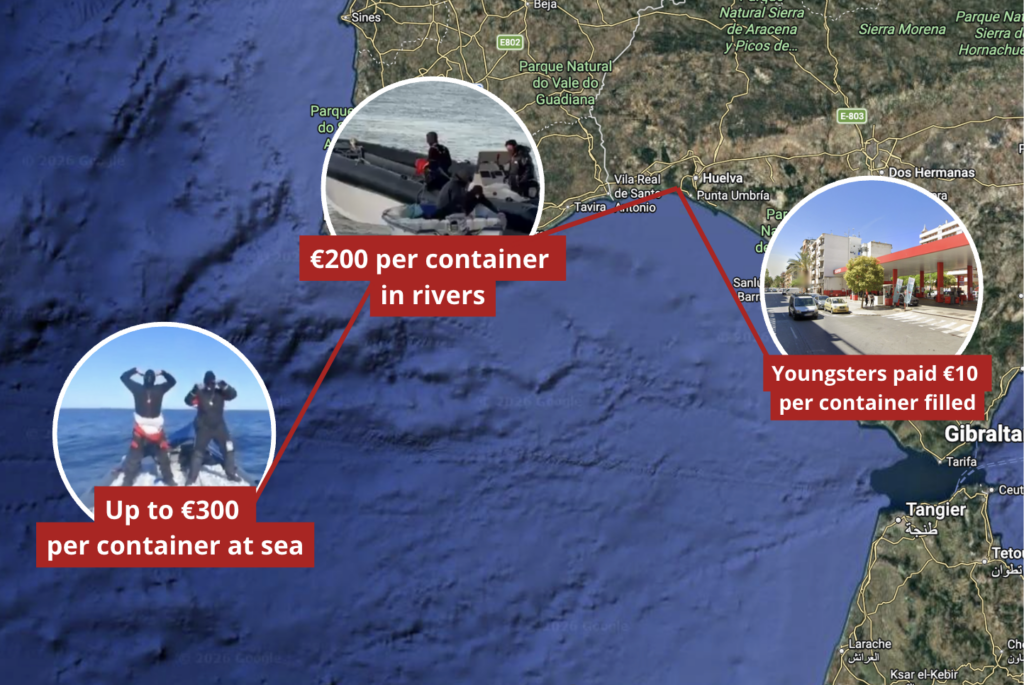
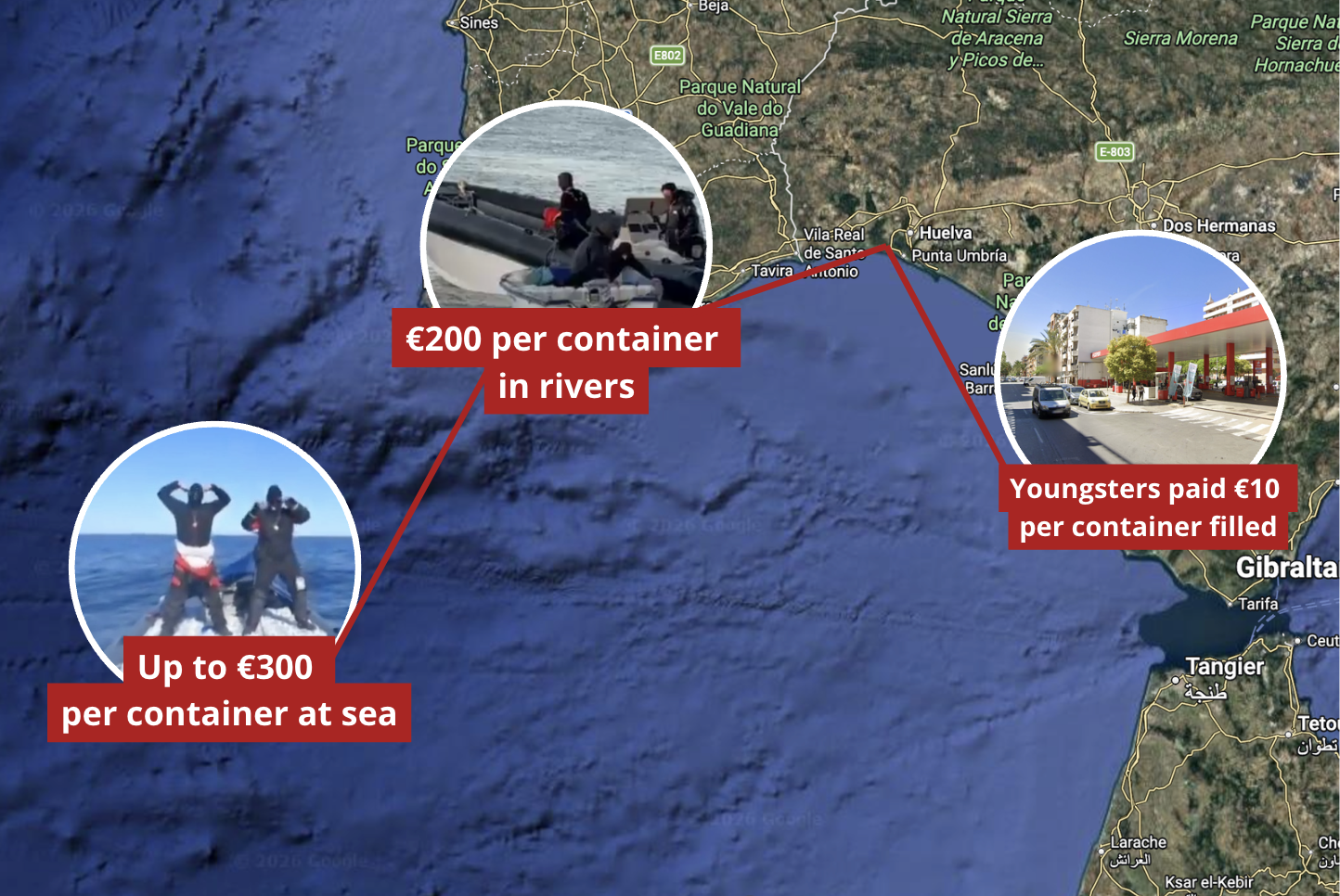
Young people filling containers at petrol stations can receive approximately €10 per container. A supplier providing the petrol can charge €60 to €80 for a full 25-litre container.
Delivered in the Isla Cristina estuary, the price reaches around €200. A couple of miles offshore, it can fetch €250, before rising to €300 in rough weather.
‘The margin is concentrated in delivery at sea, which is also where the greatest risk lies,’ AUGC explained.
That final price is almost eight times the initial fuel cost. However, it represents the sale price rather than one person’s profit, with costs and payments spread across the network.
‘There are no official figures on what each link in the chain earns, and we prefer not to give estimates we cannot substantiate,’ the association stressed.
More than 600,000 litres seized
Spain’s prosecution service recorded 262,000 litres of petrol seized in Cadiz province during 2025, up 80% on the previous year.
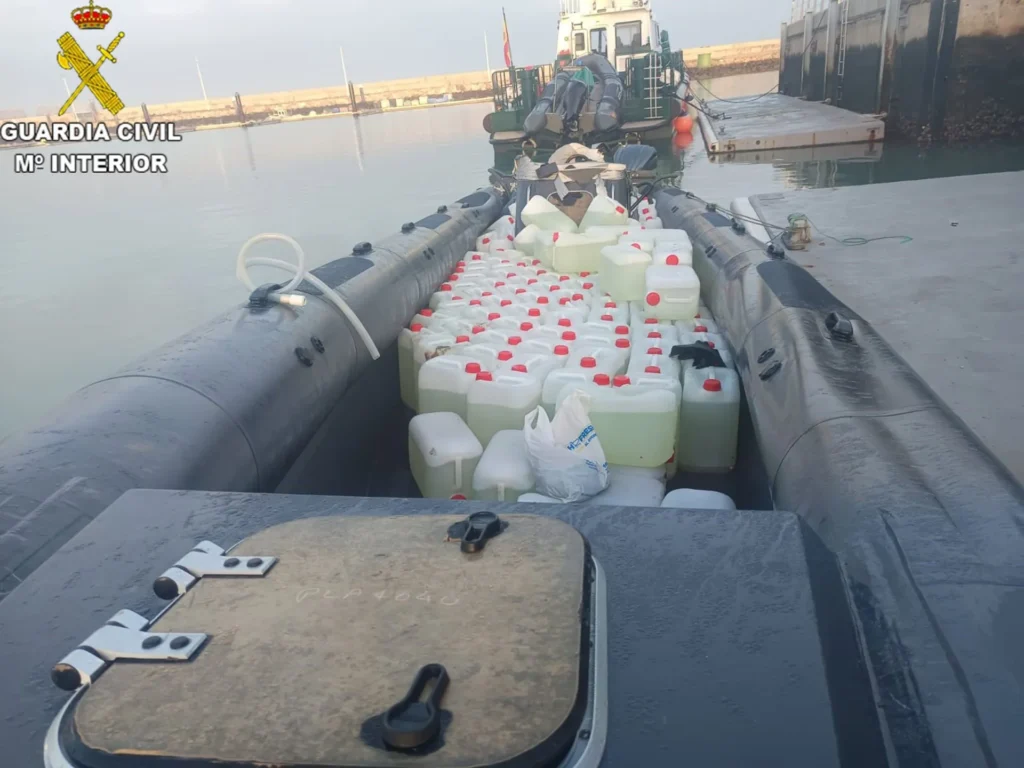
In Huelva, the figure reached 344,308 litres, representing more than double the 2024 total.
Together, the two provinces accounted for more than 606,000 litres. The report also recorded 82 proceedings involving possession of flammable substances in Cadiz, with 22 orders for pre-trial detention, and 38 proceedings in Huelva.
AUGC said the fuel networks allow narcolanchas to operate increasingly far offshore, sometimes up to 100 nautical miles from land.
It described fuel supplies and high-speed boats as inseparable parts of the trafficking business: ‘Without fuel, there is no drug shipment.’
A gateway into organised crime
For young recruits, the first job may involve nothing more than filling a container at a petrol station.
But officers warn that these apparently small tasks can draw people into a much bigger criminal enterprise.
‘Petaqueo functions as a gateway into drug trafficking: seemingly minor tasks, well paid by local standards, which require no experience,’ AUGC said.

Alongside newcomers are people with established backgrounds in drug trafficking who organise storage and supplies at sea.
While there is no public breakdown of suspects’ criminal histories, the association said officers are particularly concerned about ‘the recruitment of young people without criminal experience, attracted by quick money’.
Petrol stored near homes
The risks are not confined to those making offshore deliveries.
‘It is stored in quantities of hundreds or thousands of litres in garages, industrial units and homes close to populated areas,’ AUGC warned.
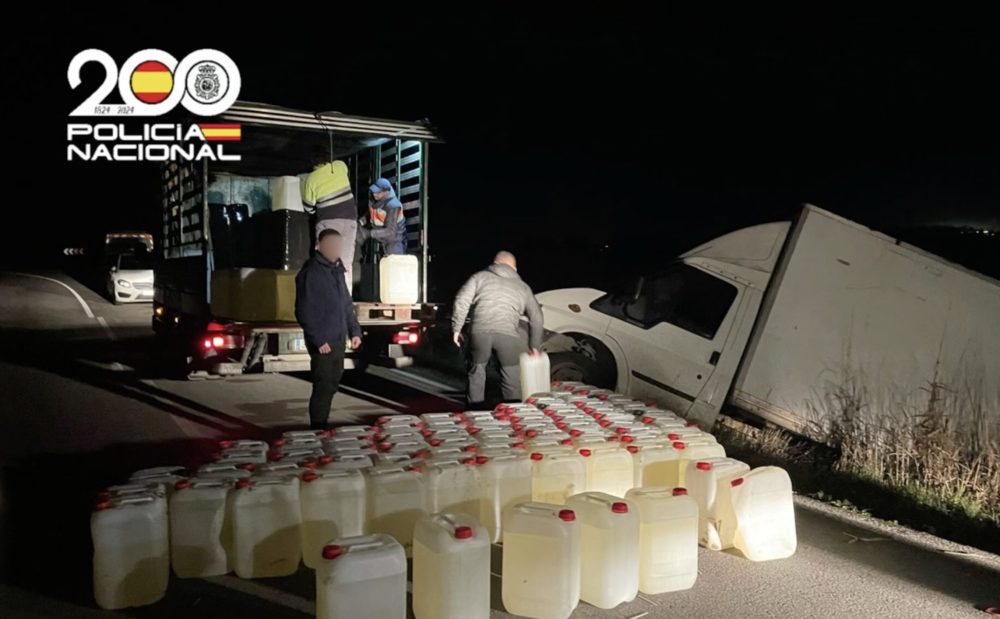
‘It is transported in vans and cars loaded with containers, without any safety measures, along roads and through urban areas.’
The association cited a van intercepted on the AP-4 on April 11 carrying 148 containers holding approximately 3,700 litres.
‘An accident, a spark or a fire can have very serious consequences for residents,’ it said.
‘For officers, every intervention means operating alongside flammable loads, on land and at sea, where supply boats operate at night and at high speed.’
‘A law is no use without resources’
A reform effective from April 10 introduced a specific liquid-fuel provision into Article 568 of Spain’s Criminal Code, carrying prison terms of three to five years. Courts can impose a lower sentencing range for less serious conduct.
AUGC said it had been demanding a specific legal response since 2021.
‘Its first effect is legal certainty: until now, the response depended on conflicting interpretations by the courts and many cases were dropped,’ the association said.
However, it cautioned that ‘it is too early to measure results’ and called for the Interior Ministry to publish data on its application.
Its central warning was blunt: ‘A law is no use without the resources to enforce it.’
‘The supply takes place at sea and requires operational boats.’
AUGC cited complaints from maritime personnel in February that none of Granada’s three service boats was operational, while only two of Almeria’s four were functioning. Those figures describe the situation reported at that time.
The association is calling for renewed maritime equipment, more specialist personnel, financial investigations and the restoration of OCON-Sur, the specialist coordination structure used against drug trafficking in southern Spain.
What is missing, it argued, is the investigative capacity ‘to reach those who finance and organise the networks, not just those transporting the containers’.
Read more Andalucia news at the Spanish Eye.