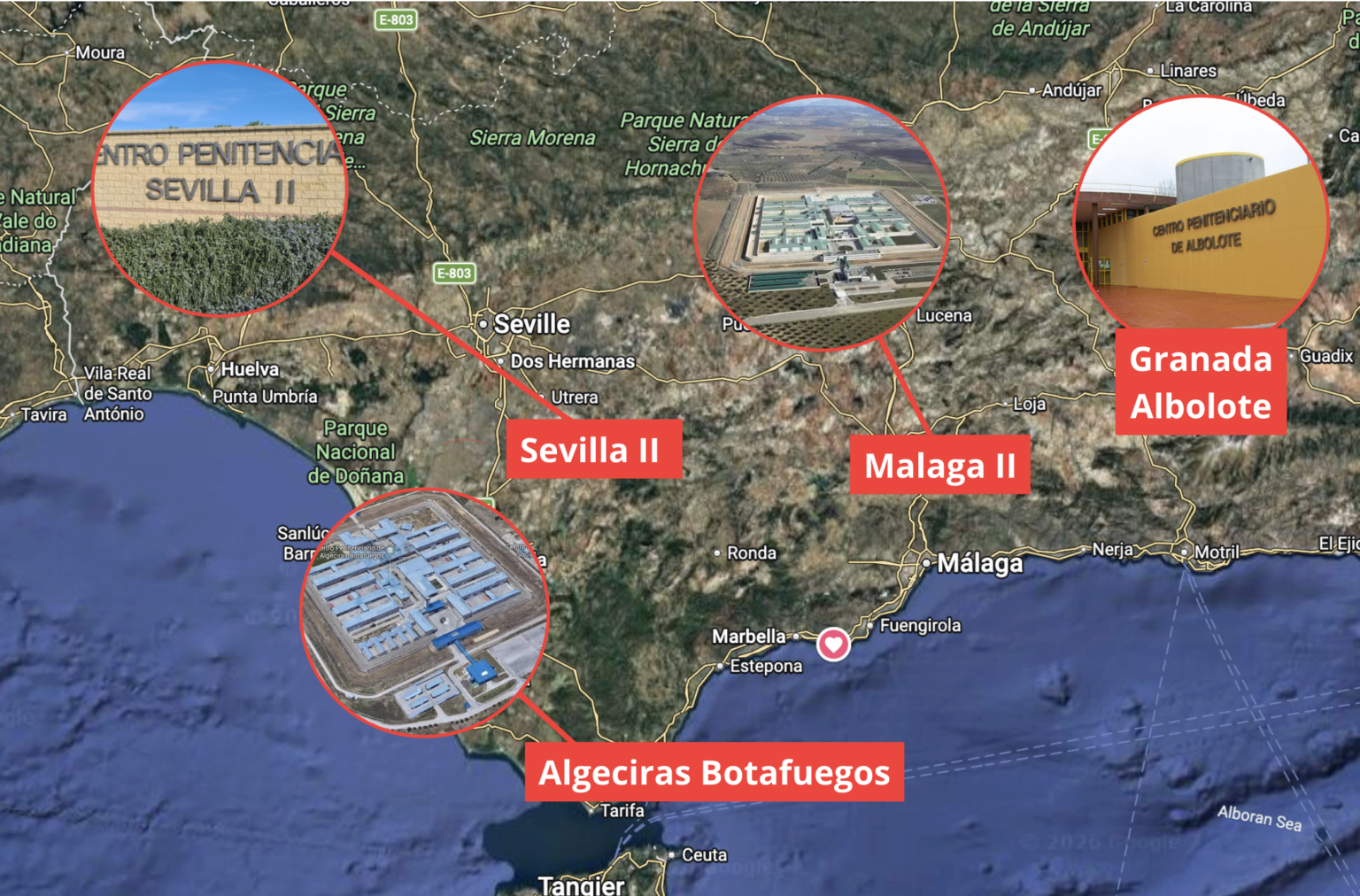

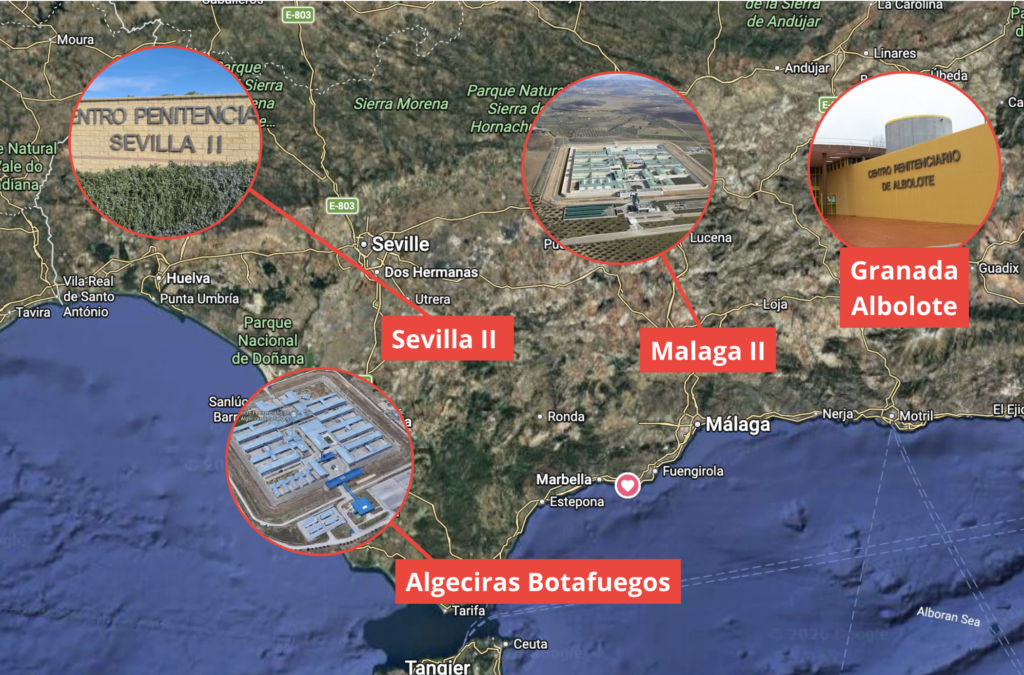
Prisons across Andalucia are being warned to brace for an influx of inmates from Ceuta as part of the government’s redistribution plan.
The alert comes after 22 prisoners were transferred from the Spanish enclave to Algeciras, while more remand prisoners are expected to be sent to facilities in Granada and Sevilla.
Many of the prisoners being transferred were part of the more than 70,000 migrants who stormed the Morocco-Spain border on July 30 and 31.
Now, concerns have been raised about a plan to send inmates to Archidona in Malaga.
A prison workers’ union has warned that such a plan could create dangerous levels of overcrowding.
Acaip-UGT raised the alarm on Saturday over the potential transfer to the Malaga II penitentiary.
The union warned it could ‘aggravate the risk of overcrowding’ at a facility it says is already operating with significant limitations.
The union stressed that any increase in prisoner numbers must be accompanied by additional staff.
‘It is not reasonable to continually increase the number of inmates without simultaneously reinforcing a workforce that is already operating with very little margin,’ it said.
One of the union’s main concerns is that the theoretical capacity of the Archidona prison does not reflect the space actually available to accommodate incoming inmates.
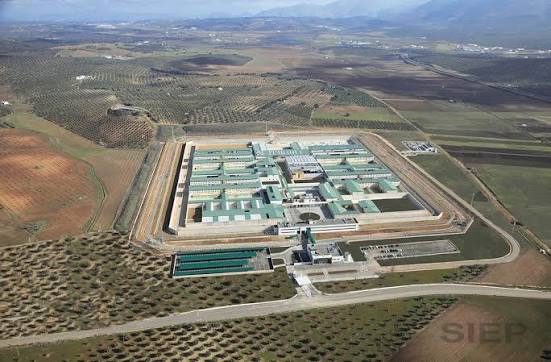
Although Malaga II has four residential modules, only two are currently being used to accommodate prisoners arriving through transfers, according to Acaip-UGT.
The prison also remains only partially operational, further restricting its ability to absorb significant numbers of additional inmates.
The union said simply having an empty cell was not sufficient when determining whether a prison had capacity.
‘It is not only a question of having free cells, but of having sufficient alternatives to carry out an adequate internal separation and correctly organise the prison population,’ it said.
Prison authorities must take into account factors including conflicts between individual prisoners, behavioural issues, medical and treatment requirements and whether particular inmates need to be separated from others.
Warning of extortion and violence
Acaip-UGT warned that concentrating increasing numbers of prisoners within limited space could have direct consequences for security inside the jail.

‘The concentration of more inmates in less space means greater daily tension, encourages the emergence of groups exercising control among the inmates themselves and increases the risk of extortion, coercion and conflicts,’ the union said.
Higher occupancy could also make it more difficult for prison staff to separate incompatible inmates or provide individual cells when required for medical or treatment reasons.
The union warned that overcrowding could additionally undermine rehabilitation programmes by reducing opportunities for individual monitoring and participation in treatment programmes.
Prison population already increasing
According to Acaip-UGT, the population at Archidona prison has already been progressively increasing.
It fears that maintaining transfers from Ceuta could eventually make conditions inside the facility increasingly difficult to manage.
The union has therefore called on Spain’s General Secretariat of Penitentiary Institutions to reconsider its transfer policy before sending more prisoners to Malaga II.