
A political row over the migrant crisis in Ceuta is emerging as the first major test of Andalucia’s new coalition government.
It comes after the Partido Popular (PP) and hard-right Vox publicly clashed over funding for unaccompanied minors and their potential relocation to the region.
The first cracks appeared after the Junta backed a €25million emergency funding package to help the Spanish enclave care for abandoned children.
While the PP insists the decision does not breach its agreement with Vox, the latter has made clear that, had the decision been theirs, Andalucia would have voted against the funding.
The dispute is likely to intensify when Madrid begins relocating unaccompanied migrant children to the region under the newly reformed immigration law.
Vox has now requested the first meeting of the committee responsible for monitoring the coalition agreement.
Andalucia was the only PP-Vox governed region to attend meetings called by Spain’s Ministry of Youth and Children to discuss the situation in Ceuta.
While other PP-Vox regional governments, including Aragon, Castilla y Leon and Extremadura, boycotted the meetings, Andalucia attended and supported the €25million package.
The Junta issued a statement on Saturday insisting the money is specifically intended to strengthen care for unaccompanied migrant children already in Ceuta and therefore does not violate the coalition agreement signed in July.
Andalucia’s vice president and regional Vox leader Manuel Gavira said his party would have taken the opposite position.
‘Anything other than returning them to their families is fuelling the pull effect and the next invasion,’ he said.
Bigger battle looms
The €25million disagreement could prove minor compared with the confrontation looming over the distribution of unaccompanied migrant children.
Reforms to Spain’s immigration legislation created a mechanism requiring autonomous communities to receive minors from territories whose reception systems have become overwhelmed.
The PP leadership has indicated that its regional governments will comply with the law, a position reiterated by senior Andalucian PP figures.
But that potentially conflicts directly with the agreement Moreno signed with Vox to form the Andalucian government.
The coalition pact states that Andalucia will oppose ‘by all legal, judicial and political means’ mechanisms for distributing irregular migrants between Spain’s regions.
It also commits the Junta to not creating new reception centres or additional places and to reducing related expenditure to the ‘minimum essential’.
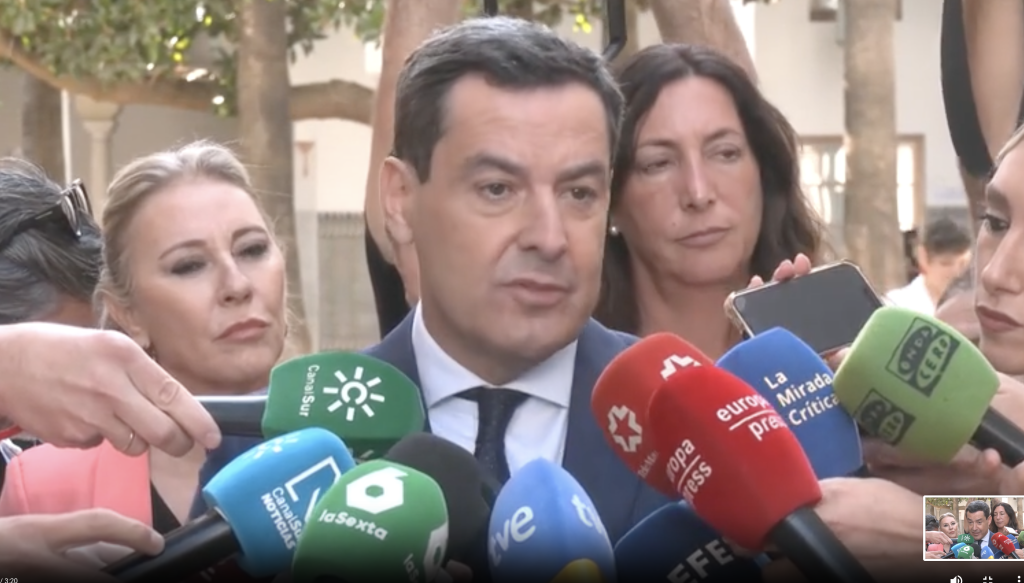
For now, Moreno’s government has attempted to keep tensions under control, insisting that the coalition agreement ‘will be fulfilled under the terms agreed’.
Vox, however, is already demanding changes to the way the coalition handles immigration.
Gavira described immigration as an ‘essential issue for Vox’ and said the two governing parties need to go further in determining how migration policy will be managed.
‘We want decisions affecting this issue to be discussed and coordinated in advance between the two parties from now on,’ he said.
‘That way we will avoid situations such as the one experienced over the extraordinary €25million aid approved this week.’
Until now, the PP and Vox have sought to emphasise the stability of their governing agreement.
But Ceuta’s migrant crisis has exposed a fundamental difference between the two parties.