Spain has officially extended the operating life of one of its biggest nuclear power stations until at least 2030, marking a significant change to its planned shutdown timetable.
The Ministry for Ecological Transition (Miteco) announced on Friday that it had renewed the operating licences for Units I and II of the Almaraz Nuclear Power Plant in Extremadura.
The decision, published in the Official State Gazette (BOE), means both reactors can continue generating electricity until June 8, 2030.
It represents a substantial reprieve for the plant, whose two reactors had previously been scheduled to shut permanently on November 1, 2027 and October 31, 2028, respectively.
The extension comes against a dramatically different international energy backdrop, with the Spanish government specifically pointing to volatility in gas prices caused by the crisis in the Middle East as one of the factors behind its decision.
Owners asked to keep Almaraz alive
The process began formally in October 2025 when Almaraz’s three owners (Iberdrola, Endesa and Naturgy) agreed to request an extension to the plant’s operating life.
The previous closure dates formed part of the phased shutdown agreement reached between radioactive waste management company Enresa and Spain’s major energy companies.
But keeping Almaraz operating has become an increasingly prominent issue as concerns have grown over energy security, electricity prices and Spain’s ability to replace nuclear generation with renewable capacity.
The government’s decision followed the approval of Spain’s Nuclear Safety Council (CSN).
On July 16, the regulator issued a favourable assessment of the proposed extension after concluding that Almaraz met the safety requirements necessary to continue operating during the additional period.
The extension is nevertheless subject to the plant complying with the CSN’s nuclear safety and radiological protection requirements.
Following the regulator’s approval, the dossier was passed to the government for the final political decision, which has now been taken.
Gas prices and Middle East crisis cited
Miteco pointed to the new international energy environment and volatility in natural gas prices resulting from the crisis in the Middle East.
According to calculations included in the resolution, keeping Almaraz operational until 2030 should have only a ‘limited and insignificant’ impact on Spain’s deployment of renewable energy.
At the same time, nuclear generation would help reduce Spain’s dependence on gas.
Nuclear power can provide continuous electricity regardless of weather conditions, unlike wind and solar generation, while avoiding the direct carbon emissions associated with gas-fired power stations.
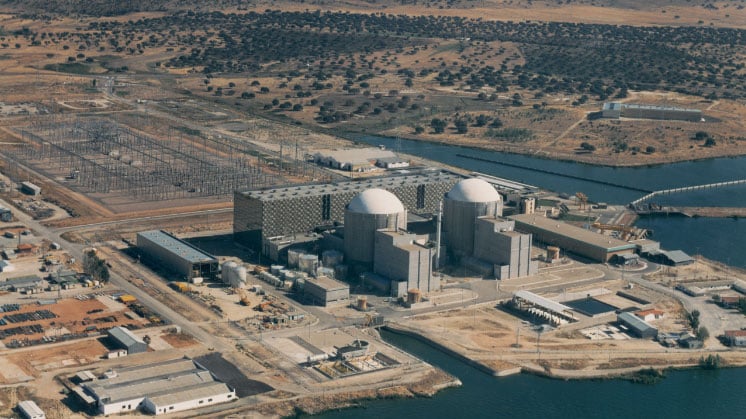
Almaraz, located in the province of Caceres, has two pressurised-water reactors and has been generating electricity since the early 1980s.