
Firefighters battling the enormous Huelva wildfire have made their first major breakthrough after a week of relentless work, allowing dozens of evacuated residents to finally return home.
The blaze has already scorched more than 31,000 hectares across Huelva and Sevilla, making it one of the most destructive wildfires to hit Andalucia in recent years.
But on Thursday, authorities said crews had managed to bring much of the fire’s northern flank under control, with the north-western front left without active flames following overnight operations.
The improvement has allowed around 60 residents to return to their homes in Caballon, Raboconejo, La Florida and Las Arenas, all areas close to where the devastating blaze first began.
‘I think this is the first time we’re going to be able to give good news,’ said Andalucia’s emregencies minister Antonio Sanz.
While the situation has improved in northern Huelva, the fire’s most dangerous front has shifted eastwards and is now advancing further into the province of Sevilla.
‘The direction in which the fire is advancing most at the moment is towards the province of Sevilla,’ said acting government delegate Francisco Toscano.
New evacuations in Sevilla
Authorities ordered fresh evacuations on Friday from isolated properties considered at risk in the municipalities of El Castillo de las Guardas and Aznalcollar.
Five rural properties were evacuated around El Castillo de las Guardas, while a tourist complex and four cortijos were affected by evacuation orders around Aznalcollar.
The SE-530 road connecting the two municipalities has also been closed.
Further evacuations had already taken place around El Madroño and Aznalcollar in recent days as the wildfire crossed from Huelva into Sevilla.
However, authorities stressed that the main urban centres remain safe and there are currently no plans for wider evacuations.
‘The growth has occurred in the eastern area and work is being concentrated on the road linking Aznalcollar with El Alamo,’ Sanz said.
‘It is the most active sector and where we have to concentrate all our efforts.’
The evolution of the fire throughout Friday is expected to depend heavily on changing wind directions.
Swirling column of smoke
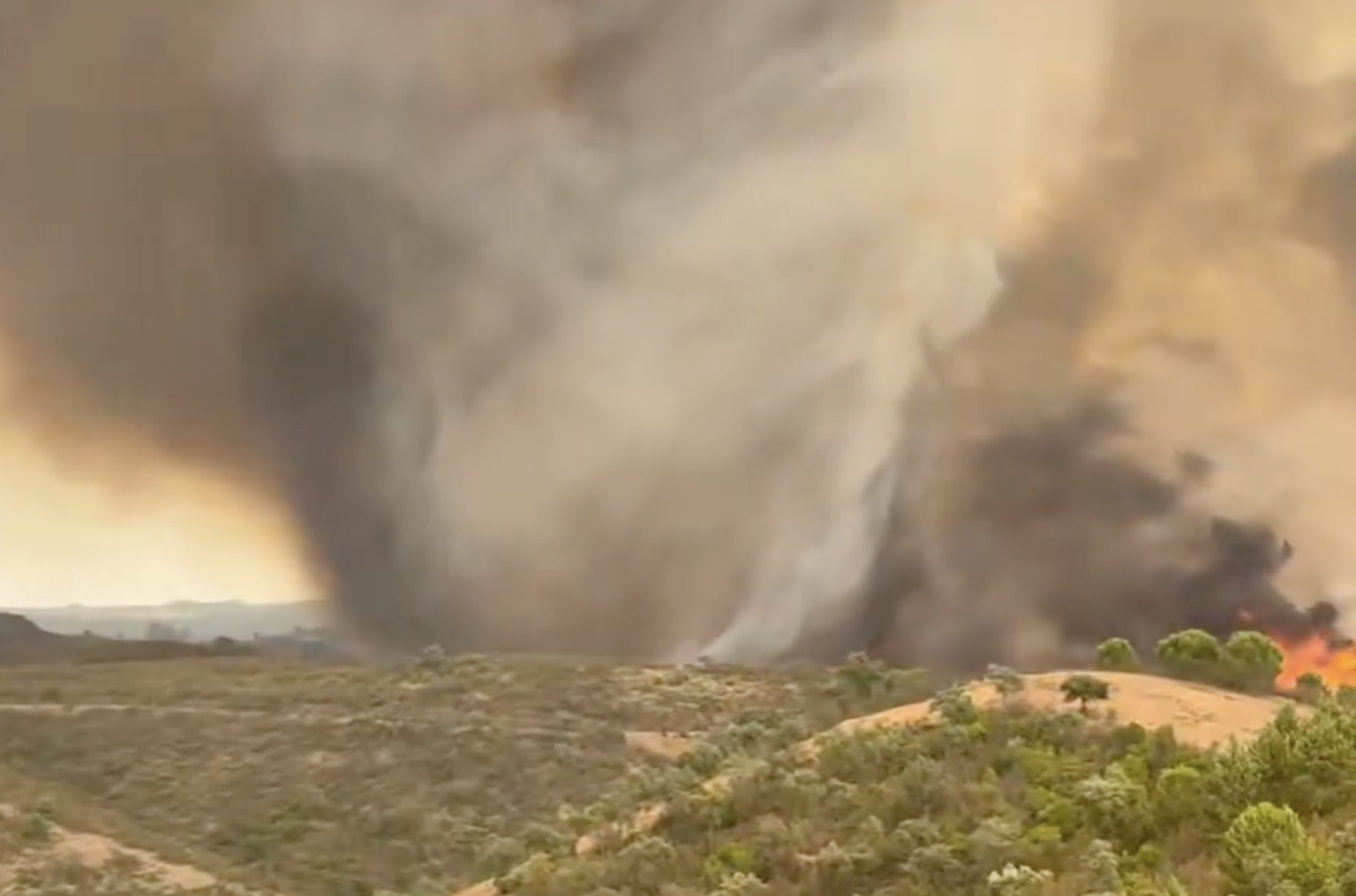
The extreme behaviour of the blaze was captured in dramatic footage on Thursday, showing a huge swirling column of smoke rising from the fire.
The phenomenon was described as a rotating convective column, created as intensely heated air generated by the wildfire rises rapidly and begins to rotate.
Footage shared by wildfire specialist Javier G. Rendo, originally filmed by the BRIF Puerto el Pico firefighting unit, showed the enormous vortex twisting upwards from the burning landscape.
Rendo warned that the rotation can increase the speed at which hot air rises, drawing more oxygen into the base of the fire and intensifying combustion.
The vortex can also act as a powerful mechanism for ‘spotting’ – carrying burning embers through the air and potentially starting new fires some distance ahead of the main front.
Conditions inside and around such a column can also generate severe turbulence, making it too dangerous for firefighting helicopters and other aircraft to operate nearby.
The extraordinary scenes illustrate the highly unstable and unpredictable behaviour that has complicated efforts to contain the Niebla blaze, even as crews have begun making significant progress along its northern flank.
Almost 800 people forced from their homes
Close to 800 people have been evacuated across Huelva and Sevilla since the wildfire erupted, while hundreds of firefighters and emergency personnel have been involved in the enormous operation.
The response has included INFOCA, the Military Emergency Unit (UME), resources from Spain’s Environment Ministry and provincial fire brigades from Huelva and Sevilla.
The successful containment of the northern sector has also allowed authorities to partially reopen the A-493 between Valverde and La Puebla and the HU-3106 between Valverde and Niebla, although access is currently restricted to residents.
Officials hope this will allow people not only to return home but also to begin recovering some normality after a week of disruption.
Read more Andalucia news at the Spanish Eye.