
Pedro Sanchez has blamed people-smuggling gangs for the unprecedented migration crisis in Ceuta.
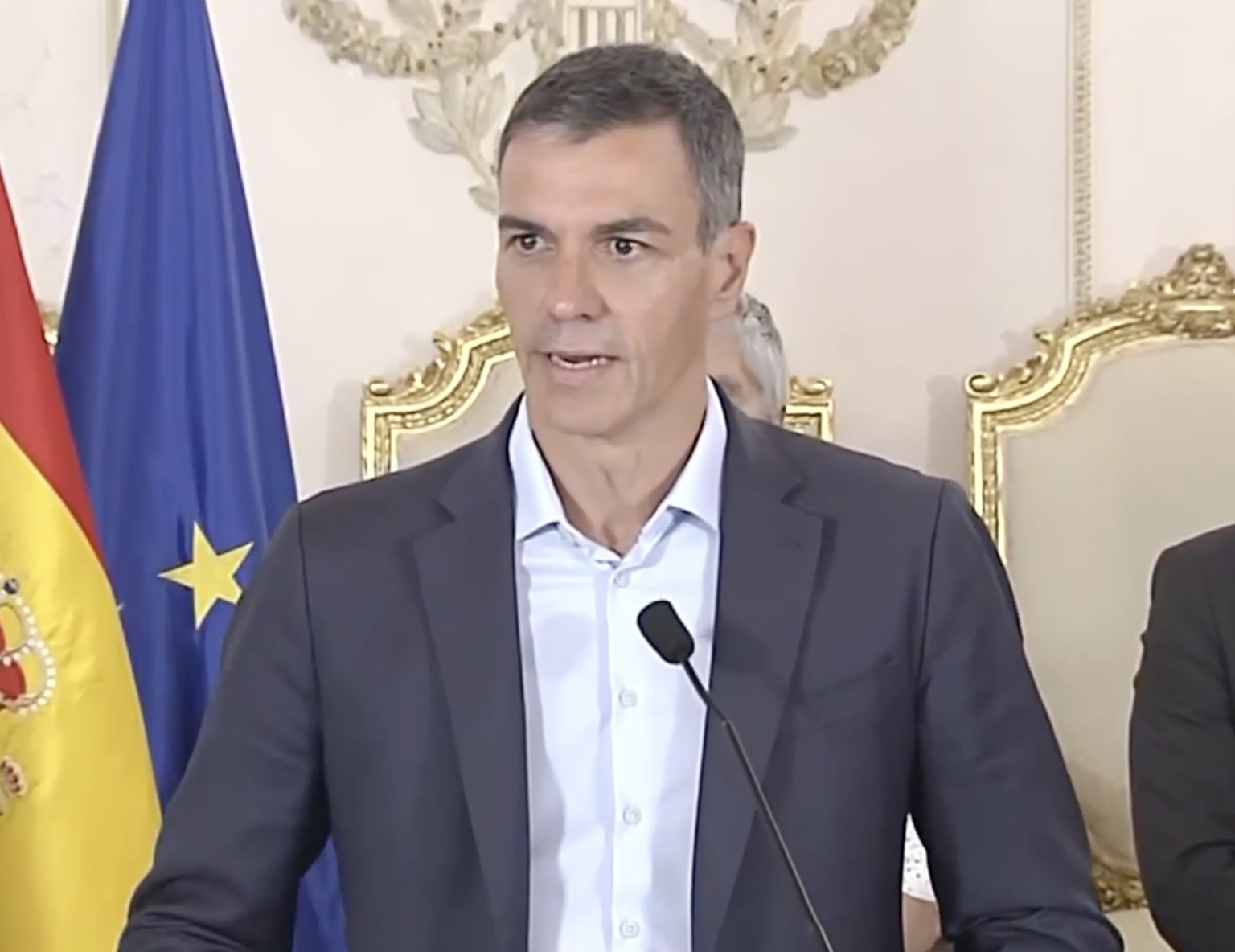
During an appearance in the North African enclave in Friday, the prime minister described the mass influx as ‘a violation of Spain’s territorial integrity’ after up to 60,000 migrants crossed into the enclave illegally, mostly on Thursday.
Speaking after touring the border alongside Interior Minister Fernando Grande-Marlaska, Sanchez rejected claims that Morocco was behind the surge, instead accusing criminal networks of exploiting a recent Supreme Court ruling on migrant returns.
‘What lies behind this is a self-interested interpretation by the mafias that traffic human beings of a Supreme Court ruling,’ Sanchez said.
He explained that the judgment found Spain could not apply so-called ‘hot returns’ (within 72 hours) to migrants intercepted while swimming into Ceuta because, legally, they had not crossed a physical land border.
Sanchez said around 34,000 migrants had already been returned to Morocco, thanking the Moroccan authorities for cooperating with Spain’s efforts to carry out rapid repatriations.
He insisted his government had invested more in Ceuta than any previous administration and said Spain would respond both to the immediate emergency and the longer-term challenges posed by irregular migration.
Floating barrier to be installed
Among the first measures announced, Sanchez said the government will install a line of floating buoys along the Tarajal breakwater to create a physical barrier aimed at preventing migrants from swimming into the enclave and making it easier for authorities to carry out returns.
He also refused to rule out changes to Spanish law following the crisis.
Ceuta leader: ‘The situation is unsustainable’
Ceuta’s president, Juan Jesus Vivas, painted an even grimmer picture, estimating that around 60,000 migrants had crossed into the city, equivalent to around 70% of Ceuta’s population.
Vivas also raised the death toll to 34 people, saying the humanitarian consequences of the crisis were becoming increasingly severe.
‘The response came too late and was insufficient. The situation in Ceuta is unsustainable,’ he said.
He praised emergency workers, police officers and volunteers responding to the crisis while expressing his ‘deep sorrow’ over the growing loss of life.
‘We are facing both a violation of our territorial integrity and a humanitarian emergency,’ Vivas added.