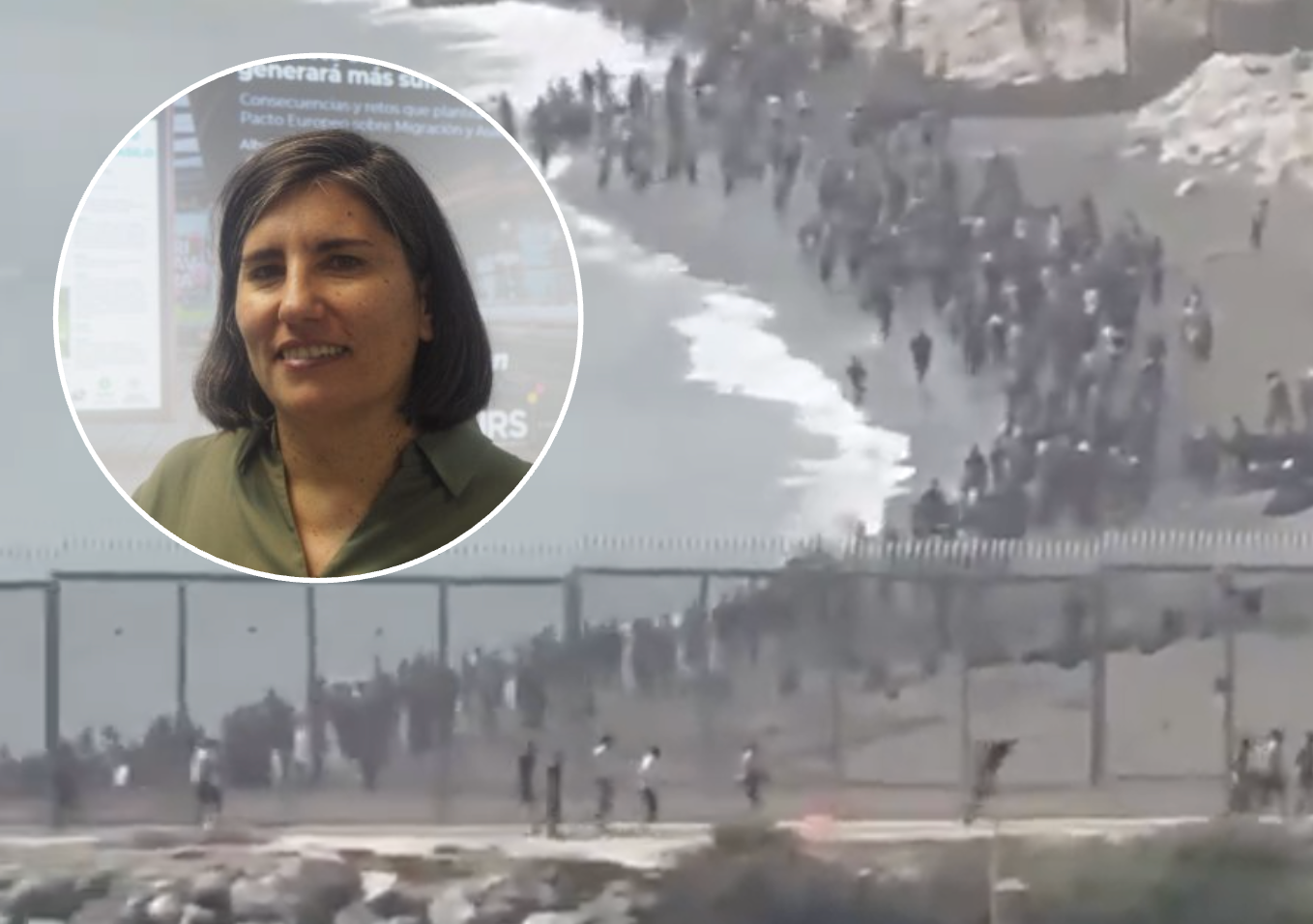

A leading migration lawyer has rejected claims that Spain’s immigration policies triggered the mass influx of migrants into Ceuta over the past 48 hours.
Speaking to Spanish radio station Cadena SER, migration and human rights lawyer Patuca Fernandez insisted that Morocco allowed the massive arrival to take place to put pressure on Spain.
She said it was ‘simply not true’ that a recent Supreme Court court ruling was responsible for the arrival of tens of thousands of people at the border on Thursday.
Opposition parties have argued that the ruling, which clarified the legal process for returning migrants, encouraged the surge.
However, Fernandez said the judgment does not prevent Spain from returning migrants, but merely requires authorities to carry out returns within a 72-hour legal timeframe rather than relying on the legal mechanism known as ‘rejection at the border’ in situations where it does not apply.
‘The Supreme Court never said the authorities cannot act,’ she said. ‘To claim this ruling caused what is happening is simply not true.’
Fernandez dismissed suggestions that Moroccan youths had travelled to Ceuta because of the court’s decision.
‘Young people in Morocco are not monitoring Spanish Supreme Court case law,’ she said.
She also argued that a movement of people on this scale could not happen without the knowledge of the Moroccan authorities.
‘Morocco has been putting pressure on this relationship for a long time so it can negotiate other issues from a position that suits it,’ she said.
According to Fernandez, Rabat has repeatedly used migration as a political tool and as a safety valve to relieve domestic social pressures.
She said the events should be viewed not as a migration crisis, but as a bilateral political crisis and a human rights crisis.
‘Migration is predictable,’ she said. ‘What we are seeing is a human rights crisis taking place within the framework of the Moroccan government’s political interests, so it can later negotiate other matters with Spain.’
Her comments come just 10 days after Pedro Sanchez travelled to Algeria, where Madrid and Algiers formally ended a four-year diplomatic dispute and agreed to increase Spanish imports of Algerian natural gas.
The timing has inevitably drawn comparisons with the Ceuta migration crisis of May 2021, when around 8,000 migrants, including roughly 1,500 minors, entered the Spanish enclave after Morocco relaxed border controls following Spain’s decision to admit Polisario Front leader Brahim Ghali for medical treatment.
At the time, Morocco openly linked the border crisis to Spain’s handling of the Western Sahara issue.
The EU accused Rabat of using migration as a political tool, while Spain said Morocco had allowed vulnerable minors to cross the border in breach of international obligations.
This time, however, the Spanish government has rejected any suggestion that Morocco is retaliating over Sanchez’s rapprochement with Algeria.
Instead, both Madrid and Rabat have blamed people-smuggling networks, accusing them of exploiting the Supreme Court ruling to encourage migrants to attempt the crossing.
The two countries have also agreed to accelerate the return of migrants who entered Ceuta illegally and strengthen cooperation at the border.
Fernandez said that Spain should have had a contingency plan in place following the similar border crisis in 2021.
The lawyer also dismissed suggestions from some European politicians that Spain could face suspension from the Schengen Area because of the crisis.
She noted that Ceuta and Melilla already operate under special Schengen arrangements, with documentary checks in place and no unrestricted movement from the enclaves into the wider Schengen zone.
Fernandez described calls to suspend Spain from Schengen as political posturing by parties seeking to capitalise on the migration crisis.
The calls have been made my Italy, which is run by right-wing prime minister Giorgia Meloni. Finland, also governed by a right-wing party, joined her demand.