


A British tourist has claimed she was left ‘in tears’ after returning to Mijas Pueblo and witnessing the town’s controversial donkey taxis.
Michelle Anne Butler, 60, who has visited the Costa del Sol village for more than a decade, told the Spanish Eye she was so disturbed by what she saw during a visit on May 24 that she felt compelled to contact local authorities, animal welfare groups and the Guardia Civil.
The allegations come as debate over Mijas’ famous donkey taxis continues to divide opinion, with campaigners demanding an end to the attraction while operators insist strict welfare standards are followed.
Michelle said she first became concerned about the animals after visiting Mijas during last year’s blackout and later joined campaign groups calling for improved treatment.
Returning this spring, she said she hoped to raise her concerns directly with local officials.
‘I was overwhelmed, sad and in tears at the suffering of the donkeys,’ she told the Spanish Eye.
She claimed several animals appeared thin and exhausted, alleging that some were forced to stand for long periods while harnessed for work.
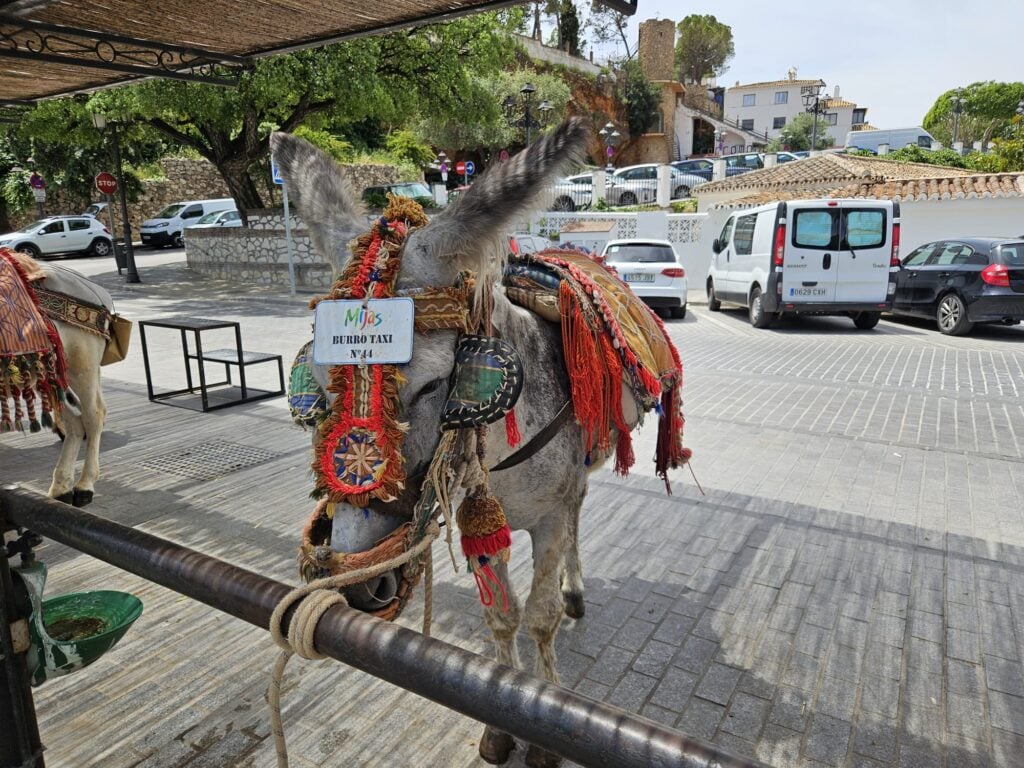
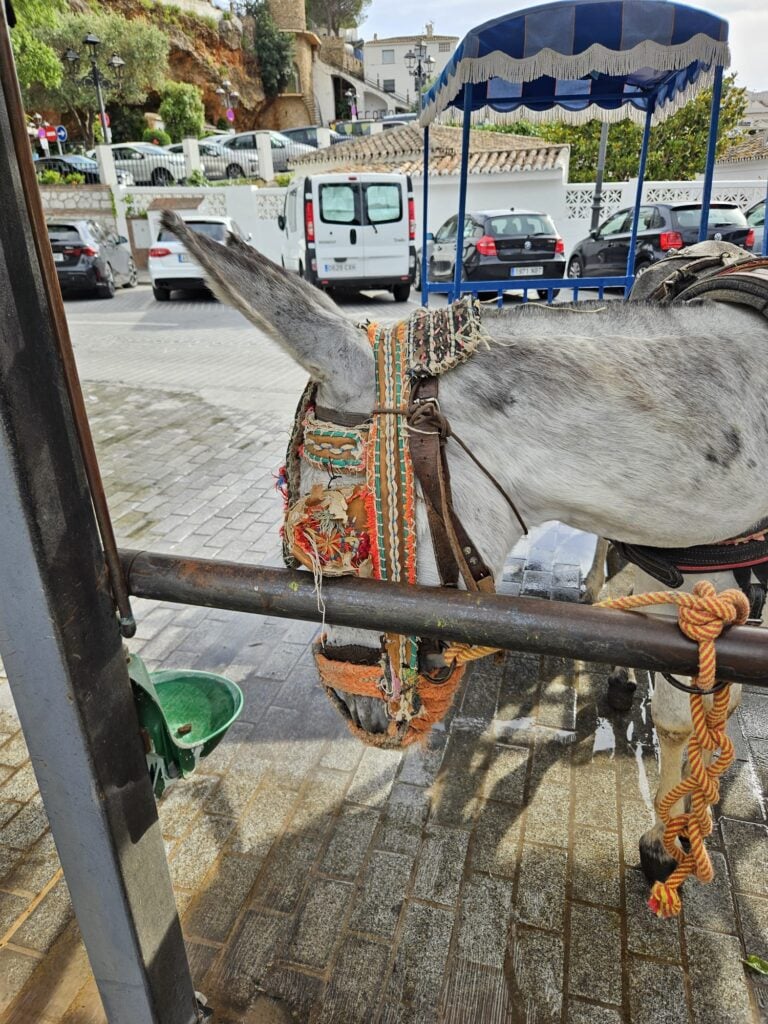
Among the most serious claims, Michelle alleged that some donkeys were tied so closely to railings that they struggled to reach water containers placed nearby.
New rules brought in last year say that ropes used to tie the donkeys should be ‘no shorter than 50cm’.
In photos shared with the Spanish Eye, that rule does seem to be being followed, however multiple donkeys had their mouths muzzled.
‘They were tied on short ropes and even if they could reach the water, they could not drink because they were muzzled,’ Michelle said.
She also alleged that harnesses and straps appeared to be rubbing against the animals’ skin, causing discomfort.

The tourist also described a confrontation with donkey owners after she attempted to raise concerns about one of the animals.
She claimed she and another British woman pointed out what they believed was a donkey becoming tangled in its restraints.
‘We were met with blank stares and then aggressive shouting,’ she alleged.
Michelle further claimed that a disagreement broke out after another visitor removed part of a donkey’s harness in an attempt to feed it carrots.
According to her account, the situation escalated into a heated argument between the women and several handlers.
‘I felt extremely unsafe and vulnerable,’ she said.
In another allegation, Michelle claimed the donkeys were not provided with water at a time she had been told they would be.
‘The owners made a big deal of washing down the cobbles and the donkeys’ legs, but the donkeys received no water to cool them down from the extreme heat,’ she said.
She also described what she called a ‘barbaric’ overnight shelter where she alleges the animals are kept after work.
‘They are led into this cell and tied up in rows facing a wall for the night,’ she claimed.
Michelle said she has since written to the tourist office, local politicians, animal welfare representatives and the Guardia Civil, but claims she has yet to receive a satisfactory response.
The donkey taxis of Mijas have long been one of Andalucía’s most recognisable tourist attractions, carrying visitors through the picturesque whitewashed village since the 1960s.
In recent years, however, they have become the focus of repeated criticism from animal rights organisations, particularly during periods of extreme summer heat.
Animal welfare groups have repeatedly called for the practice to be phased out, while operators and local authorities have maintained that veterinary checks, working-hour restrictions, shade structures and welfare protocols are in place to protect the animals.
The Spanish Eye has contacted Mijas Town Hall for comment.
New rules brought in
A decree signed by the conservative mayor Ana Mata (Partido Popular) in April 2025 stated that the taxis should be paused or stopped altogether in extreme bouts of heat.
If state weather agency Aemet issues a yellow alert for high temperatures, then the donkeys must not be put to work between 2pm and 6pm.
If an orange or red warning is in place, then they must not work at all until the alert is deactivated.
Secondly it calls on donkey owners to clear up after their animals, or face serious fines.
The document says: ‘The excrement collection system at all stops on this service will be the responsibility of the concessionaires. Failure to do so will be punishable as a serious offence.
‘Likewise, the concessionaires will also be responsible for cleaning up animal excrement along the route.’
The ruling advised donkey owners to use ‘preventative’ bags that can be attached to the donkey and collect their excrement ‘before it falls to the ground.’
It added: ‘It is also important to remember that failure to comply constitutes a serious offence, punishable by a fine of €750 to €1,500.’
Finally, it ordered that the rope used to tie the animals up be no shorter than 50cm to guarantee ‘a minimum standard of freedom of movement and well-being for the animals.’
Mijas town hall said the new rules ‘demonstrate its commitment to the safeguarding and well-being of riders, coachmen, and the animals themselves.’
Read more Andalucia news at the Spanish Eye.





I hope this comment gets to the article of the donkeys in Mijas! It is absolutely disgraceful that this blatant suffering and abuse of donkeys is still permitted. Not only are the donkey owners at fault, but even more so the disgusting tourists who think it’s ok to use these donkey taxis – shame on you ALL.
Thanks to the pressure of the foreigners some minimal measures have been taken; this once more shows the Spanish lack of concern for animals’ wellbeing.