
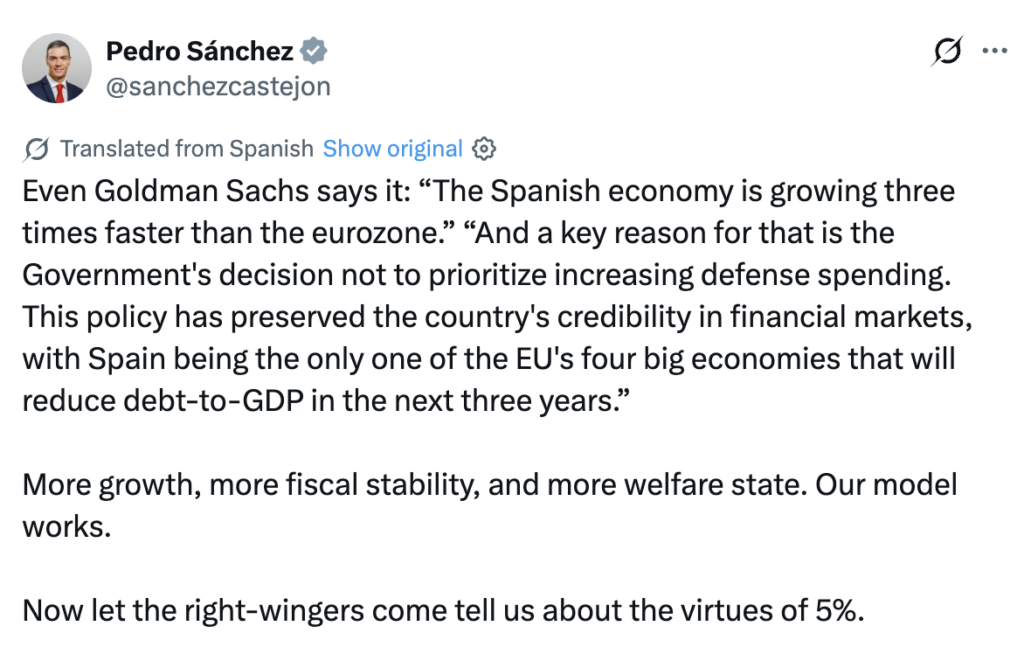
Pedro Sanchez has seized on a new Goldman Sachs report that predicts Spain’s economy will grow three times faster than the wider eurozone this year.
Taking to social media, the prime minister highlighted the investment bank’s forecast that GDP will expand by 2.1% in 2026, compared with just 0.7% across the euro area.
The Socialist leader also pointed to the report’s conclusion that Spain is expected to be the only one of the EU’s four largest economies to reduce its debt-to-GDP ratio over the next three years.
‘More growth, more fiscal stability, and a stronger welfare state. Our model works,’ Sanchez wrote in a post on X.
The comments came after Goldman Sachs praised what it described as Spain’s ‘structural resilience’ during a period of economic uncertainty across Europe.
Why Spain is outperforming
According to Goldman Sachs economist Filippo Taddei, Spain has benefited from a combination of falling unemployment, rising productivity and strong employment growth in higher-value sectors such as technology, finance and professional services.
The report notes that Spain’s unemployment rate has fallen to its lowest level since 2008, while the country’s employment rate has reached a record high.
At the same time, productivity growth has outpaced that of Germany, France and Italy, helping Spain maintain stronger economic momentum than many of its European neighbours.
Goldman Sachs also pointed to Spain’s willingness to accept higher levels of immigration as a factor supporting economic expansion, although it warned that population growth is increasing pressure on the housing market.
Debt falling despite extra spending
One of the report’s most notable findings relates to Spain’s public finances.
Despite introducing measures to help households and businesses cope with rising energy costs, Goldman Sachs said Spain has managed to preserve confidence among investors.
The report argues that one reason for this has been the government’s decision not to prioritise a major increase in defence spending, allowing public finances to remain on a more sustainable path than some other European countries.
As a result, Spain is forecast to be the only one of the EU’s four biggest economies to reduce its debt burden relative to the size of its economy over the coming years.
Risks remain
Despite the positive outlook, Goldman Sachs warned that challenges remain.
Tourism, which accounts for more than 12% of Spain’s economy, could be affected if rising energy prices make air travel more expensive during the summer season.
The report also highlighted political uncertainty as a potential concern for investors. Spain continues to be governed by a fragile coalition, while attention is already beginning to turn towards the next general election.
Goldman Sachs cautioned that prolonged political instability could undermine investor confidence and slow the economic progress seen in recent years.
Nevertheless, the investment bank concluded that Spain remains one of Europe’s strongest-performing major economies, with growth continuing to outpace both the eurozone and the US.