
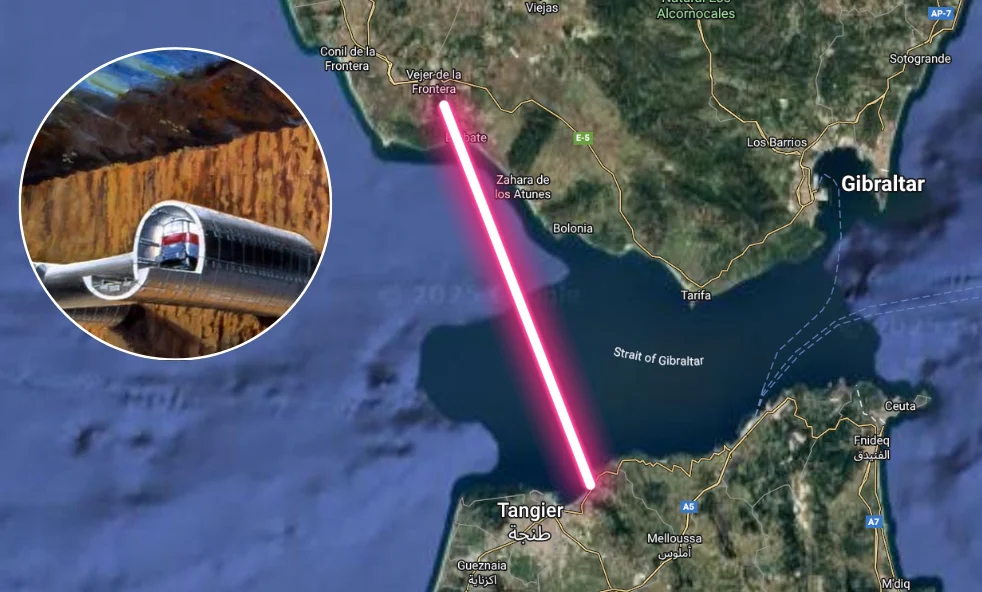

The long-held ambition to link Europe and Africa via an undersea tunnel beneath the Strait of Gibraltar is once again gathering real momentum.
THe project has fresh funding, new scientific missions and the most comprehensive technical review in nearly two decades is now underway.
After years of stop-start progress, the project has quietly entered a decisive new phase.
At the centre of it is Spain’s public engineering firm Ineco, which is leading a full update of the tunnel’s preliminary design – the first since 2007.
Due for completion in August 2026, the document will reassess everything from the route and geology to technical feasibility and financial viability.
In parallel, the Spanish government has stepped up its financial commitment.
A fresh €1.73 million injection approved in March brings total funding for the project since 2022 to more than €9.6 million.
It’s a sharp increase compared to previous years and a clear sign of renewed political will following improved relations between Spain and Morocco.

A mission to the seabed
One of the most critical steps will take place before summer, when a major scientific expedition will analyse the seabed of the Strait, reports Europa Sur.
Led by CSIC, the two-week campaign will focus on the Camarinal Sill – a notoriously complex underwater zone widely seen as the single biggest engineering challenge for the tunnel.
Using high-precision mapping technology, researchers will study the seabed, analyse subsoil layers and collect samples to build a 3D geological model.
The data will be crucial in determining whether tunnelling at depths of up to 475 metres is realistically achievable in such unstable terrain.
The challenge is not just geological. More than 100,000 ships cross the Strait each year – one of the busiest maritime corridors in the world – while the area is also home to rich marine ecosystems, with more than 1,900 species under protection.
Spain and Morocco step up cooperation
The project is also being driven diplomatically.
Spain’s transport minister Oscar Puente recently signed an agreement with his Moroccan counterpart to study seismic activity and tectonic dynamics in the area over the next three years – a crucial factor given the Strait sits on the boundary between continental plates.
What the tunnel could look like
Current plans point to a railway tunnel stretching around 65 kilometres, made up of two parallel tunnels and a central service gallery.
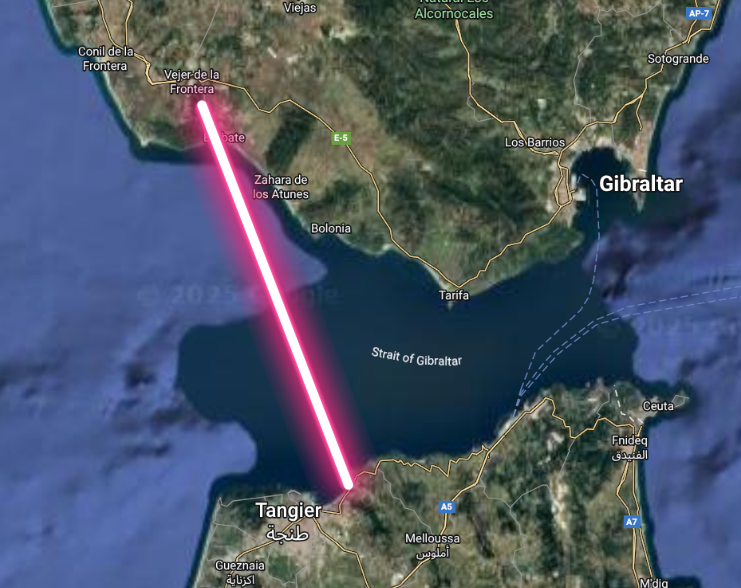
The journey between southern Spain and northern Morocco could take as little as 30 minutes, creating a strategic corridor not just for passengers, but also for freight, energy and telecommunications.
Economically, the project remains a huge undertaking. Analysts are studying models similar to the Channel Tunnel to assess long-term viability, including passenger demand, cargo flows and potential additional uses such as electricity interconnections and fibre optic networks.
Still years away
If timelines hold, the next major milestone will be the construction of an exploratory tunnel before 2027 – a test phase that could cost close to $1 billion.
Full construction of the final link is not expected to begin before 2030, with a possible opening date between 2035 and 2040.
For now, the dream of physically connecting Europe and Africa remains just that, but for the first time in years, it is edging closer to reality.
Read more Andalucia news at the Spanish Eye.





Spain has huge gaps in Raíl coverage that need building before funds are diverted into a tunnel.
The line from.Malaga that should go to Algeciras vía Marbella for example .
Long promised but only goes as far as Fuengirola.
Very busy urbanisations with only cars and poor bus services as transport options