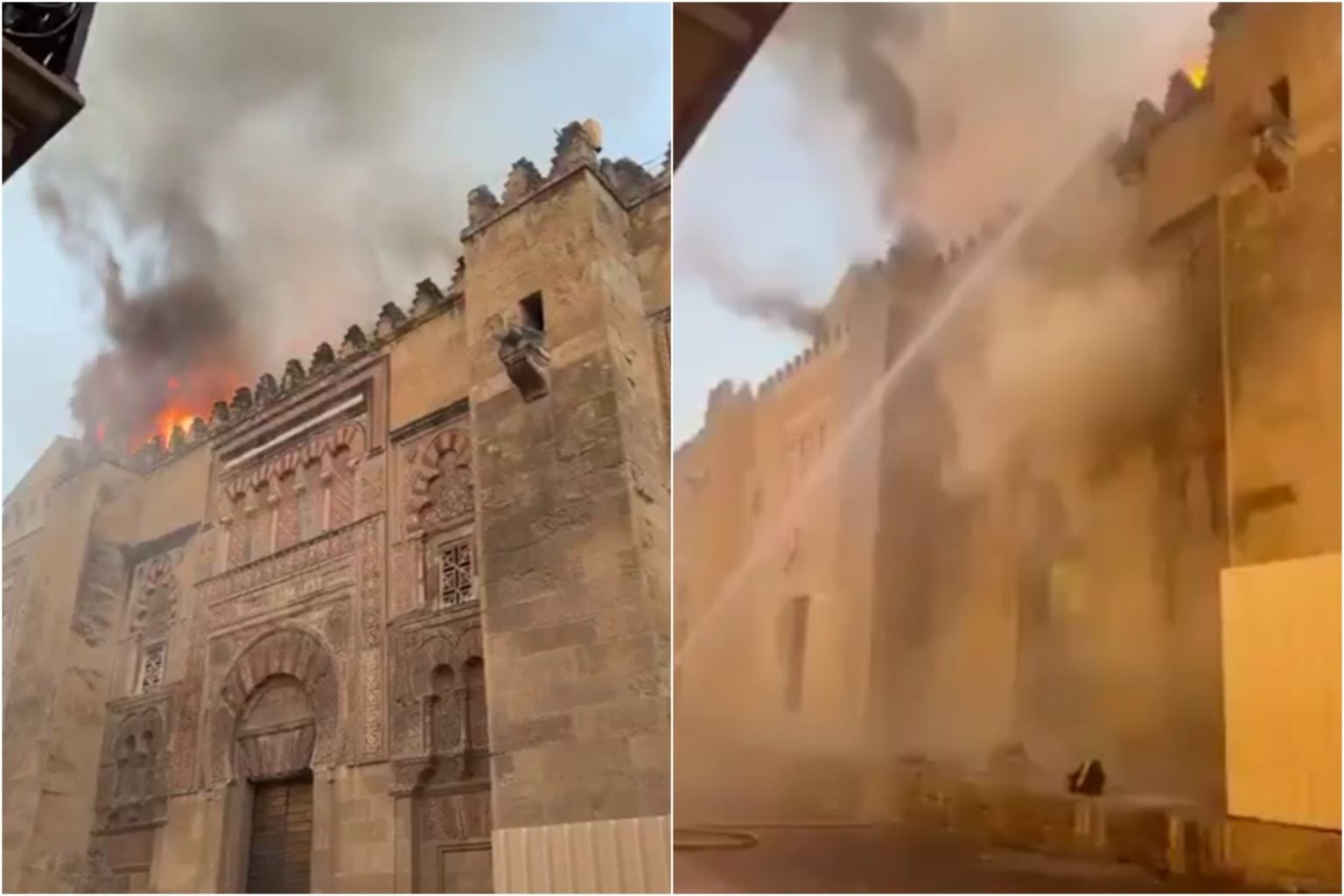

Panic took hold in Cordoba on Friday night after a fire broke out at the iconic Mezquita de Cordoba .
The inferno was first noticed shortly after 9pm, at the Puerta de San Jose (gate of San Jose).
The area was evacuated as residents and tourists filming the incident on their phones were told to clear the area.
Locals had fears of a repeat of the devastating Notre Dame fire in France, which left the centuries-old site in ruins.
Luckily, the Cordoba blaze was quickly ‘sectioned and controlled’ before being extinguished.
Smoke was visible from several kilometers away, and emergency services worked hard to extinguish the blaze.
The flames have caused damage to the upper part of the building, which is a World Heritage Site and symbol of Cordoba and Andalucian history.
While the damage has not yet been assessed, authorities said the fire originated next to the Espiritu Santo chapel, where cleaning equipment and chairs were located.
The cultural importance of the Mezquita
The Mezquita de Cordoba, or Mosque–Cathedral of Cordoba, is one of Spain’s most remarkable architectural landmarks, reflecting over a 1,000 years of religious and political change.
Its origins date back to 785 AD, when the Umayyad emir Abd al-Rahman I ordered the construction of a grand mosque on the site of a former Visigothic church dedicated to St Vincent.
Using materials from Roman and Visigothic structures, the mosque became a statement of the emirate’s power and the cultural sophistication of al-Andalus.
Over the next two centuries, successive rulers expanded and embellished the building. Abd al-Rahman II, Al-Hakam II, and Almanzor all added new sections, creating a vast prayer hall supported by hundreds of columns topped with double-tiered red-and-white arches.
The richly decorated mihrab (prayer niche), installed under Al-Hakam II in the 10th century, remains one of the finest examples of Islamic art in Europe.
The mosque was not only a religious centre but also a symbol of Cordoba’s status as the capital of Muslim Spain and one of the largest, most advanced cities in Europe at the time.
This era ended in 1236, when King Ferdinand III of Castile captured Cordoba during the Christian Reconquista. The mosque was consecrated as a Catholic cathedral, and Christian worship has continued there ever since.
In the 16th century, a Renaissance-style nave and choir were inserted into the heart of the former mosque by order of Bishop Alonso Manrique. This dramatic blend of Islamic and Christian architecture – sometimes criticised in its own time – has become one of the building’s defining features.
Today, the Mezquita de Cordoba stands as a UNESCO World Heritage Site, embodying the complex, layered history of southern Spain and the coexistence, and conflict, of its cultures.