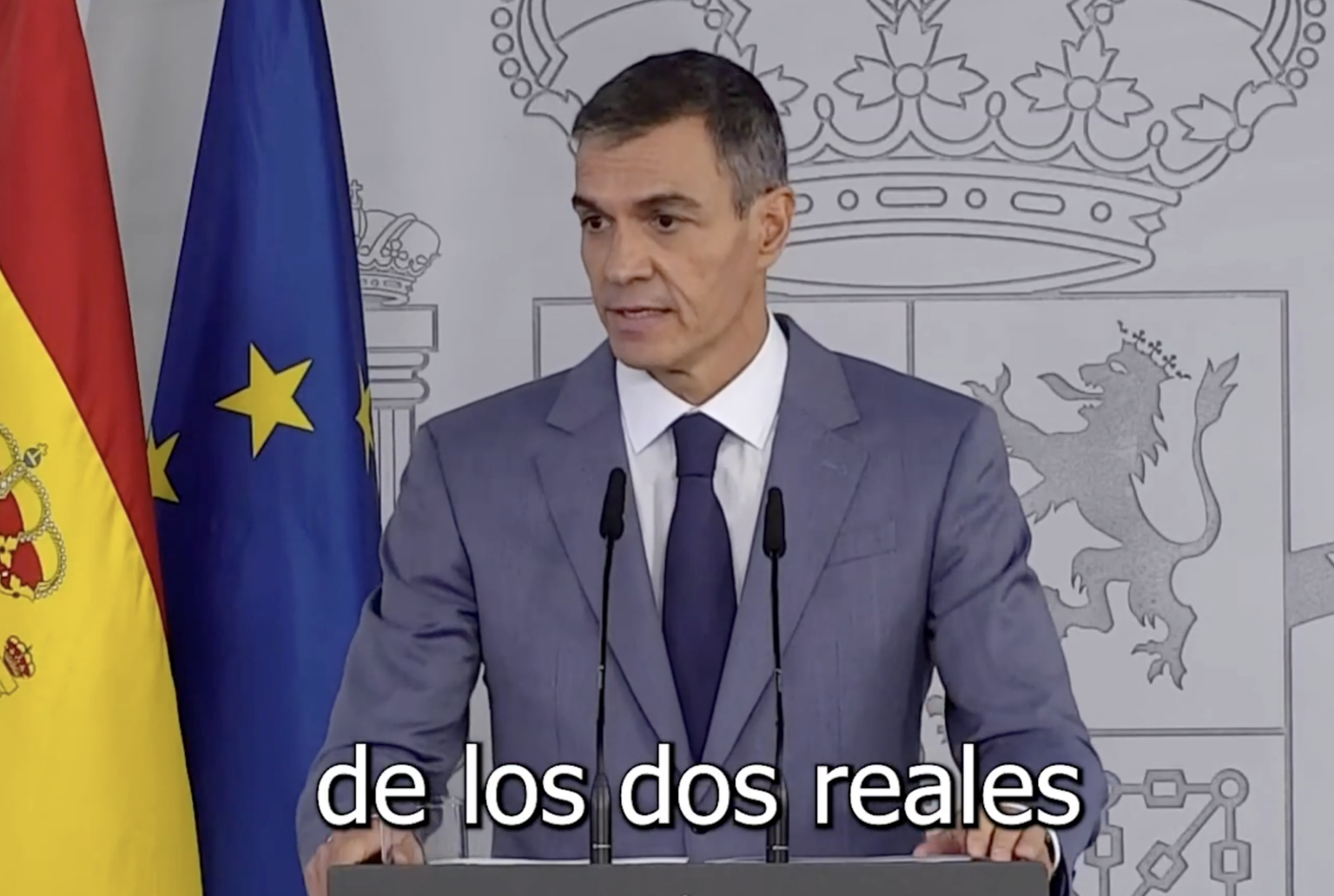

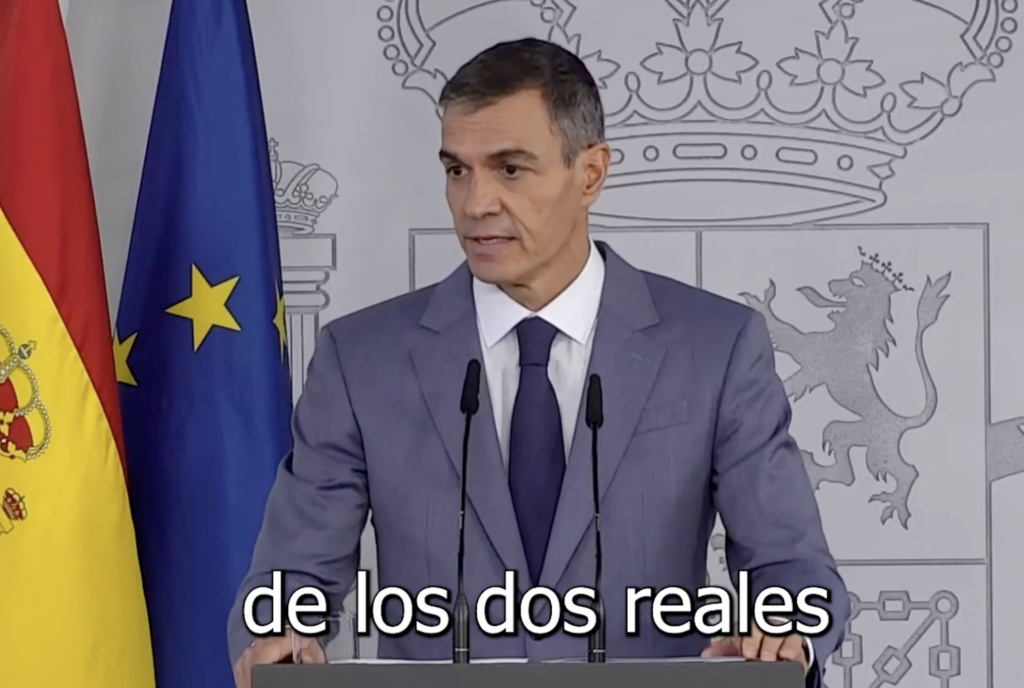
Pedro Sanchez has announced a €10billion scheme to give first-time buyers interest-free loans of up to €50,000.
The Tu Casa programme is intended to help people who earn enough to make monthly mortgage payments but cannot save the deposit demanded by a bank.
Unlike many existing homebuyer schemes, the financing will not be restricted to young people.
The prime minister said it would be an ‘intergenerational’ measure available to older households as well as younger buyers, provided they are purchasing their first main home.
However, the scheme comes with a significant condition, as any property bought using the public financing will be permanently subject to a maximum resale price.
How much could buyers receive?
Successful applicants could borrow the lower amount between 20% of the home’s value or €50,000.
The public loan would complement, not replace, the buyer’s conventional mortgage.
No interest or commission would be charged on the government-backed portion, which will be managed by Spain’s Official Credit Institute, the ICO.
The mechanism is therefore designed to cover some or all of the deposit normally required because Spanish banks commonly lend only around 80% of a property’s value.
A buyer purchasing a €200,000 home, for example, could theoretically receive €40,000 through Tu Casa, equivalent to 20% of its value.
For a home valued at €300,000, the 20% calculation would reach €60,000, but the public loan would be capped at €50,000.
The €10billion fund would be sufficient to provide 200,000 loans if every recipient obtained the full €50,000. The actual number of recipients could be higher if buyers receive smaller amounts.
Sanchez said: ‘The financing line will be endowed with €10billion, managed by the ICO, and will provide up to €50,000 interest-free to those who want to buy their first home.’
Buyers would eventually have to return the money.
The framework provides for a repayment period of up to 10 years, with a grace period linked to the duration of the conventional mortgage and capped at 30 years.
This means the public loan is intended to reduce the immediate savings barrier facing purchasers rather than provide them with a non-repayable subsidy.
Further details,including possible income limits, maximum eligible property prices, application procedures and affordability tests, must still be established through a separate Council of Ministers agreement.
Applicants will need to be buying their first mortgaged property as their habitual residence.
The rules currently establish no maximum age, supporting the government’s claim that the programme will not be limited to young buyers.
Permanent restriction on resale price
The most important long-term condition is that homes purchased through Tu Casa will remain permanently subject to a maximum sale price.
If the owner later sells, the price cannot exceed the original purchase price adjusted in line with inflation.
Certain qualifying renovations and improvements may also be added to the permitted resale value, although the detailed rules have yet to be developed.
The restriction will be recorded in the purchase deed and entered into the Land Registry, meaning it will continue to apply during second and later sales.
It does not simply disappear once the original buyer repays the €50,000 loan.
The provision is designed to ensure that public money is used to support access to affordable homes rather than allow recipients to make unrestricted profits from later property-price increases.
However, it also means buyers benefiting from the scheme may not receive the same capital growth as owners purchasing without public assistance.
Who is it aimed at?
The government says the scheme is aimed at people with stable incomes who are capable of paying a mortgage but cannot accumulate the tens of thousands of euros needed upfront.
In addition to a deposit, buyers in Spain generally need further savings to cover taxes and purchasing costs, which can add roughly 10% or more to the price depending on the property and region.
Sanchez emphasised that first-time buyers in their 30s, 40s or older could qualify.
‘It will be intergenerational, families of older ages, not only young people,’ he said. ‘Everyone who is going to acquire a first home.’
The detailed eligibility rules will determine whether previous ownership abroad, inherited shares in properties or homes owned by a spouse could affect an application.
Those questions have not yet been resolved publicly.
Part of wider housing package
The loan scheme forms part of 21 housing measures approved again by the Council of Ministers after earlier versions were rejected by Congress last Friday.
Other proposals include tax deductions for tenants, incentives for small landlords offering affordable rents, controls on seasonal and room rentals, and tighter restrictions on purchases by large investment funds.
The government also plans €280million in guarantees to support industrialised construction and €400million for providers of social housing.
Additional measures would extend certain rental contracts, limit rent increases and maintain protection against evictions for vulnerable households without alternative accommodation.
Sanchez acknowledged that the package alone would not resolve Spain’s housing crisis, saying the country still needed ‘hundreds of thousands’ of additional homes, particularly public and affordable rental properties.
Parliamentary approval still required
The decrees must now be considered by the Diputacion Permanente, the reduced parliamentary body that operates after the dissolution of Congress.
The government appears capable of securing the narrow majority needed for the main housing package if the PNV and its other previous allies support it.
Until the decree is validated and the detailed ICO agreement is adopted, prospective buyers cannot apply for the Tu Casa loans.
Sanchez nevertheless insisted that the government would continue pursuing the measures despite the earlier parliamentary defeat.
‘We are neither throwing in the towel nor abandoning people,’ he said.