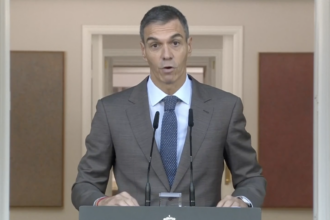

Pedro Sanchez is attempting to revive his controversial housing reforms just days after they were rejected by Spain’s Congress of Deputies, it has emerged.
According to Idealista, the government is using the little-known Diputacion Permanente, where it has more favourable numbers, to make another attempt at passing its defeated measures before the November 29 election.
The government approved revised versions of the two decrees at Tuesday’s Council of Ministers, despite Sanchez having already dissolved Parliament and called a snap vote.
While the measures can no longer return to the full 350-seat Congress, the government intends to submit them to the Diputacion Permanente – a smaller parliamentary body that remains active between legislatures.
Crucially for Sanchez, the balance of power in this temporary chamber is more favourable to his government.
The move is legal and has been used previously, but constitutional experts have questioned whether it is appropriate to use an emergency mechanism to resubmit measures defeated by the full Parliament only days earlier.
What is the Diputacion Permanente?
The Diputacion Permanente exists to ensure that Congress can continue performing certain essential duties when Parliament is not sitting.
It remains in place until the newly elected Congress is constituted.
Under Article 78 of the Spanish Constitution, the body can protect the powers of Parliament, consider emergency decrees and exercise certain responsibilities relating to states of alarm, emergency and siege.
It can therefore vote to validate or repeal royal decree-laws approved by the government while Parliament is dissolved.
The current Diputacion Permanente has 69 members: 68 MPs plus Congress president Francina Armengol.
The Partido Popular (PP) has 27 representatives, the PSOE 24, Vox and Sumar each have six, while ERC, Junts, EH Bildu, the PNV and the Mixed Group each have one. Podemos currently holds the Mixed Group seat.
Armengol, a Socialist, effectively gives the PSOE 25 votes.
That means the parties that backed the government’s first housing decree can reach the 35 votes needed for a majority, while the PP, Vox and Junts together have 34.
In the full Congress, the opposition of Junts helped defeat the measures. In the smaller temporary chamber, its vote would no longer be decisive.
One decree could pass
The government’s first decree contained a wide-ranging package of housing measures.
These included extending protections against the eviction of vulnerable people until 2030, regulating seasonal and tourist rentals, introducing tax changes and restricting certain property purchases by investment funds.
One provision would prevent qualifying investment funds from buying homes for less than 70% of their assessed market value until the end of 2028.
The measure was presented politically as a ban on purchases by ‘vulture funds’, although it was not a blanket prohibition.
The decree also contained measures affecting public and affordable housing, landlords, tenants and the taxation of property.
PSOE, Sumar, ERC, EH Bildu, Podemos and the PNV supported that decree when it was put before the full Congress. If they vote together again, it could pass through the Diputacion Permanente by 35 votes to 34.
However, the PNV has said it will inspect the revised text before committing its support.
The Basque nationalist party says its position is based on ‘protecting vulnerable people and defending small property owners under the principle of legal certainty’.
Its vote is even more important for the second decree, which concerned the automatic extension of rental agreements.
The PNV opposed that measure last Friday. If it does so again, the revised decree could be defeated by 35 votes to 34, even without Junts.
What would the rental decree change?
The defeated measure sought to change Spain’s Urban Leasing Law by providing greater continuity once rental contracts reached the end of their minimum term.
That minimum is generally five years when the landlord is an individual and seven when the property is owned by a company.
Under the proposal, contracts could be renewed for further periods unless one of the parties gave notice that they did not wish to continue.
Landlords would generally have to provide six months’ notice and could be required to compensate tenants with the equivalent of 12 months’ rent if they refused an extension without one of the permitted justifications.
Additional protections would apply to vulnerable tenants and homes situated in officially declared pressured housing areas.
Government introduces changes
The new texts reportedly include changes from the decrees rejected on Friday, although government sources have described them as ‘non-substantial’.
Javier Tajadura, professor of Constitutional Law at the University of the Basque Country, told Idealista that approving an identical text through the Diputacion Permanente after it had been rejected by the full Congress could amount to an abuse of law.
He argued that the government must modify the decrees at least partially rather than simply asking a smaller parliamentary body to reverse the decision taken by the entire chamber.
Tajadura also questioned whether the situation meets the constitutional requirement of ‘extraordinary and urgent necessity’ needed to legislate through a royal decree-law.
In his view, the Diputacion Permanente should principally be used to respond to urgent events such as natural disasters or national security emergencies.
His interpretation is contested, however. Constitutional case law has historically given governments considerable discretion when establishing whether an issue is sufficiently urgent to justify a decree-law.
Measures would take effect immediately
Royal decree-laws take effect upon publication in Spain’s Official State Gazette, although they must be submitted for parliamentary validation within 30 days.
That means the revised housing rules could temporarily enter into force before the Diputacion Permanente votes on whether to retain or repeal them.
The date of that vote has not yet been announced.
With Spain already in an election period, the political consequences could be as significant as the legal ones.
Sanchez will be able to campaign on having restored protections for tenants and vulnerable households.
The PP, Vox and Junts are likely to accuse him of using a reduced parliamentary body to bypass the verdict of the full Congress.