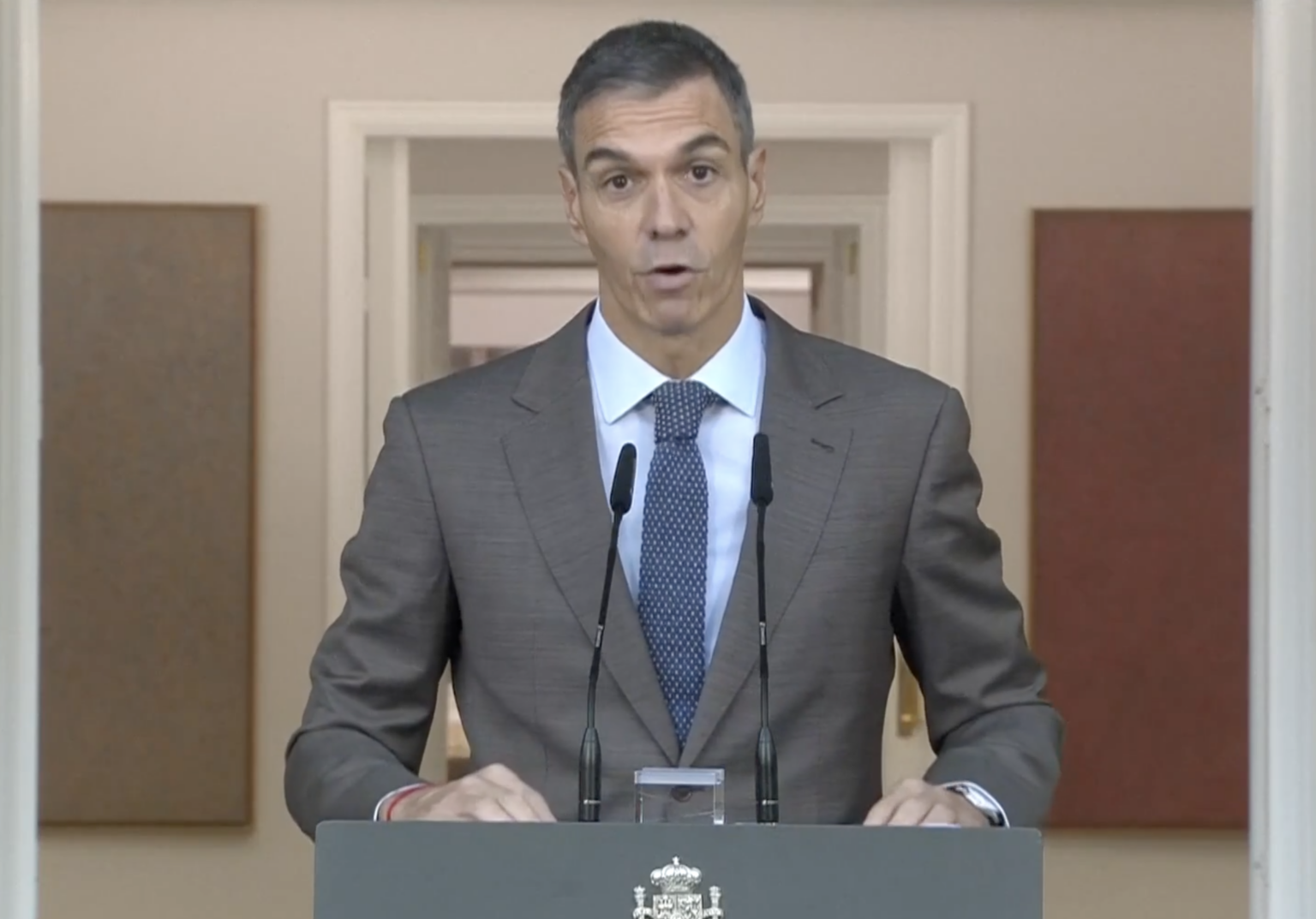

Pedro Sanchez has called a snap general election for November 29 after his minority government suffered a major parliamentary defeat over its housing reforms.
The prime minister announced the decision during a televised address on Monday morning, saying Spain needed a stronger progressive majority to overcome the political deadlock in Congress.
An extraordinary meeting of the Council of Ministers was called for 11.30am to approve the dissolution of both houses of parliament and formally begin the electoral process.
The election decree is expected to be published in the Official State Gazette on Tuesday, October 6.
”After informing the head of state, as required, I have decided to convene an extraordinary Council of Ministers this morning to dissolve parliament and call a general election for Sunday, November 29,’ Sanchez said.
Housing defeat triggers election
The announcement came three days after Congress rejected two emergency housing decrees proposed by the coalition government.
The measures included stronger protections against evictions, restrictions on investment funds buying heavily discounted homes and new rules governing rental contracts.
They were defeated after the conservative Partido Popular (PP), Vox and Catalan separatist party Junts voted against them.
The loss exposed the fragility of Sanchez’s parliamentary position and raised doubts about whether his government could pass further major legislation or approve a new national budget.
‘We have not managed to do everything we set out to achieve,’ Sanchez acknowledged.
‘To do more, we need to renew and expand the support of the people. We must mobilise and ensure that parliament gives us a much broader progressive majority.’
‘Choice over Spain’s future’
The Socialist leader framed the election as a choice between continuing his progressive programme and allowing Spain to join what he described as Europe’s ‘far-right wave’.
‘Spanish men and women must decide what role they want to play and what role they want Spain to play,’ he said.
‘Whether you want to join that far-right wave which brings regression wherever it governs, or whether you want Spain to remain a bastion of openness, social justice and environmental responsibility.’
Sanchez also defended his government’s economic and social record, highlighting employment growth, renewable energy, increased welfare spending and expanded parental leave.
However, he admitted that some progressive voters were dissatisfied and that his administration had made mistakes.
The decision represents a significant political gamble. Recent opinion polls have placed the Partido Popular ahead of the PSOE, with some suggesting that PP leader Alberto Núñez Feijóo could secure a governing majority with the support of Vox.
Sanchez is hoping that public anger over Spain’s housing crisis and the rejection of the government’s decrees will mobilise left-wing voters.
Campaign begins in November
Under the provisional electoral timetable, parties will submit their candidate lists between October 21 and 26.
The official campaign is expected to run from November 13 until November 27, followed by the traditional day of reflection on November 28.
Voting will take place on Sunday, November 29.
‘Now it is up to you,’ Sanchez told voters. ‘We are going to give everything we have to deserve your trust, to inspire hope and to win again.’