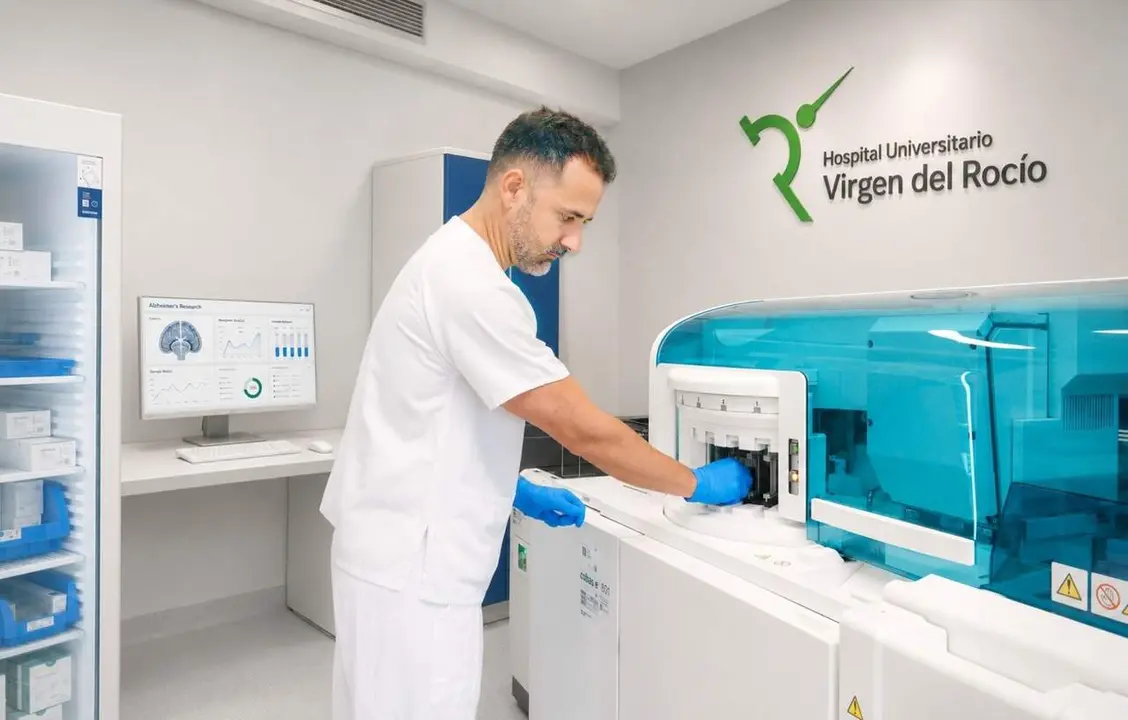

New blood tests designed to help detect Alzheimer’s disease earlier and more accurately are being progressively introduced at public hospitals across Andalucia.
The tests look for specific biomarkers associated with the disease and could help doctors obtain crucial diagnostic information through a simple blood sample rather than more invasive procedures.
The development was announced by the Junta de Andalucia to coincide with World Alzheimer’s Day on September 21.
It comes as new figures reveal that almost 18,000 people aged over 65 were diagnosed with some form of dementia in Andalucia during 2025, including around 12,000 diagnoses of Alzheimer’s.
An estimated 100,000 people across the region are living with the disease.
Alzheimer’s clues found in blood
The breakthrough centres on blood biomarkers, which are measurable biological signs that can provide evidence of the processes associated with Alzheimer’s.
One of the most promising is p-tau217, a form of the tau protein which can be measured in blood.
Its potential use in Andalucia has been assessed through the multicentre Andalucian Alzheimer’s cohort project, known as ANRAC.
Researchers analysed more than 300 samples from patients attending specialist memory units, with the results supporting the potential of p-tau217 and other blood biomarkers.
The research has recently been published in the Journal of Alzheimer’s Disease.
Andalucia’s regional health minister Antonio Sanz said the development could improve both the accuracy of diagnosis and care received by patients.
He said blood tests could mean less invasive testing in some cases while also making diagnostic testing more accessible and reducing costs.
Nine Andalucian hospitals involved
The research brought together specialists from nine hospitals across the region, including Virgen de la Victoria Hospital in Malaga.
Also involved were Torrecardenas in Almeria; Jaen University Hospital; Virgen de las Nieves and San Cecilio in Granada; Reina Sofia in Cordoba; Juan Ramon Jimenez in Huelva; and Virgen de Valme and Virgen del Rocio in Sevilla.
The work was developed under the Andalucia-Roche Alliance for Precision Neurology.
The blood tests are now being progressively incorporated into specialist care in Andalucian hospitals, rather than being offered as a general population screening test.
Andalucia has been expanding the use of disease-specific Alzheimer’s biomarkers since 2023.
Until now, one important approach has involved analysing cerebrospinal fluid, which requires a lumbar puncture.
Such testing has been used particularly where a patient’s symptoms create diagnostic uncertainty – including people developing symptoms unusually young, patients with atypical non-memory-related presentations and cases progressing particularly rapidly.
The testing is now available across all eight Andalucian provinces, with around 1,000 automated determinations being carried out annually, according to the Junta.
Blood biomarkers potentially offer a considerably less invasive route to obtaining some of the information specialists need.
However, they should not be interpreted as a simple standalone test that can definitively tell any member of the public whether they have Alzheimer’s.
Their introduction is taking place within specialist clinical protocols, with results interpreted alongside a patient’s symptoms and other medical assessments.
Search for treatments continues
Researchers across Andalucia are also studying potential treatments and the biological mechanisms behind Alzheimer’s.
Current projects include assessing the safety, tolerability and pharmacokinetics of medicines, as well as investigating links between Alzheimer’s and conditions including type 2 diabetes and vascular dementia.
Scientists are also examining the cellular and molecular processes involved in neurodegeneration using both human samples and laboratory models.
There are currently 13 research groups in Andalucia studying Alzheimer’s, alongside other forms of dementia and neurodegenerative disease.
The Junta says more than 70% of the objectives contained in its 2023-2027 Comprehensive Plan for Alzheimer’s and Other Dementias have so far been met.
Its priorities now include strengthening coordination between healthcare and social services, improving support for carers and ensuring patients receive more consistent care regardless of where they live in Andalucia.
With around 100,000 people in the region estimated to be living with Alzheimer’s, authorities hope the emerging generation of blood biomarkers can help specialists identify the disease more accurately and at an earlier stage, while reducing the need for invasive testing in some patients.