It’s become one of Spain’s most politically divisive policies: the mass regularisation of over 500,000 undocumented migrants.
Supporters say it will fill labour shortages and bring in extra tax revenue, while critics claim it will place further pressure on public services.
According to the latest figures, over one million people applied before the June 30 deadline, more than double the government’s original estimate.
Now, newly released data is providing the clearest picture yet of who those applicants actually are – and it challenges several of the most common assumptions surrounding undocumented migrants in Spain.
Myth: ‘Most migrants don’t work’
One of the biggest misconceptions is that regularisation primarily benefits people who are economically inactive.
According to the Ministry of Inclusion, 159,097 people had already joined Spain’s Social Security system by June 30 as a direct result of the scheme.
Of those:
- 83.4% entered the General Social Security regime as employees.
- 77.3% secured permanent (indefinite) contracts.
- Just 22.7% were employed on temporary contracts.
The figures suggest that the overwhelming majority moved directly into formal employment.
Myth: ‘They only work in agriculture’
While agriculture remains an important employer, it is far from the dominant sector.
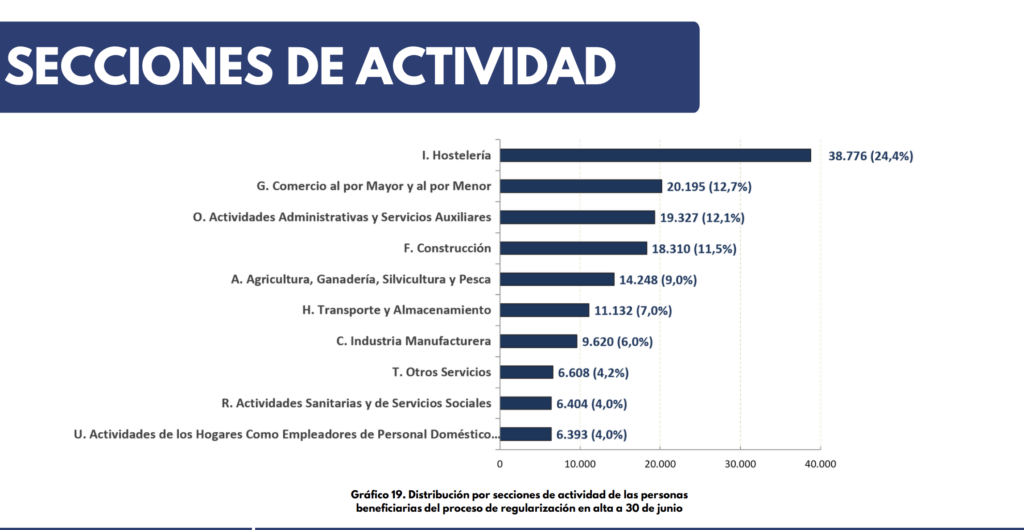
The largest industries employing newly regularised migrants are:
- Hospitality: 38,776 workers (24.4%)
- Wholesale and retail: 20,195 (12.7%)
- Administrative and support services: 19,327 (12.1%)
- Construction: 18,310 (11.5%)
- Agriculture, forestry and fishing: 14,248 (9%)
Hospitality alone accounts for almost three times as many workers as agriculture.
Myth: ‘They don’t learn the language’
Perhaps the most striking finding concerns language.
The government survey found that:
- 66% are native Spanish speakers
- 18% have a high level of Spanish
- 7% have intermediate proficiency
- 9% have only a basic level
That means 84% possess native or high-level Spanish, reflecting the large number of applicants from Latin American countries such as Colombia, Venezuela and Peru.
Myth: ‘They’re poorly educated’
The data also paints a more qualified workforce than many might expect.
Two-thirds (67%) have continued studying beyond compulsory education.
Breaking that down:
- 43% completed upper secondary education or vocational training.
- 24% hold a university qualification.
- 33% have only compulsory education.
- Just 10% report having no formal education.
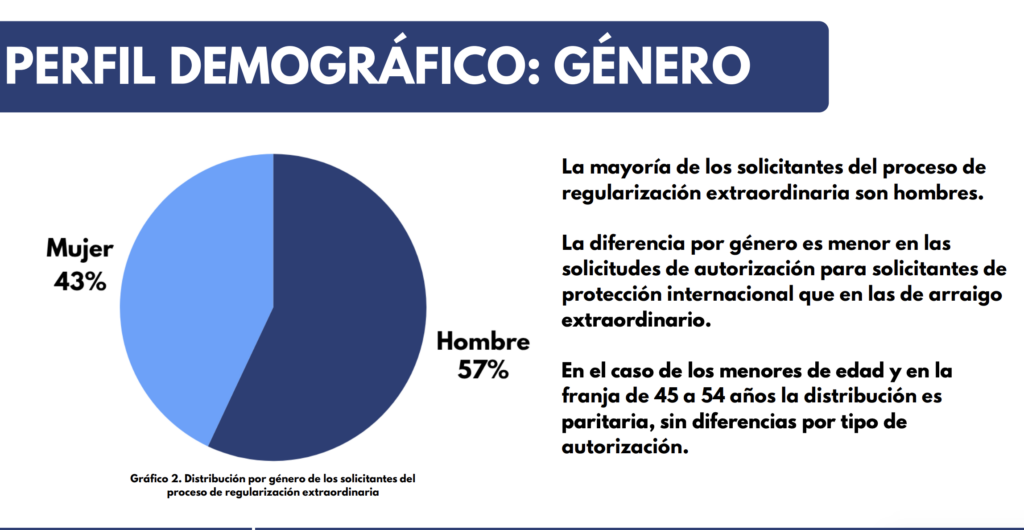
Myth: ‘It’s almost entirely young men’
Men are the majority, but not overwhelmingly so.
The government’s figures show that 57% of applicants have been male, with 43% being female.
Myth: ‘Regularisation means insecure, low-quality jobs’
The employment data suggests otherwise.
Among those who had already entered formal employment:
- More than three-quarters (77.3%) were hired on permanent contracts.
- Around 55% work full-time.
- Roughly 30% work part-time.
- Around 14% are fixed-discontinuous workers, a contract commonly used in tourism and seasonal industries.
What the figures don’t prove
The statistics do not settle the wider political debate over immigration.
They cannot answer questions about the long-term impact on housing, public services, crime, tax revenues or future migration flows.
Nor do they prove whether the regularisation policy itself will ultimately benefit or disadvantage Spain.
What they do provide, however, is the clearest demographic snapshot yet of the people applying for legal status.
The average applicant is more likely to be a working-age adult under 45, often from Latin America, who already speaks Spanish, has continued education beyond compulsory school and is moving into formal employment – most commonly in hospitality, retail, construction or administrative services.