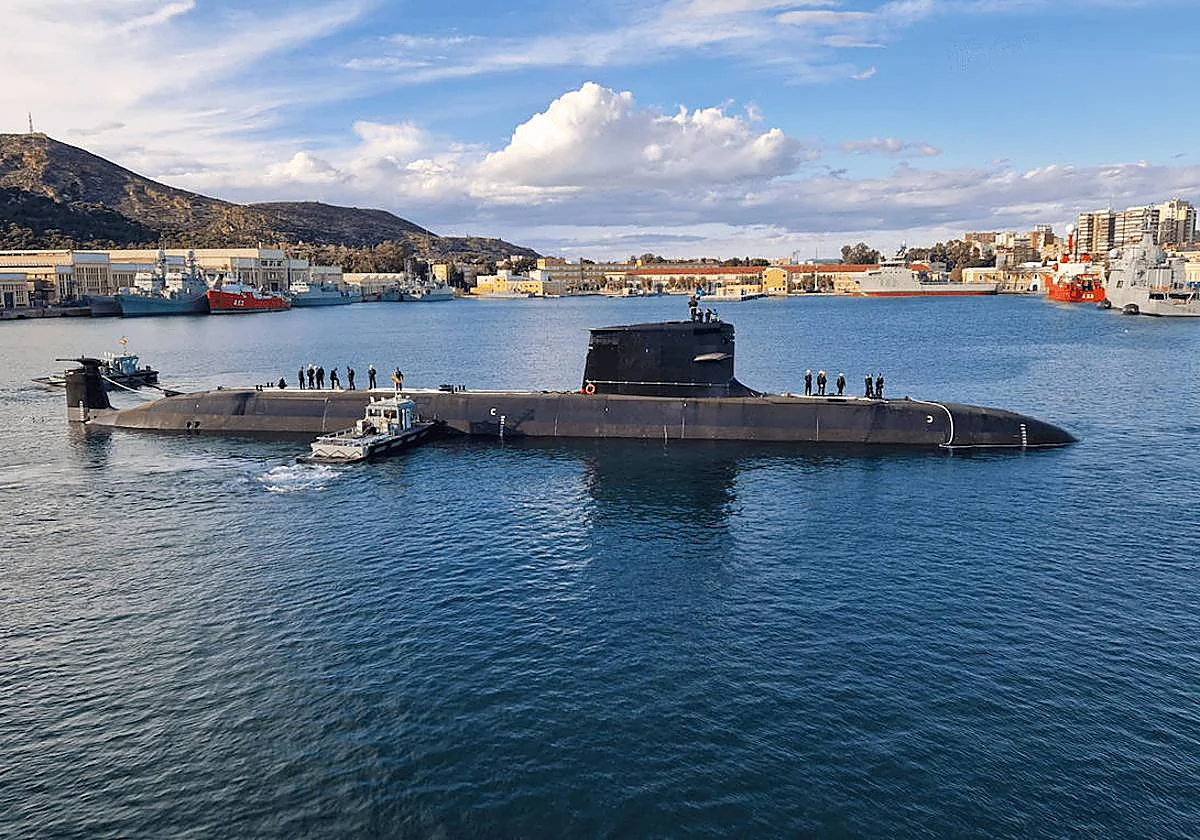

Defence company Navantia has begun testing a revolutionary propulsion system that will allow one of the Spain’s next-generation submarines to remain submerged for up to three weeks without surfacing.
The trials are taking place at Navantia’s shipyard in Cartagena and focus on the Air Independent Propulsion (AIP) system destined for the S-83 Cosme Garcia, one of four submarines being built under Spain’s ambitious S-80 programme.
The technology is designed to solve one of the biggest weaknesses of conventional submarines.
Traditionally, non-nuclear submarines rely on batteries that must be recharged every few days. To do this, they are forced to rise close to the surface and use a snorkel system to draw in air and power diesel engines.
That process significantly increases the risk of detection by enemy radar, thermal sensors and surveillance systems.
The new Spanish-developed system aims to eliminate much of that vulnerability.
Instead of storing large quantities of hydrogen under pressure, as some foreign systems do, Navantia’s design generates hydrogen onboard when it is needed.
The submarine uses bioethanol and liquid oxygen as its primary fuels. Through a specialised reformer, the bioethanol is converted into hydrogen, which is then fed into fuel cells that generate electricity for the vessel.
The result is a quieter and more efficient source of power that dramatically extends underwater endurance.
Engineers have already begun loading the key fuels for the first round of testing in Cartagena, while also evaluating the submarine’s ability to expel gases at operational depths without compromising its stealth capabilities.
If the trials are successful, the S-83 will be able to remain hidden beneath the waves for around three weeks at a time – a capability normally associated with far more expensive nuclear-powered submarines.
Military analysts regard extended underwater endurance as one of the most valuable advantages in modern naval warfare, allowing submarines to conduct surveillance, intelligence gathering and combat missions while remaining extremely difficult to detect.
The tests are also another milestone for Spain’s S-80 programme, which has become one of the country’s most significant defence projects.
The first vessel in the class, the S-81 Isaac Peral, has already entered service with the Spanish Navy, while the S-82 is currently undergoing harbour tests.
Construction continues on both the S-83 and the S-84.
Should the AIP system perform as expected, Spain will further strengthen its position within the small group of nations capable of designing and building advanced strategic submarines using largely domestic technology.
For Navantia, the project represents years of research and development. For Spain’s armed forces, it could deliver a significant boost in underwater operational capability at a time when naval security has become an increasingly important geopolitical priority.