
Millions of voters across Andalucia head to the polls on Sunday to elect the region’s next parliament – but Spain’s electoral system means not all votes carry the same weight depending on where you live.
The Parliament of Andalucia is made up of 109 seats, which are divided between political parties after each regional election.
Parties therefore need to reach the ‘magic number’ of 55 seats if they want to rule with an absolute majority. Anything below that figure and they will be forced to look for coalition partners to make up the numbers.
Unlike some countries that use a single national constituency, Andalucia’s elections are organised province by province.
That means each of the region’s eight provinces (Huelva, Sevilla, Malaga, Almeria, Jaen, Sevilla, Cordoba and Granada), allocates its own number of MPs based on the local vote.
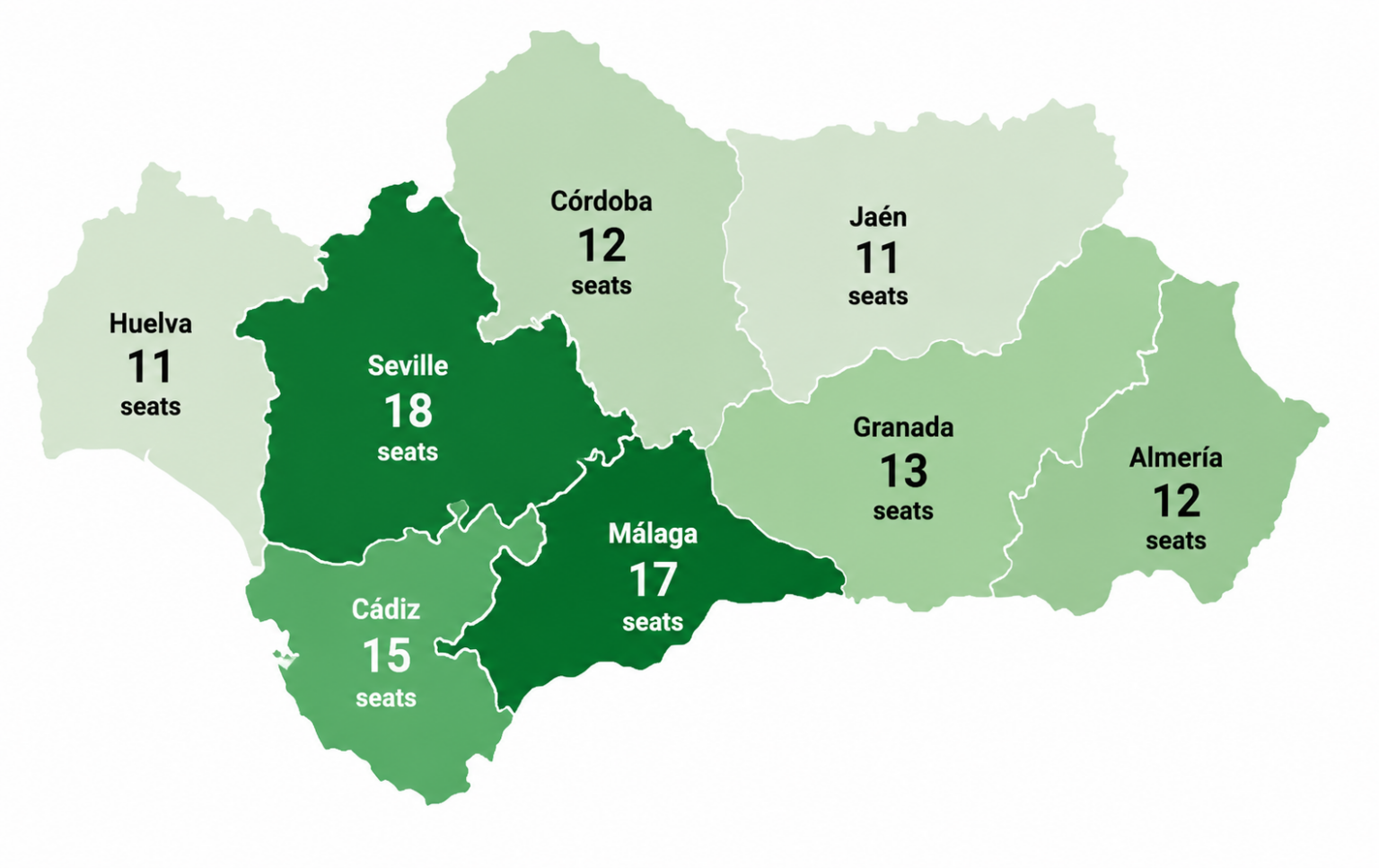
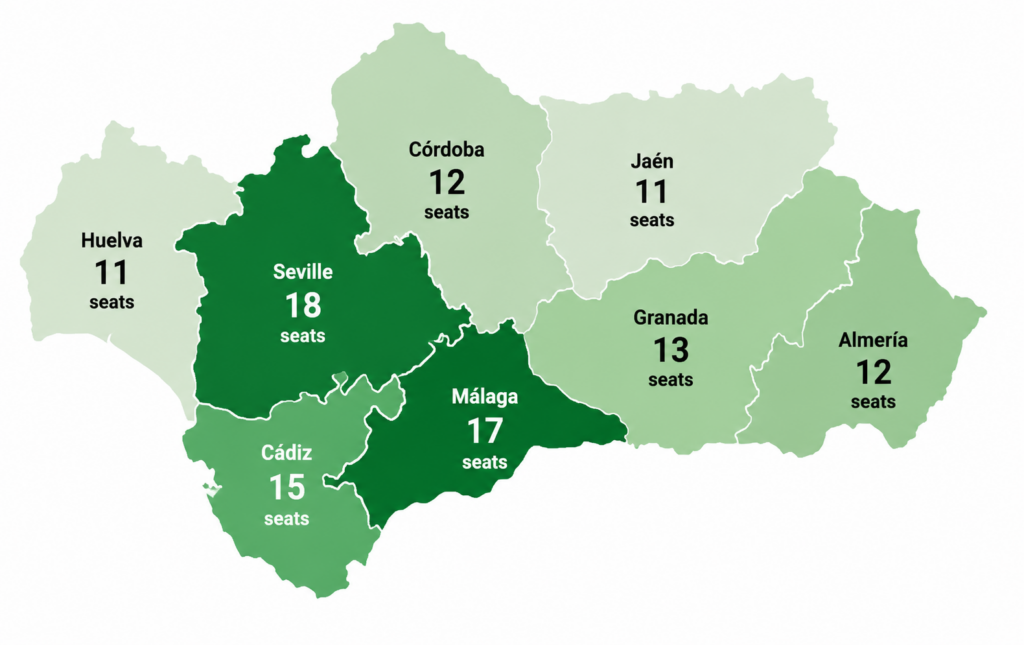
However, not every province distributes the same number of seats.
Under the Andalucian system, each province automatically receives eight parliamentary seats as a starting point – accounting for 64 seats in total.
The remaining 45 seats are then distributed according to population size.
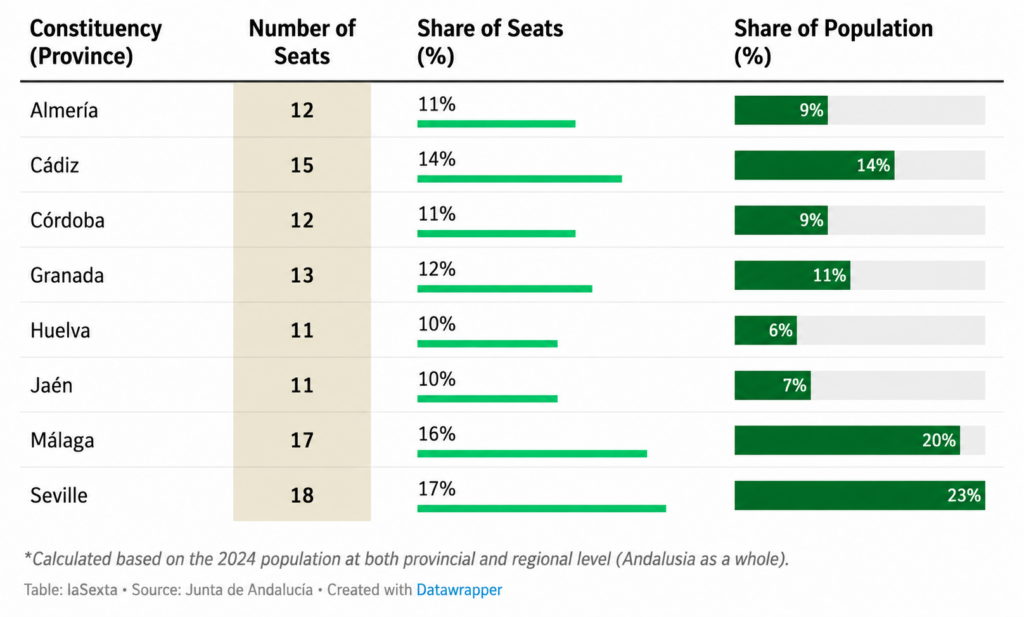
But the system also includes a territorial correction designed to favour smaller provinces, meaning larger provinces are underrepresented compared to their actual population share.
For example, Sevilla contains roughly 23% of Andalucia’s population, yet only distributes around 17% of parliamentary seats.
Meanwhile Huelva, one of the region’s least populated provinces with around 6% of Andalucia’s population, controls approximately 10% of the seats.
As a result, the number of votes needed to win a seat varies dramatically depending on the province.
In smaller provinces such as Huelva or Jaen, parties generally require far fewer votes to gain representation than they do in heavily populated areas like Sevilla or Malaga.
Based on 2026 electorate estimates, around 37,000 votes may be enough to secure a seat in Huelva.
In Sevilla, by contrast, more than 88,000 votes may be needed to achieve the same result.
The figures are not exact because turnout levels and the number of parties crossing the electoral threshold can significantly alter the final calculations.
In the last Andalusian election in 2022, the final seat awarded in Huelva reportedly required around 20,000 votes, while the final seat in Seville effectively required more than 40,000.
Another key factor is the 3% threshold.
Parties must obtain at least 3% of valid votes within a province to qualify for seat allocation there.
That creates an especially difficult environment for smaller and mid-sized parties, particularly in provinces where only a limited number of seats are available.
In practical terms, analysts often describe it as ‘easier’ to win seats in smaller provinces because the absolute number of votes needed is lower.
At the same time, though, the system can heavily punish parties that lack concentrated support, making it harder for smaller political movements to break through across the region.
The structure of the system is one reason why the final seats in provinces like Cordoba, Granada, Malaga and Cadiz are being so closely watched ahead of Sunday’s vote.
Those last few seats – often decided by narrow margins and leftover vote calculations known as ‘restos’ – could ultimately determine whether Juanma Moreno governs alone or depends on support from Vox.
How are seats calculated?
Parties are awarded seats inside each province according to the percentage of votes they receive there.
A party does not ‘win’ an entire province in the way US states work in presidential elections. Multiple parties usually win seats in every province.
For example, if there are 17 seats available in Malaga, the PP might win seven, PSOE five, Vox three and smaller left-wing parties the remaining two. The exact distribution depends on the vote totals.
The system used to decide this is called the D’Hondt system, a mathematical formula designed to distribute seats proportionally while slightly favouring larger parties.
It works by dividing each party’s vote total by a series of numbers: 1, 2, 3, 4, 5 and so on. The highest resulting figures are then ranked from largest to smallest until all seats in the province have been allocated.
Imagine Malaga has 17 seats and four parties. If the PP gets 340,000 votes, PSOE 250,000, Vox 120,000 and another party 60,000, each party’s total is repeatedly divided. The PP’s numbers would be 340,000, then 170,000, then 113,333, then 85,000 and so on. PSOE’s would also be divided in the same way.
The system then simply takes the 17 highest numbers overall. Every time a party appears in that ranking, it wins another seat.
This is why the ‘last seat’ in a province is often hugely important during election night. Sometimes a party can gain or lose a seat because of just a few thousand votes.
Analysts spend hours watching these final calculations because they can decide whether a government has a majority or needs support from another party.
Read more Andalucia news at the Spanish Eye.