
Spanish households enjoyed one of the strongest increases in real disposable income among developed economies last year, according to new data published by the OECD.
The organisation said Spain’s real household income – which measures earnings after inflation and taxes – rose by 1.5% in 2025, comfortably above the OECD average of 0.8%.
The figures come at a time when soaring living costs and Spain’s worsening housing crisis remain at the centre of political debate.
Pedro Sanchez’s government repeatedly insists that economic growth is filtering through to ordinary families via wage rises and redistributive policies.
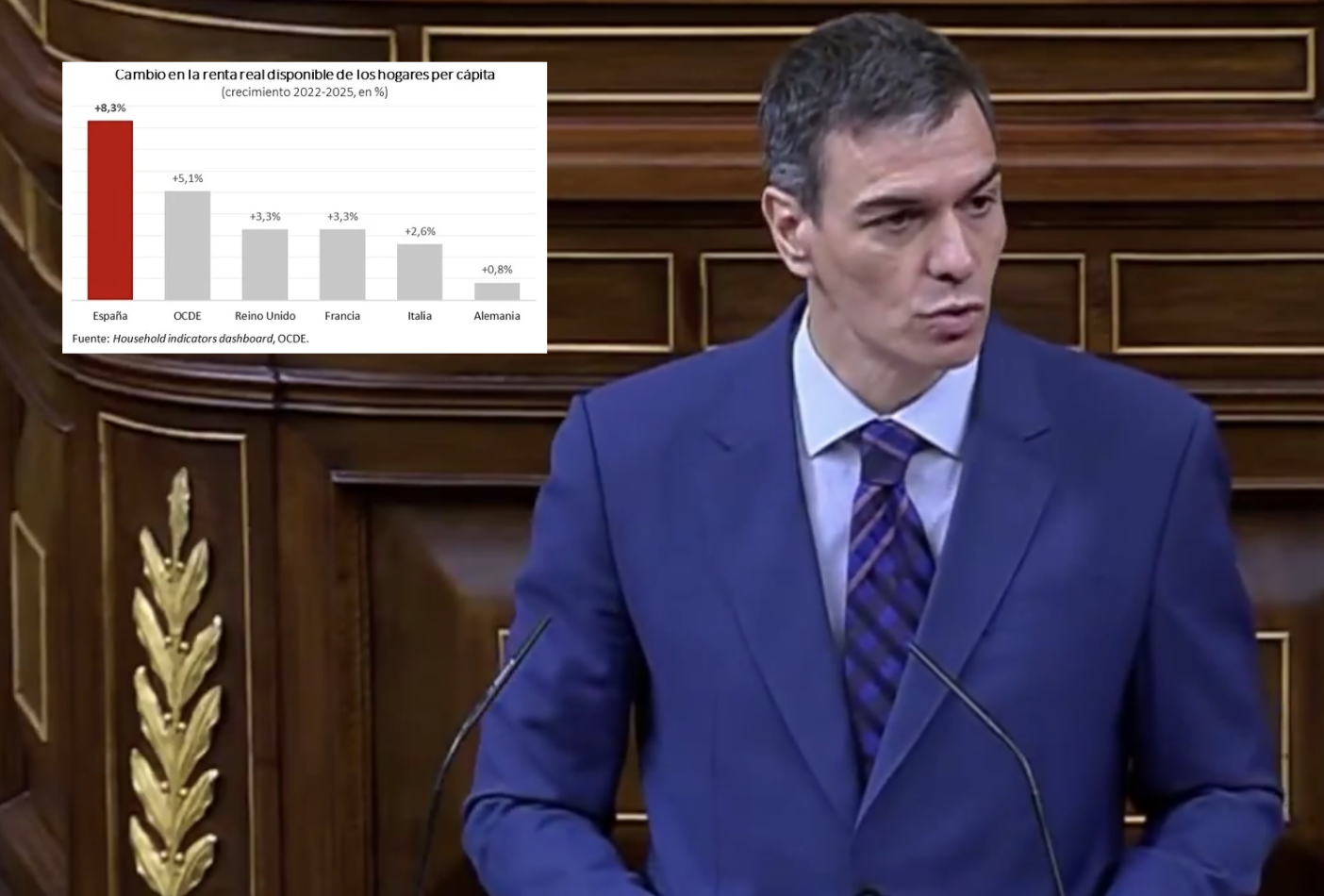
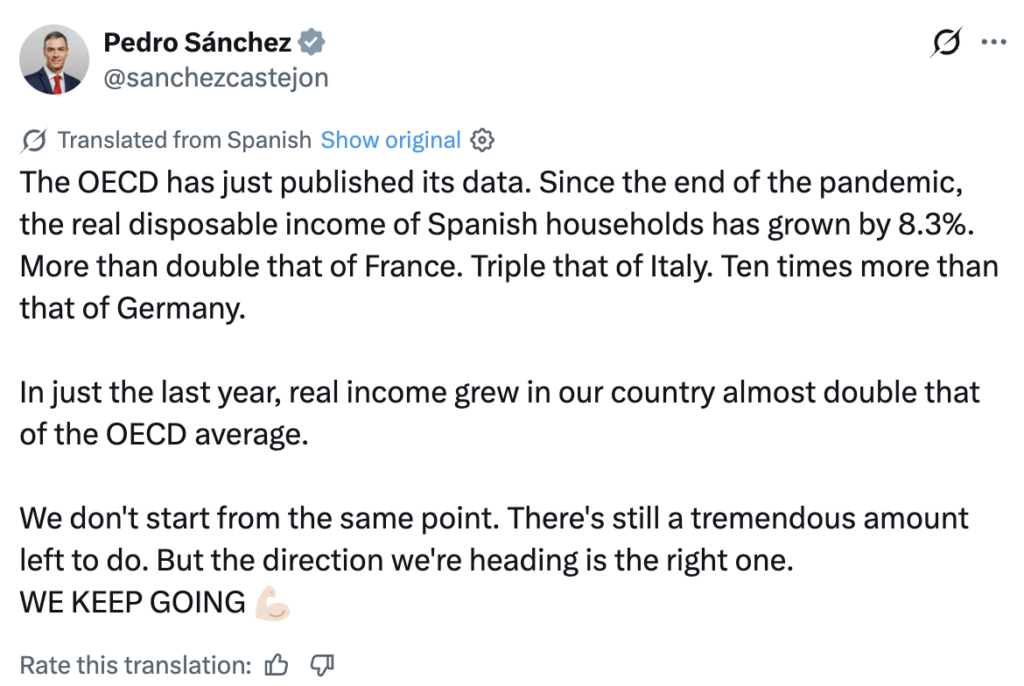
In a post on X on Thursday, the PSOE leader shared a graph showing how real disposable income in Spain has soared by 8.3% since 2022 – more than double the UK (3.3%).
He said: ‘The OECD has just published its data. Since the end of the pandemic, the real disposable income of Spanish households has grown by 8.3%. More than double that of France. Triple that of Italy. Ten times more than that of Germany.
‘In just the last year, real income grew in our country almost double that of the OECD average.
‘We don’t start from the same point. There’s still a tremendous amount left to do. But the direction we’re heading is the right one. WE KEEP GOING!’
Last year, Spain recorded the eighth-highest increase in real household incomes among the 20 OECD countries analysed.
The figure includes salaries, social benefits, property income and financial earnings, while accounting for taxes and inflation.
Although the increase was slower than the 3.1% growth recorded in 2024, Spain still significantly outperformed several major European economies.
Germany saw household incomes rise by just 0.6%, while France managed only a marginal 0.2% increase.
Italy, the eurozone’s third-largest economy, posted growth of 0.8%, still well below Spain’s figure.
Outside the EU, the US recorded a 1.2% increase and the UK 0.7%.
While the OECD report does not analyse the reasons behind each country’s performance, Spain benefited from several favourable factors during 2025.
Among them was a 4.4% rise in the minimum wage, which increased to €1,184 gross per month across 14 payments – a level the government says now represents 60% of Spain’s average salary.
Meanwhile, wages agreed through collective bargaining agreements rose by 3.56% during the year.
With average inflation standing at 2.67%, many workers effectively gained close to one percentage point in real purchasing power.
Earlier data from the Bank of Spain had also suggested lower-income households were among those seeing the biggest improvements in earnings during the inflation crisis triggered by the war in Ukraine.
Across the OECD overall, however, growth in household incomes slowed sharply in 2025, dropping from 2.1% in 2024 to 0.8%.
Austria recorded the steepest decline, with household incomes falling by 1.8% after strong growth the previous year.
Poland once again topped the rankings with a 4.1% increase, although that was still well below the 7.8% rise it recorded in 2024.
Chile and the Netherlands followed with gains of 2.3% each.