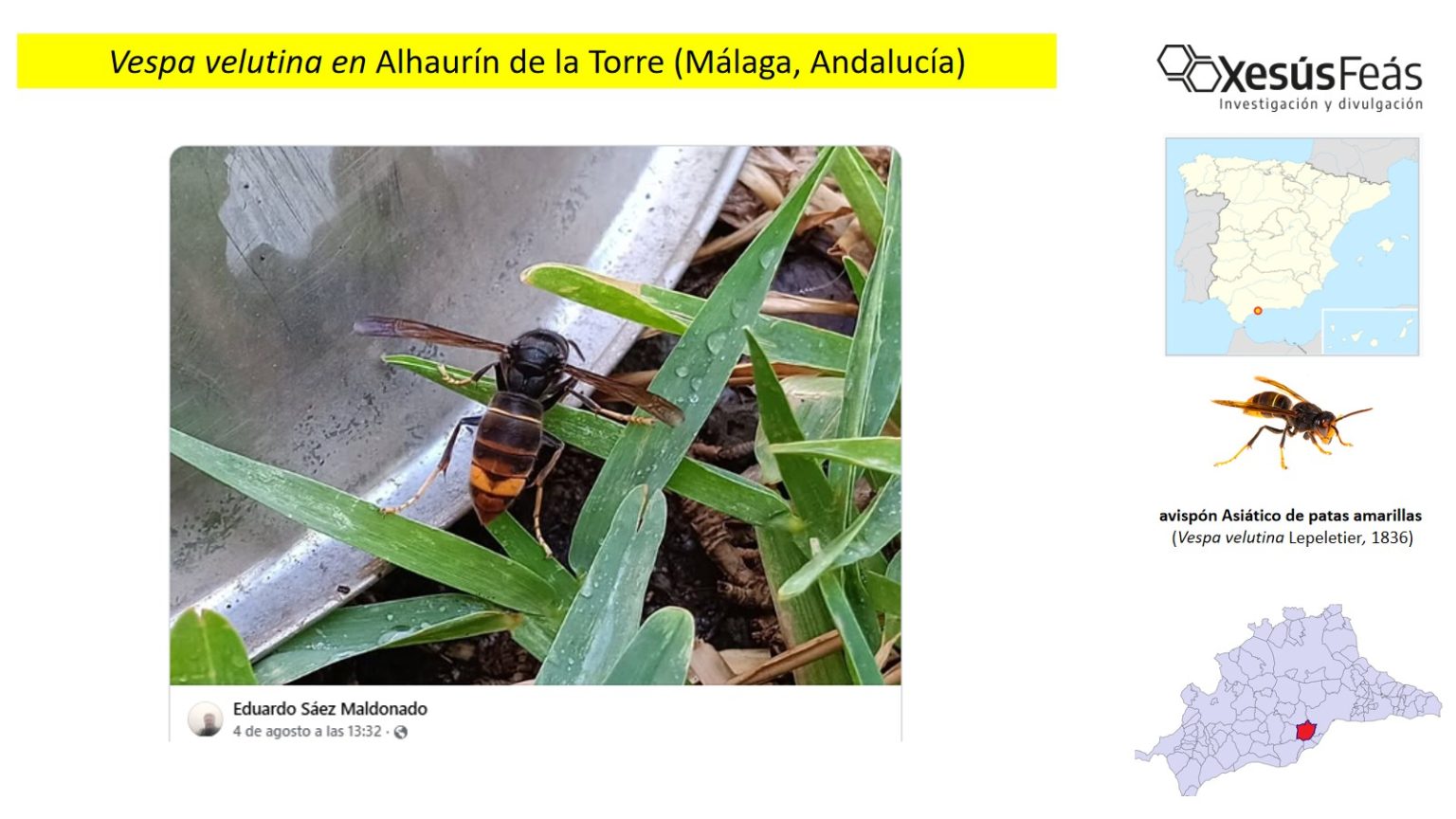

The first ever Asian hornet (Vespa velutina) nest has been discovered in Malaga province.
The nest was located in the Pinos de Alhaurin residential area, in the town of Alhaurin de la Torre.
This invasive wasp species, originally from Asia, had been spotted in the area earlier this summer, according to Eduardo Saez, a biologist who lives in the area.
The Asian hornet first arrived in Spain in 2010 via France, the first European country where it was recorded.
Until now, sightings in Spain had mostly been limited to the north, with no confirmed presence in the south. Saez notes that the only previous southern sighting was a single nest found in Algeciras (Cadiz) in 2022.
Local beekeepers were the first to raise the alarm after noticing the hornets attacking hives.
‘They go for bee colonies and cause serious damage,’ Saez explained to Malaga Hoy.
As a local resident, he’s been closely involved in the efforts to locate the nest.
Once the presence of the hornet was confirmed in Pinos de Alhaurin, neighbours alerted both the Andalucian regional government and the local council.
Finding the nest wasn’t easy. Saez describes a months-long process involving traps with food and water, regular monitoring, and searches through dense vegetation – much of it on private land and hard to access.
Step by step, the search was narrowed down, and the nest was finally located last Friday with the help of thermal cameras and a group of volunteers.
The next stage is removing the nest. According to Saez, this is essential to stop the spread of a highly invasive species.
‘There’s only one nest confirmed so far, so it should be relatively easy to contain. The real issue is when you don’t act fast enough. That’s why detecting this one was so important,’ he said.
The Junta de Andalucia will carry out the removal. It won’t be simple as the nest is around 10 metres off the ground and measures 30 to 40 cm in radius.
The operation will involve special protective gear, injecting insecticide, and extreme caution.
‘They’re usually harmless when foraging, but if they feel threatened, they will defend themselves,’ Saez warned. On top of that, the removal must be done at night.
Saez stressed how critical it is to destroy the nest before the hornet spreads any further, warning against a repeat of the eastern hornet invasion – another non-native species that reached southern Spain and rapidly spread through the Costa del Sol, Cadiz, and Granada, becoming virtually unstoppable.
Read more Andalucia news at the Spanish Eye.