
Spain’s two largest trade unions have agreed to stage a 24-hour walkout over housing costs and low salaries before Spaniards go to the polls on November 29.
The CCOO and UGT announced on Monday evening that they had agreed to call the strike this autumn, although the decision must still be formally ratified by their senior governing bodies.
A date has yet to be fixed, but union sources have indicated that it is likely to take place in early November, before Spain’s snap general election but outside the official campaign period.
It will be the first general strike supported by both the CCOO and UGT since Pedro Sanchez became prime minister in 2018.
‘Workers need decent salaries to access decent housing,’ the unions said in a joint statement.
‘The demonstrations last weekend showed the strength of that demand, and the response must be built by all the organisations supporting it.’
Date to be agreed with tenants
The final date will be discussed with the Sindicato de Inquilinas tenants’ union and other social, neighbourhood and housing organisations.
The unions said the objective was to persuade workers across Spain to participate in a 24-hour stoppage ‘for the right to housing and salaries that are sufficient to pay for it’.
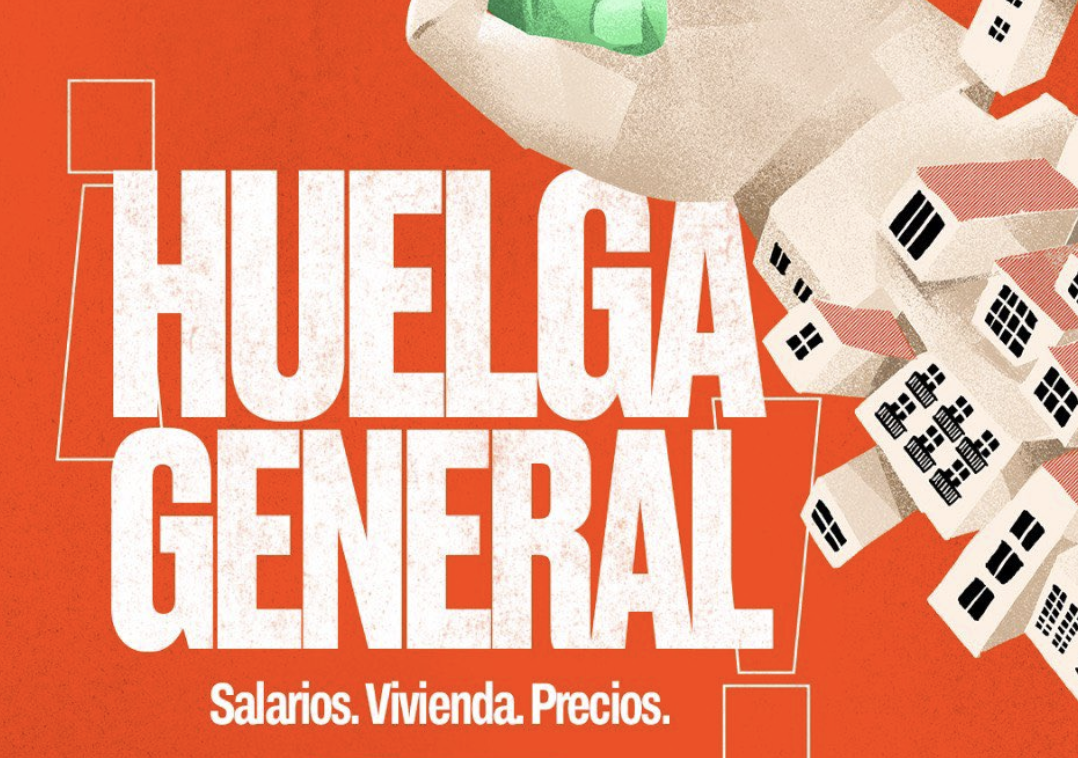
CCOO published a poster on Monday carrying the message: ‘For a decent salary, a roof over our heads and for prices to stop suffocating us.
‘We work to live, not to pay. We know that struggle and organisation are the only way forward.
‘That is why… we’re going on general strike.’
The accompanying image carried the slogan: ‘General strike: wages, housing, prices.’
UGT general secretary Pepe Alvarez said the strike would not be held during the formal election campaign, which is scheduled to run from November 13 to 27.
The announcement means the stoppage could take place during the first fortnight of November.
Pressure grows after weekend protests
The decision follows demonstrations in 54 Spanish cities over the weekend, during which protesters demanded lower rents, stronger tenant protections and the expropriation of homes owned by so-called vulture funds.
The largest protest took place in Madrid, where organisers claimed 500,000 people joined marches converging on Plaza de Cibeles. The Government Delegation put the attendance at around 70,000.
The movement was initially being driven by the Sindicato de Inquilinas and the smaller CGT union, whose newly re-elected general secretary Miguel Fadrique said anything short of a full 24-hour stoppage would have little impact.
The tenants’ union subsequently increased the pressure on CCOO and UGT, arguing that the support of Spain’s two largest labour organisations would be essential to secure widespread participation.

Housing decrees defeated
The mobilisation follows the defeat of the Sanchez government’s two emergency housing decrees in Congress on Friday.
PP, Vox and Junts voted against the measures, which included longer protections against evictions, automatic extensions to certain rental contracts and restrictions affecting investment funds buying residential property.
The parliamentary defeat prompted Sanchez to dissolve Parliament and call a snap election for November 29.
CCOO and UGT had supported the decrees, although they argued that further measures would be required to address Spain’s housing emergency.
The unions now want the election campaign to focus on rents, property prices and salaries.
Their proposals include building a larger permanent stock of public housing, imposing rent controls, ensuring that the national Housing Law is applied throughout Spain and including housing costs in negotiations over salary increases.
They are also seeking pay rises of between 4% and 7%, salary-review clauses linked to living costs and an end to delays affecting collective bargaining agreements.
Unions target governments and employers
CCOO and UGT stressed that the action would not be aimed exclusively at the national government.
Spain’s regional governments and town halls hold many of the powers covering housing, planning, social accommodation and tourist rentals.
‘The general strike challenges the different public administrations with housing responsibilities, as well as employers’ organisations, which must accept that salaries have to guarantee access to a basic necessity such as housing,’ the unions said.
‘We will continue mobilising and negotiating collectively until housing stops being a privilege and salaries allow people to live with dignity.’
Employers question legality
Spain’s main business association has questioned whether a general strike over housing would be lawful.
CEOE president Antonio Garamendi said housing was a ‘real’ and ‘complex’ problem but argued that it did not constitute a workplace dispute.
He maintained that demonstrations were legitimate but claimed a strike must be connected to an employment conflict.
The unions reject that interpretation.
They argue that Constitutional Court and Supreme Court case law allows strikes with mixed social and employment-related objectives, even though purely political strikes are prohibited.
CCOO and UGT maintain that housing costs have a direct impact on workers’ living standards and salary negotiations, giving the proposed walkout a clear labour dimension.
First major stoppage since 2012
The last general strike backed jointly by CCOO and UGT took place in November 2012, when workers protested against austerity measures and labour reforms introduced under Mariano Rajoy’s PP government.
CGT called another nationwide stoppage over Gaza in October 2025, but CCOO and UGT supported only partial walkouts and did not endorse the full general strike.
Their participation this time gives the housing strike considerably greater potential to disrupt businesses, transport and public services.
Government figures show that UGT and CCOO were involved in signing 628 and 619 collective agreements respectively last year, compared with 51 involving CGT.
The scale of the eventual disruption will depend on the selected date, the sectors joining the action and whether negotiations produce concessions before it takes place.