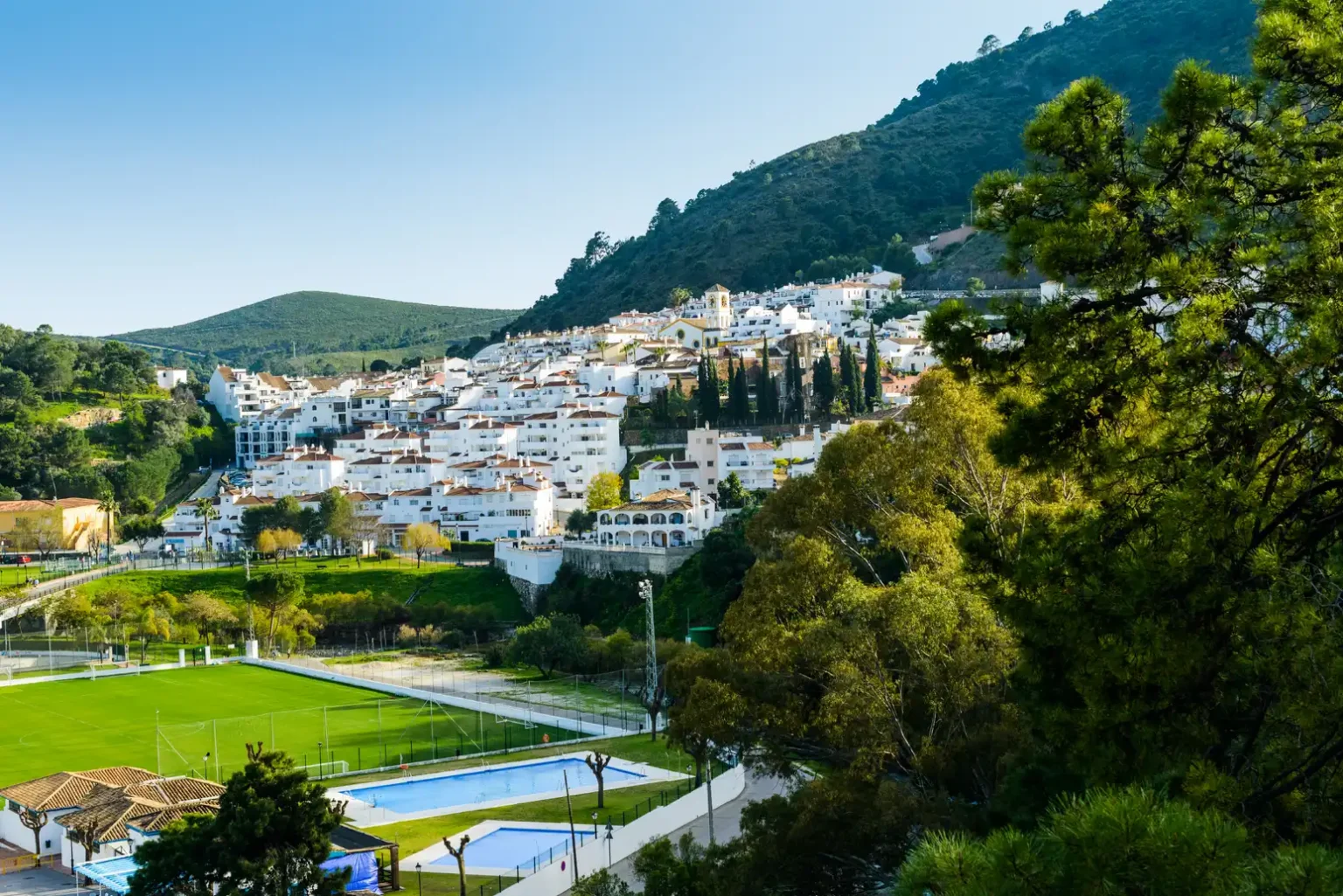

Benahavis has been named the richest municipality in Andalucia and the second wealthiest in Spain by average declared income.
Residents in the exclusive Costa del Sol enclave reported an average gross income of €79,041, according to the latest municipal data published by the national Tax Agency.
That places Benahavis comfortably above the other 565 Andalucian municipalities included in the figures.
Its average income is 5.4 times higher than that of Guadahortuna in Granada, which sits at the bottom of the regional table with €14,514.
However, the extraordinary Benahavis figure comes with an important caveat as its median income is only €26,657.
The median represents the person in the middle when all taxpayers are arranged from lowest to highest income.
It is often considered a better reflection of what a typical resident earns because a small number of extremely wealthy taxpayers can dramatically inflate the average.
Average almost three times the median
In Benahavis, the average income is nearly three times its median, representing the largest such gap among the 566 Andalucian municipalities analysed.

This suggests that its headline figure of €79,041 is being pulled upwards by a relatively small group of exceptionally high earners.
The next-largest gap is found in San Roque (home to Sotogrande), where the average is 1.64 times the median, followed by Mojacar at 1.48.
At the other end of the scale is Trebujena in Cadiz, where the average income of €23,368 is only slightly higher than its €22,178 median.
Benahavis is one of only two Andalucian municipalities to appear among Spain’s 100 wealthiest by average income.
The other is Tomares in Sevilla province, which ranks 97th nationally with €41,622, little more than half the Benahavis figure.
Rich neighbours separated by enormous gulf
Benahavis also accounts for Andalucia’s three largest income gaps between neighbouring municipalities.
Its average exceeds that of nearby Istan by €50,761, Estepona by €48,335 and Marbella by €44,870.
The next-biggest divide is between San Roque, where average income stands at €40,033, and San Martin del Tesorillo, at €21,459.
That €18,574 difference is less than half the gap between Benahavis and Marbella.
The picture changes considerably when municipalities are ranked by median rather than average income.
Tomares leads Andalucia with a median of €32,734, followed by Espartinas at €31,466 and Castilleja de Guzman at €29,173.
Mairena del Aljarafe comes next at €28,997, followed by Aljaraque with €28,947.
Using this measure, the distance between Andalucia’s highest and lowest-income municipalities falls from a multiple of 5.4 to 2.7.
Sevilla dominates wealth rankings
Sevilla province accounts for five of the 10 Andalucian municipalities placed highest in the national ranking: Tomares, Espartinas, Bormujos, Valencina de la Concepcion and Mairena del Aljarafe.
Malaga province contributes Benahavis and Rincon de la Victoria, while San Roque represents Cadiz, Granada city represents its province and Aljaraque represents Huelva.
A total of 39 Andalucian municipalities have an average gross income of at least €30,000.

Twelve are in Sevilla province, 10 in Granada, eight in Malaga, five in Cadiz, two in Jaen and one each in Cordoba and Huelva.
No municipality in Almeria reaches the €30,000 threshold. The provincial capital comes closest with an average of €29,688.
Which Andalucian capital is richest?
Granada has the highest average income among Andalucia’s eight provincial capitals, at €35,414.
It is followed by Cadiz at €34,676, Sevilla at €34,032 and Malaga at €31,949.
Cordoba records €31,226, Jaen €30,649 and Almeria €29,688.
Huelva sits at the bottom of the list with an average gross income of €28,552.
Several very small villages outperform the Huelva capital, including Viznar in Granada, Añora in Cordoba and Huetor de Santillan in Granada. Each has fewer than 2,000 residents.
Across the 566 municipalities analysed, 39 places with average incomes above €30,000 contain 38.3% of the population.
By contrast, the 179 municipalities where the figure remains below €20,000 account for just 7.8% of residents.