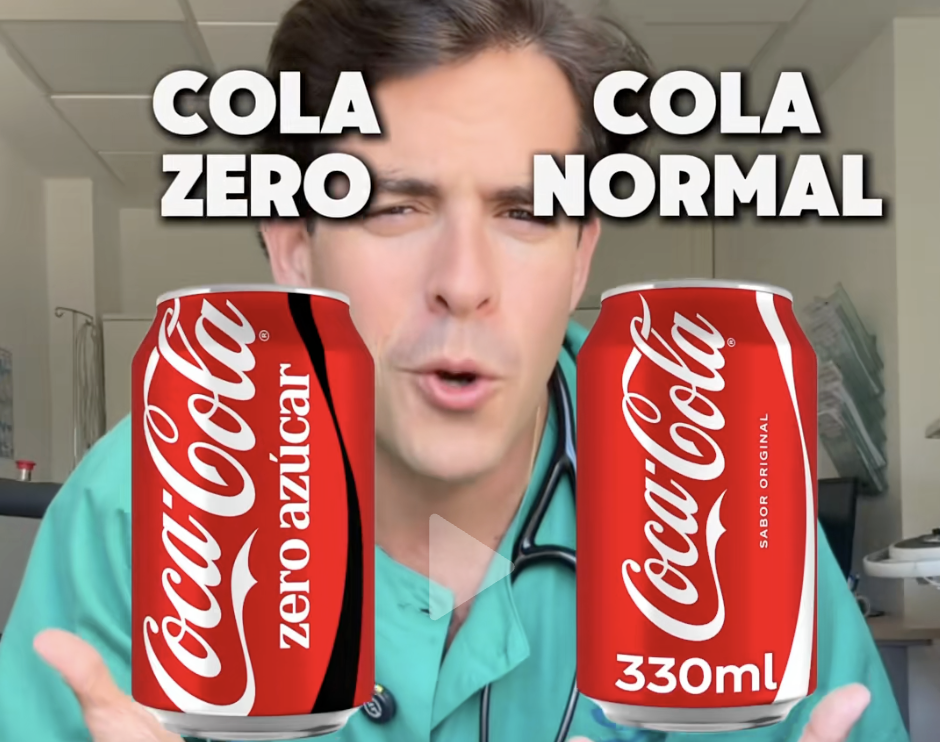

Coke Zero may be a better choice for your health than the full-sugar original despite concerns surrounding the artificial sweetener aspartame, according to a Spanish cardiologist.
Dr Aurelio Rojas has weighed up the two versions of the world’s best-known fizzy drink, pointing to the stark difference in their sugar and calorie content.
A regular cola can contain around 39g of sugar and 140 calories, while its Zero counterpart contains virtually no sugar or calories.
But the latter achieves this partly through artificial sweeteners including aspartame, which has attracted considerable attention since the World Health Organization’s cancer research agency classified it as ‘possibly carcinogenic to humans’ in 2023.
For Rojas, it is clear that the regular, sugar-loaded version is worse for your health, but that doesn’t mean Coke Zero is good for you.
Aspartame warning?
The International Agency for Research on Cancer (IARC), part of the WHO, classified aspartame as ‘possibly carcinogenic to humans’ after finding limited evidence of an association with hepatocellular carcinoma, a form of liver cancer.
However, that classification does not mean normal consumption of aspartame has been shown to cause cancer.
At the same time as the IARC announcement, the Joint FAO/WHO Expert Committee on Food Additives reviewed the available evidence and found insufficient reason to change the established acceptable daily intake.
That remains 0–40mg of aspartame per kilogram of body weight per day.
To put that into perspective, according to the WHO figures cited in the report, a 70kg adult consuming a diet soft drink containing around 200–300mg of aspartame would need to drink more than nine to 14 cans per day to exceed the acceptable daily intake, assuming they consumed no aspartame from other sources.
Dr Francesco Branca, the WHO’s Director of Nutrition and Food Safety, has previously said that safety is not a major concern at the quantities people typically consume, although potential effects warrant further, better-quality research.
So is Coke Zero healthy?
Rojas’s argument is not that drinking large quantities of artificially sweetened soft drinks is beneficial, but that when choosing between regular and zero-sugar cola, the latter avoids the substantial dose of added sugar and empty calories.
Aspartame is widely used in thousands of sugar-free or reduced-calorie products, ranging from soft drinks and chewing gum to yoghurt, desserts and some medicines.
Rojas argues that even if future research ultimately found greater cause for concern about aspartame than currently established, it would still have to be weighed against the known nutritional impact of repeatedly consuming large quantities of sugar.
‘Can you imagine drinking 14 cans of zero cola in a single day? Neither can I,’ he said, ‘And that’s precisely the point.’
He added that even if the science surrounding aspartame ultimately proved more concerning, it would still be necessary to explain how consuming 39g of sugar and 140 empty calories per can represented the safer alternative.