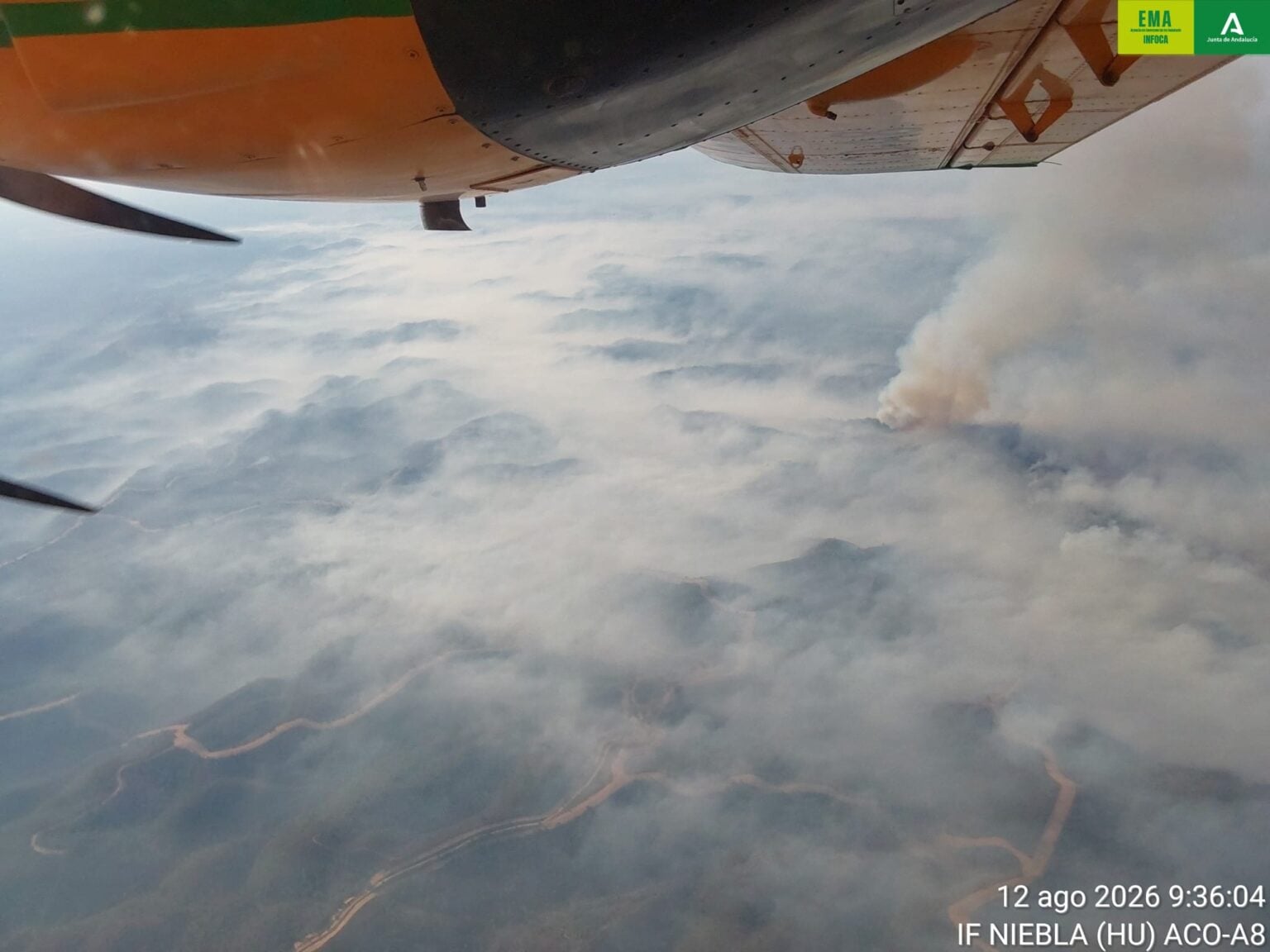

The enormous wildfire raging across Huelva and Sevilla has now reached a perimeter of at least 28,000 hectares as firefighters approach a full week battling the blaze.
The Niebla fire endured what authorities described as a ‘frankly complex’ night into Wednesday, with powerful fire jumps, unfavourable winds and a temperature inversion complicating efforts.
However, Antonio Sanz, the regional minister for Emergencies, said on Wednesday that crews had managed to ‘progressively slow’ the growth of the fire.
‘The day before yesterday we managed to reduce its growth by 50% compared with the previous day, and yesterday by another 50%,’ he said.
‘In other words, yesterday it grew by only 25% compared with two days earlier.’
Sanz nevertheless warned that extinguishing the enormous blaze remained a ‘long-distance race full of obstacles’.
Dramatic overnight battle
Some of the most difficult conditions were recorded on the north-western flank overnight.
Authorities reported ‘abnormal’ fire behaviour, including major spot fires which managed to jump ahead even against the prevailing wind.
Some 15 firefighting crews involving around 120 professionals, together with heavy machinery, were rushed towards the area to prevent the flames advancing towards El Pozuelo, in the municipality of Zalamea la Real.
Sanz said firefighters succeeded in stopping the new outbreaks from becoming established.
Despite the area remaining evacuated, authorities said there had been no direct threat to residents.
Attention has now shifted to Wednesday’s difficult weather conditions.
Winds began the day blowing from the east but are expected to rotate clockwise before eventually coming from the south-west during the afternoon.
Strong gusts are expected, with the most critical period potentially arriving around midday.
Convective activity and flying embers are creating further difficulties, while a morning temperature inversion delayed the deployment of aircraft.
Solar eclipse
Wednesday’s solar eclipse is also having an unusual impact.
According to Sanz, firefighting aircraft will have to cease operations at 7.30pm under nationwide aviation restrictions imposed by Spain’s Aviation Safety and Security Agency (AESA) in connection with the eclipse.
‘It’s a general aviation safety measure that affects us directly, but ground crews will continue fighting on the ground,’ Sanz said.
The restriction comes at a particularly difficult moment, with several sections of the fire still active.
One of the main areas of concern is around Berrocal, which has been surrounded by the fire although authorities say its infrastructure has escaped damage.
Crews are also concentrating on the eastern sector around Pata del Caballo, in Escacena del Campo, where they are trying to stop the flames crossing the road between El Alamo and Aznalcollar.
Conditions on the southern flank are considerably better, with authorities describing it as much more stable.
Almost 700 firefighters and emergency workers deployed
The emergency remains at Operational Situation 2 under the Infoca plan, with 695 personnel and 257 resources mobilised.
The vast operation includes Infoca firefighters, the Military Emergency Unit (UME), provincial fire brigades and emergency services.
Chef Jose Andres’s World Central Kitchen is also supporting the response.
Meanwhile, 681 people remain displaced as a precaution.
Authorities are continuing to allow residents limited access to evacuated areas for urgent reasons, including caring for animals and collecting medication.
However, Sanz said residents would not be allowed to return permanently to their homes on Wednesday.
A total of 11 roads across Huelva and Sevilla remain closed because of the fire.
Read more Andalucia news at the Spanish Eye.