
Police are probing the cause of the enormous Niebla wildfire amid speculation that a discarded cigarette butt may have started the blaze, which has now spread from Huelva into Sevilla province.
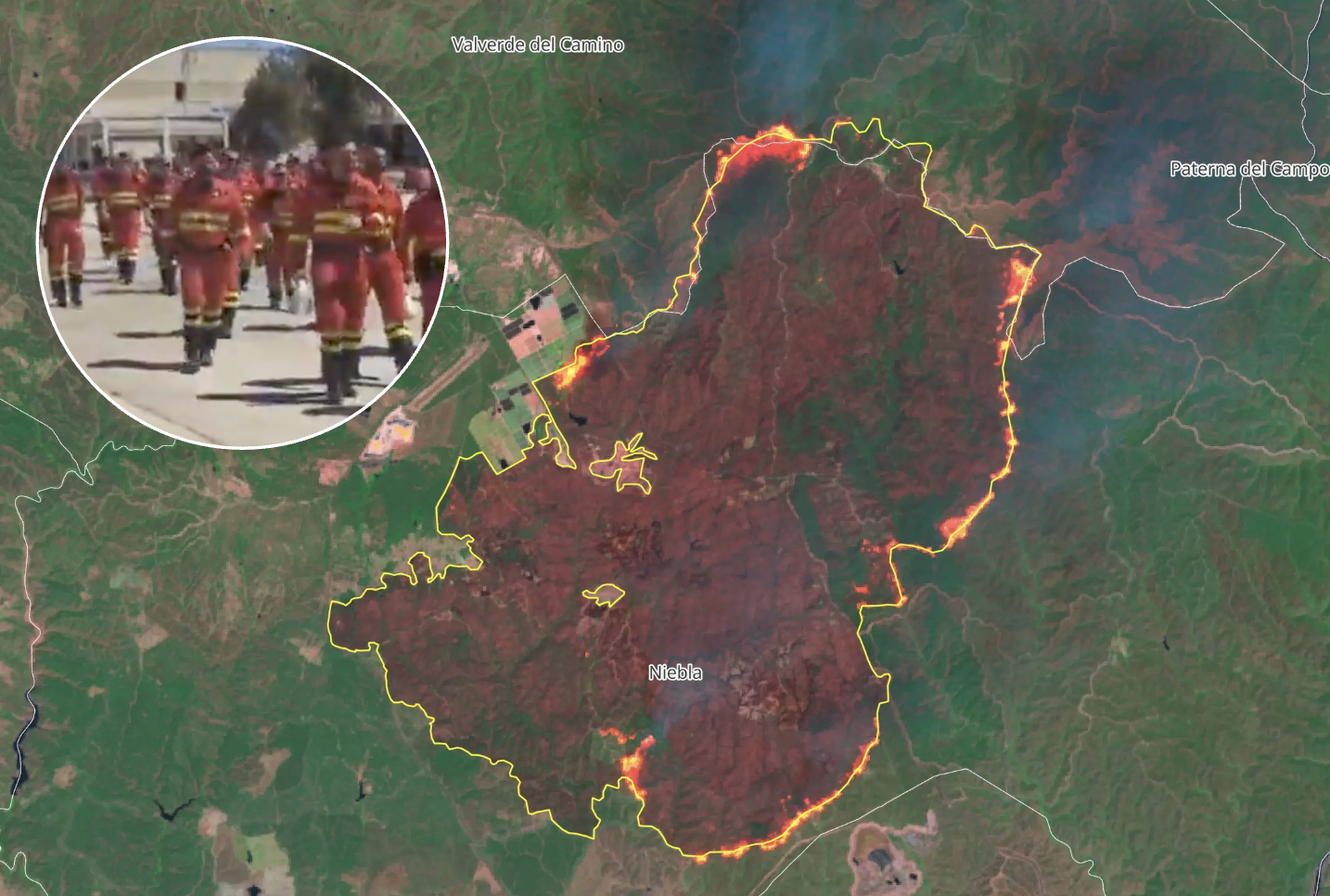
The fire, which began near Niebla in Huelva last Thursday, August 6, has now swept across an estimated 25,000 hectares, forced around 800 people from their homes and crossed the provincial boundary into Sevilla.
Francisco Toscano, acting Spanish government delegate in Andalucia, urged people to exercise ‘caution’ over claims circulating about how the devastating blaze began.
Investigations by the Guardia Civil’s environmental protection unit, Seprona, and the specialist Forest Fire Investigation Brigade (BIIF) remain at a ‘very early stage’.
‘We are aware that there are some theories outside the investigation, but I insist that all hypotheses remain open,’ Toscano said.
‘Until the Seprona investigation has been concluded, we are not going to make any statement in that regard.’
It means the suggestion that a poorly extinguished cigarette triggered the disaster remains merely a theory.
Meanwhile, the scale of the emergency continues to grow.
The Junta estimates that the fire has now covered approximately 25,000 hectares, although regional emergency chief Antonio Sanz stressed that this does not mean every hectare within that area has been burned.
Authorities are awaiting satellite imagery from the EU’s Copernicus programme to establish the definitive perimeter and determine which areas have been destroyed and which escaped the flames.
The fire has now officially entered Sevilla province, where what authorities described as an ‘important hotspot’ has been detected within the municipality of Aznalcollar.
Gonzalo Dominguez, vice-president of Sevilla’s provincial firefighters’ consortium, said the flames remained well away from the town itself and sought to reassure residents.
The fire has not entered the municipality of El Madroño, according to authorities, although the town and its four hamlets – El Alamo, Juan Anton, Juan Gallego and Villargordo – remain evacuated as a precaution.
Some 61 evacuees were accommodated in El Castillo de las Guardas, with 26 spending the night on camp beds. Most of the remaining 286 residents evacuated from El Madroño found somewhere to stay with relatives or friends.
Across all affected areas, around 700 people remain displaced from Niebla, Berrocal, Villarasa, Zalamea la Real and El Madroño.
There are now ‘many possibilities of a favourable evolution’ after winds eased, Dominguez said.
However, Sanz warned that the emergency was far from over.
‘It’s a fire that still has days of work ahead because its extent and perimeter remain very large,’ he said.
Teams must work ‘metre by metre’ to secure the perimeter and prevent the blaze from reigniting.
More than 650 firefighters and personnel deployed
A huge operation remains underway, involving up to 652 personnel, including Plan Infoca firefighters, Spain’s Military Emergency Unit (UME), provincial firefighting teams from Huelva and Sevilla and a unit deployed from Caceres.
Up to 26 aircraft and 14 bulldozers are available to tackle the blaze.
The extraordinary behaviour of the wildfire has produced secondary fires as far as 3.5km ahead of the main front, at times making direct firefighting operations too dangerous.
Smoke from the blaze has also prompted warnings to residents, with people advised to close doors and windows and take particular precautions with children, the elderly and those with respiratory problems.
Meanwhile, 11 secondary roads remain closed, eight in Huelva and three in Sevilla.
The emergency remains at operational situation 2 under Andalucia’s wildfire emergency plan.
Guardia Civil searches for cause
Some 312 Guardia Civil officers have been deployed since the emergency began, helping with evacuations, securing affected areas and supporting firefighting operations.
At the same time, Seprona specialists are gathering evidence to establish exactly where and how the wildfire began.
Their investigation will ultimately determine whether the cigarette-butt theory or any of the other explanations currently circulating has any basis.
The investigation could also establish whether any individual or organisation bears responsibility for starting the fire.
Meanwhile, El Madroño mayor Antonio Lopez warned that despite calmer conditions close to his municipality, another tongue of fire advancing towards Zalamea la Real and Pata del Caballo remained a concern.
‘The fire is not under control at all,’ he said.
Calls for year-round wildfire response
The leader of the PSOE in Andalucia, Maria Jesus Montero, has meanwhile called for a new approach to wildfire prevention and response, arguing that reinforced services should be fully operational ‘365 days a year’.
Montero described the Niebla blaze as the ‘largest and most difficult to extinguish in the recent history of Andalucia’ and linked increasingly violent wildfires to climate change.
‘Climate change is an unquestionable reality,’ she said, arguing that Andalucia must prepare for a ‘new climate’ capable of producing increasingly extreme events.
She called on Junta president Juanma Moreno to review the region’s preparedness once the immediate emergency has ended and said future decisions should be based on ‘scientific evidence and not political interests’.
Read more Andalucia news at the Spanish Eye.