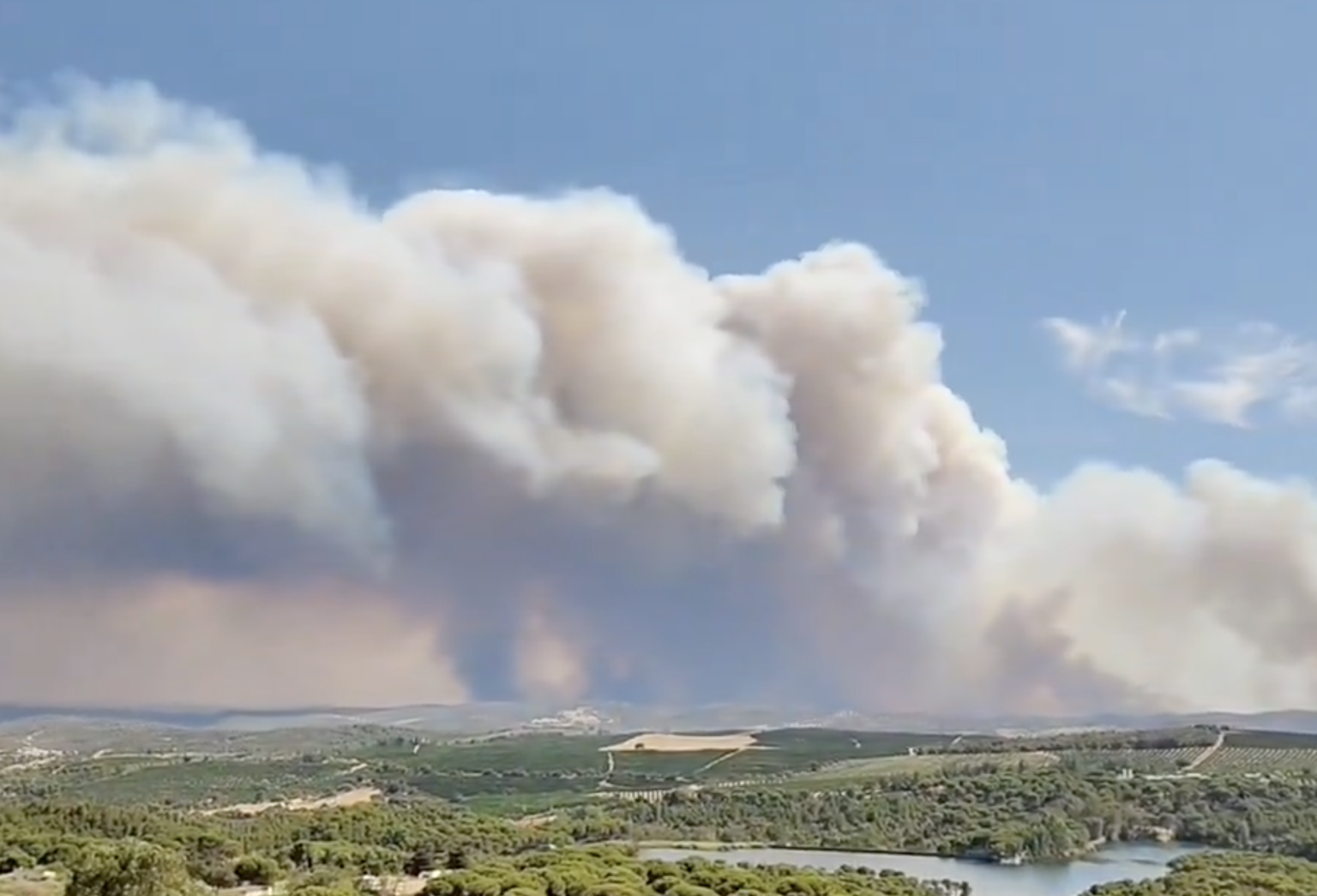

Firefighters are battling to prevent a huge wildfire in Huelva from reaching nearby towns and spreading into Sevilla province.
Around 500 personnel, 178 ground resources and as many as 26 aircraft were deployed to tackle the Niebla fire on Sunday as the emergency entered another critical phase.
The Junta’s regional emergencies minister Antonio Sanz said on Sunday evening that the fire remained active and at operational level 2 of the forest fire emergency plan.
After another intense night battling the flames, crews are concentrating on preventing the wildfire from threatening populated areas and stopping a change in the wind from driving it eastwards towards Sevilla province.
Firefighters have established two defensive lines in an attempt to contain the blaze.
The first is on the northern edge of the fire and is designed to stop it advancing towards nearby communities.
A second has been established on the left bank of the Tinto river to prevent the flames spreading east towards Pata del Caballo and ultimately Sevilla province if they manage to cross the waterway.
‘We have reinforced the protection of population centres and we now have two new defensive lines deployed to anticipate the evolution of the fire,’ Sanz said.
Weather conditions remain a major concern, particularly because the wind has repeatedly changed direction since the fire began.
Humidity is also expected to fall significantly during the hottest part of Sunday, potentially making firefighting efforts more difficult.
Sanz said conditions overnight had ‘not been entirely favourable’, but stressed that the blaze had avoided the worst of the scenarios anticipated by emergency commanders and had not created any new risks to residents.
A total of 474 people remain unable to return to their homes because of the wildfire.
They include 283 residents of Berrocal, 73 from El Pozuelo, 42 from La Florida, Las Arenas and nearby greenhouse areas, 21 from Raboconejo and Caballón, 20 from Membrillo Alto and 14 from Marigenta.
Two people have also been evacuated from Tumbalejo, another five from Las Arenas and seven more were ordered to leave on Sunday morning.
Niebla and Valverde del Camino are currently the two municipalities most affected by the emergency.
The Red Cross has established a reception centre for evacuees at the theatre in Zalamea.
Heavy machinery has meanwhile been used to strengthen protection around Berrocal, El Pozuelo and Marigenta.
Attempts to carry out a planned controlled burning operation in the north of the affected area were largely frustrated by weather conditions.
The enormous firefighting operation includes around 250 EMA Infoca personnel and 250 members of Spain’s Military Emergency Unit (UME).
They have been joined by 16 firefighters from the La Iglesuela BRIF brigade, Huelva provincial firefighters and personnel from several other agencies.
The first six aircraft began operating at around 8am on Sunday, including two land-loading planes, two light amphibious aircraft and two medium-heavy helicopters.
‘We have half a thousand professionals giving their best against a fire that remains very complex,’ Sanz said.
‘We will maintain all the necessary resources and adapt the strategy according to its evolution.’
Five roads have also been closed because of the wildfire: the HU-3106 between Niebla and Valverde; the A-493 between La Palma del Condado and Valverde; the HU-4103 between La Palma del Condado and Berrocal; the HU-5104 between Zalamea la Real and Berrocal; and the HU-6107 at Berrocal.
Spain’s Ecological Transition Minister Sara Aagesen visited the Advanced Command Post on Sunday.
Both Aagesen and Sanz said there were grounds for greater optimism than on previous days, although they stressed that the wildfire remains uncontrolled and urged caution.
Aagesen also warned of a sharp increase in major wildfires across Spain this year, saying around 200,000 hectares have already been affected.
‘Last year there were 15 fires; this year we are already at 40,’ she said.
The minister announced that the national government would cover 50% of the cost of hydrological and forestry restoration work required in areas damaged by wildfires.
Read more Andalucia news at the Spanish Eye.