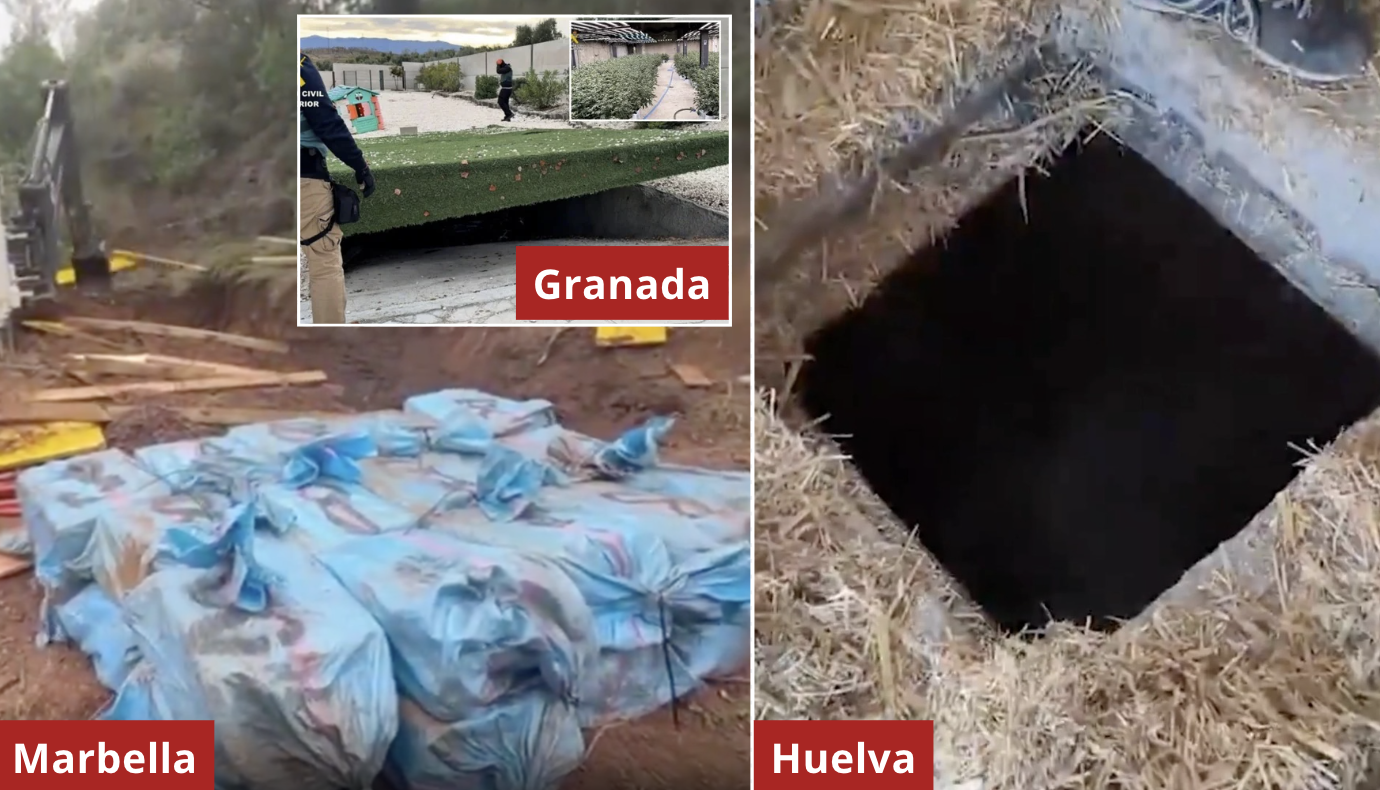

A series of major drug busts across Andalucia this year has exposed a lesser-seen side of the country’s multibillion-euro narcotics trade.
From residential neighbourhoods in Cadiz to rural Granada, Marbella and Huelva, police have uncovered sophisticated underground bunkers used to store vast volumes of cocaine, hashish and more.
A 1.8-tonne cocaine seizure in Cadiz
The latest discovery came this week following a joint investigation by the Guardia Civil and Policia Nacional in Sanlucar de Barrameda and Chipiona.
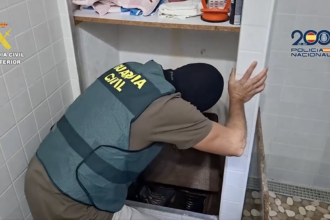
Footage shared by the Guardia Civil shows officers discovering one of the storage spaces hidden beneath a bathroom inside a home.
A second bunker was filmed being accessed in the hallway of a property by an officer using a ladder.
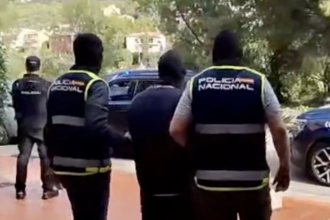
Authorities seized a total of 1.823 tonnes of cocaine and arrested seven suspects.
Six of those have previous convictions or records for drug trafficking, according to the Guardia Civil and Policia Nacional.
Officers also seized €171,300 in cash, more than 35kg of marijuana and numerous vehicles.
Plantation under playground
Granada has also witnessed multiple discoveries of clandestine underground cannabis plantations this year, including one associated with a children’s playground.
At first glance, it appeared to be an innocent play area, with a swing and a playhouse on artificial grass.
But beneath it, the Guardia Civil found two rooms containing 1,954 cannabis plants.
The underground site lay beneath the back garden of a home in Las Gabias, near Granada city.
It covered about 180 square metres and was large enough for vehicles to enter, the Guardia Civil said.
In October, The Spanish Eye reported on another underground cultivation facility discovered on an olive grove in the province.
Almost 7,900 marijuana plants and 21 weapons were seized in operations between October 19 and 21, with 18 people arrested and another 22 placed under investigation.
The concealed growing facility was discovered on rural land in Cogollos de la Vega, accessed through a narrow passage leading underground.
Inside, officers found 490 cannabis plants alongside artificial lighting, ventilation, climate-control equipment and a water supply.
Above ground, branches concealed the climate-control units, while three surveillance cameras hidden among olive trees monitored the surrounding property.
Further discoveries in Huelva and Marbella
On October 26, The Spanish Eye reported the discovery of around a tonne of drugs at an underground storage facility in Huelva.
This is the moment police seized more than four tonnes of hashish from a property in Ayamonte, including over a tonne hidden beneath a floor covered with loaves of bread.
Investigators became suspicious after spotting hundreds of baguettes scattered across the floor, despite there being no animals at the property to explain their presence.
A closer inspection revealed a concealed underground compartment containing more than 1,000kg of hashish.
Policia Nacional said the property served as a storage site for a criminal organisation bringing drugs ashore in Huelva before smuggling them across Spain and Europe.
In Marbella, police also uncovered a cocaine stash in Las Chapas following an investigation involving a confrontation between officers and suspected drug traffickers.
The dramatic raid happened in Las Chapas after the Policia Nacional received intelligence that a major drug shipment was due to arrive on the Malaga coast.
Officers set up a discreet surveillance operation and eventually tracked suspicious activity to the Ricmar forest area.
During the stake out, police spotted a high-powered car acting suspiciously as it headed towards the beach.
According to investigators, the vehicle appeared to be carrying out manoeuvres to check whether police were nearby.
Once the car moved away, officers moved into the wooded area.
There they discovered three men brutally beating another person, with two of them carrying submachine guns and wearing what appeared to be police-style vests.
Investigators believe they had stumbled across a ‘vuelco’ – a violent robbery of drugs between rival criminal gangs.
But when the suspects realised police were closing in, they didn’t surrender.
Instead, they fled on foot and opened fire at officers with submachine guns before being captured.
Four suspected members of the criminal network were eventually arrested.
After searching the area, officers discovered what police described as a large underground ‘narco-zulo’ – a hidden bunker dug into the ground to stash drugs.
Inside were 30 burlap-wrapped bales containing 1.056 tonnes of cocaine.
Police also found a surveillance camera monitoring the access path leading to the hiding place.
The operation uncovered a huge arsenal and equipment linked to organised crime.
Among the items seized were three luxury vehicles – two of them stolen – as well as military-grade weapons including an AK-47, an AR-15 assault rifle and an Uzi-type submachine gun.
Other operations have exposed underground facilities linked to international organised crime, including a case involving the notorious Sinaloa cartel in Alicante.
Cross-border organised crime in Ceuta
The phenomenon extends beyond mainland Spain.
The discovery of a clandestine tunnel linked to suspected drug trafficking in Ceuta has highlighted the continuing challenges facing authorities along Spain’s land border with Morocco.
The enclave occupies a strategically important position in the fight against international drug trafficking.
Are narco bunkers becoming more common?
The number of discoveries reported this year raises the question of whether underground criminal bunkers are becoming more widespread or whether police are increasingly successful at uncovering them.
The Spanish Eye has contacted the Unified Association of Civil Guards (AUGC) for its assessment of the phenomenon and whether officers have sufficient resources to confront increasingly sophisticated criminal networks.
Read more Andalucia news at the Spanish Eye.