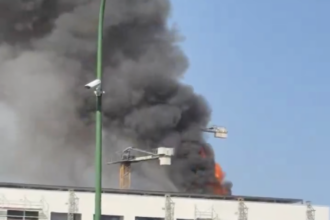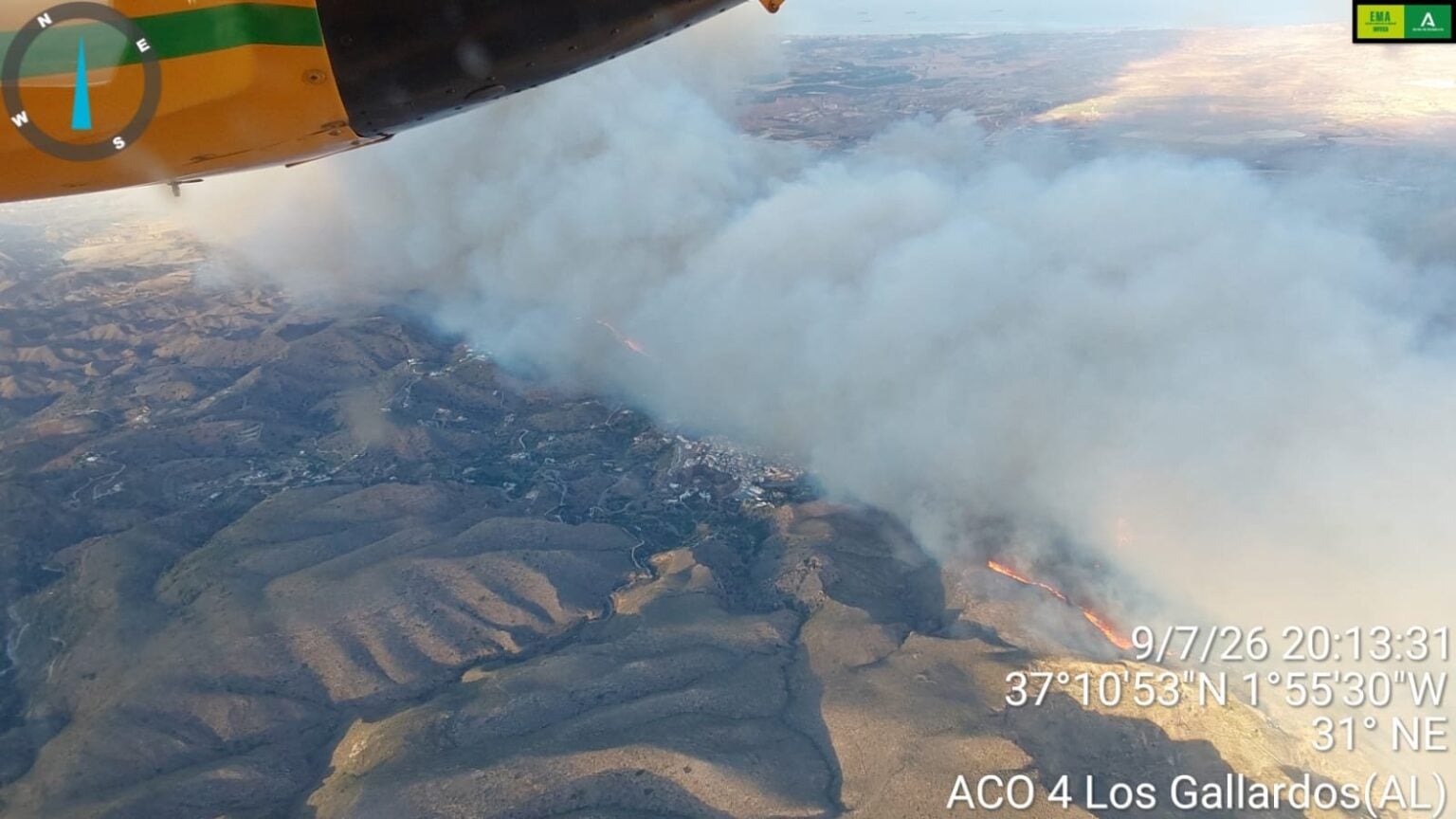

The catastrophic wildfire that tore through Almeria last week released more than twice the amount of energy produced by the atomic bomb dropped on Hiroshima.
Researchers estimate the blaze emitted around 140 terajoules (TJ) of radiant heat energy – compared with the estimated 63 terajoules released by the ‘Little Boy’ bomb detonated over Hiroshima in 1945.
Experts stress that the comparison refers only to the total amount of energy released, not to the destructive effects of the two events.
Unlike a nuclear explosion, which releases its energy in a fraction of a second, the Almeria wildfire emitted its heat gradually over many hours as it burned across thousands of hectares.
The analysis was carried out by student Simon Schütze using data from the European Meteosat Second Generation (MSG) and Meteosat Third Generation (MTG) satellites.
His findings were later shared by leading wildfire scientist Víctor Resco de Dios, a professor at the University of Lleida and one of Spain’s foremost experts on extreme wildfire behaviour.
Satellite measurements show the fire’s Fire Radiative Power (FRP) – a standard scientific measure of wildfire intensity – peaked at nearly 9,000 megawatts on the afternoon of July 9, when the blaze was at its most violent.
A second surge of more than 5,000 megawatts followed on July 10 before the fire gradually weakened.
By adding together the energy emitted throughout the entire event, researchers calculated a total Fire Radiative Energy (FRE) of approximately 140 terajoules.
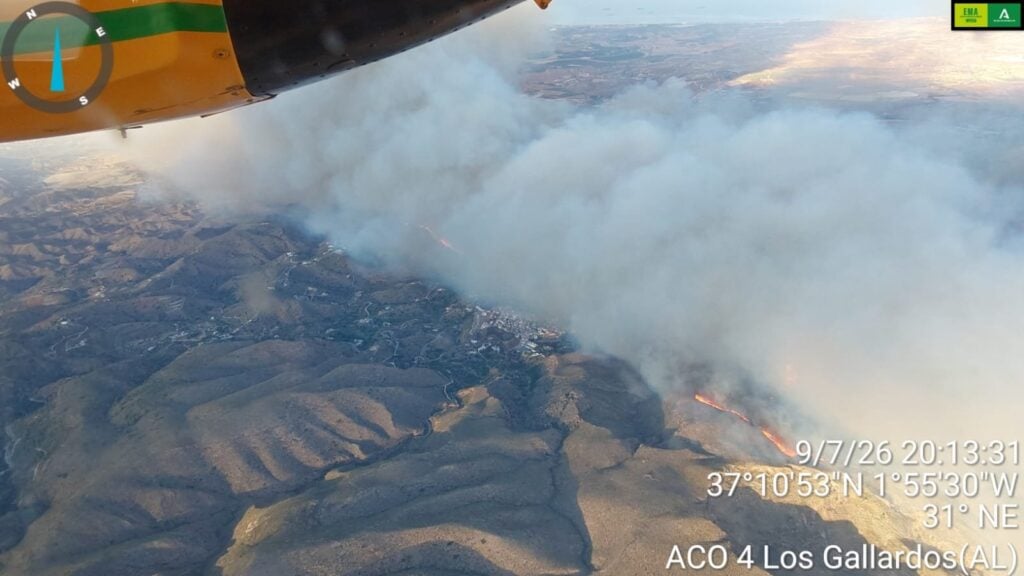
Although the specific calculations for the Los Gallardos wildfire have yet to be published in a peer-reviewed scientific paper, the methodology is widely accepted and routinely used by researchers around the world to estimate wildfire intensity, biomass burned and carbon emissions.
Resco de Dios has previously warned that the intensity of wildfires across the Iberian Peninsula has increased by 30% to 40% in recent years.
He has also coined the term ‘atomic power fires’ to describe the most extreme blazes – those capable of releasing an amount of energy comparable to the Hiroshima bomb, albeit spread over many hours rather than in an instantaneous explosion.
The Los Gallardos wildfire, which claimed 13 lives and became Andalucia’s deadliest wildfire in modern history, is now being cited as another stark example of how extreme fires are becoming more powerful amid rising temperatures, prolonged drought and the build-up of dry vegetation fuel.