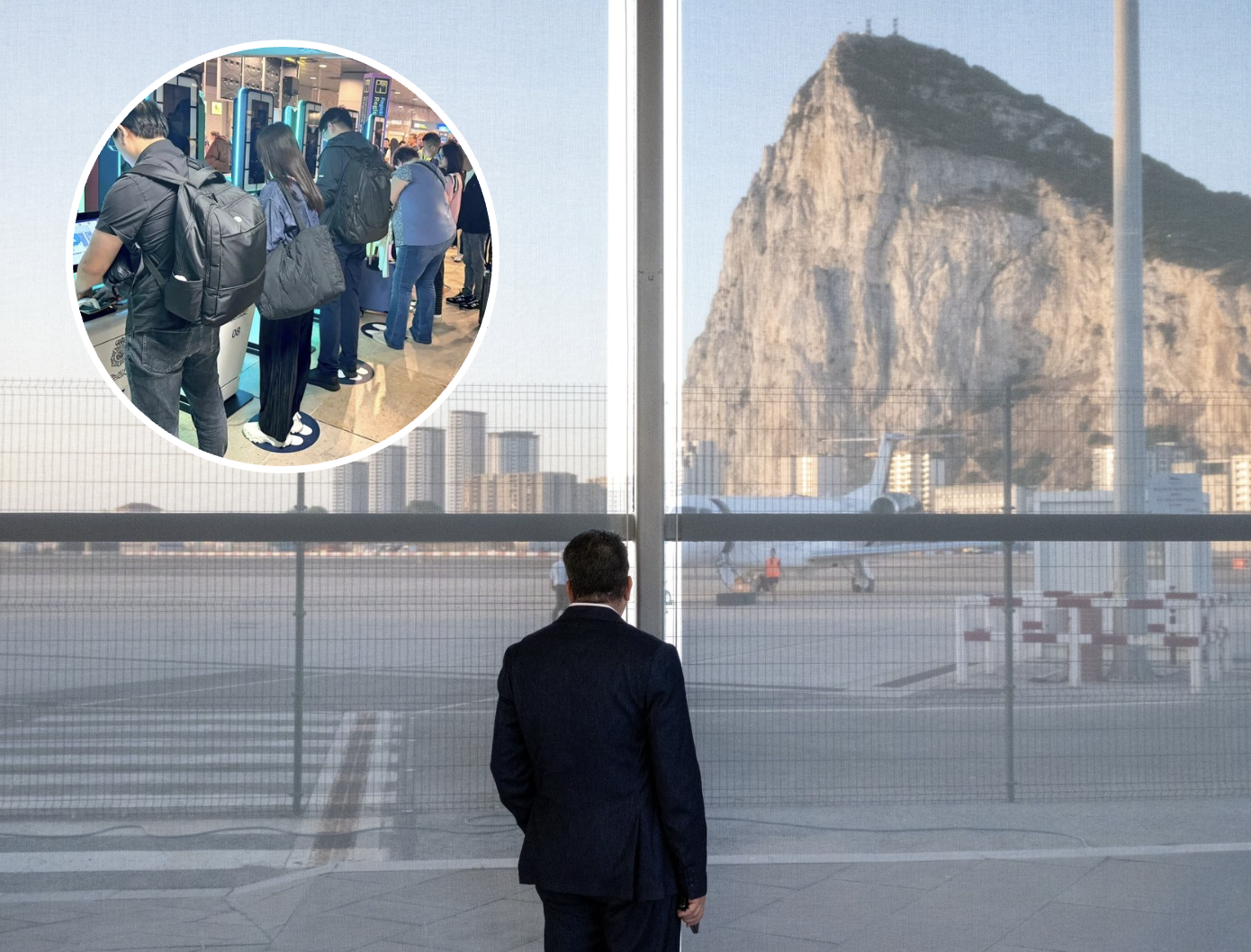

British travellers flying to Gibraltar from the UK will now have to pass through the EU’s Entry/Exit System (EES).
The new system, in force from this week, marks one of the biggest-ever changes to travel between Britain and the Rock.
The requirement comes into force as Gibraltar officially joins the Schengen free movement area under the landmark UK-EU agreement that removes checks at the land border with Spain.
While the deal means motorists and pedestrians can now cross freely between Gibraltar and La Linea without passport controls, it also means non-EU nationals arriving by air will instead be checked at Gibraltar Airport before entering the Schengen zone.
What is the Entry/Exit System?
The EES is the EU’s new electronic border management system for non-EU and non-resident visitors.
Instead of receiving passport stamps, travellers have their passport scanned and their biometric data recorded electronically.
On their first entry into the Schengen area, travellers are required to scan their passport, have their fingerprints taken and a facial photograph captured.
That information is then stored electronically for future visits.
Subsequent journeys should be quicker, as travellers who have already enrolled in the system will only need to verify their identity at scanners.
Who will have to use it at Gibraltar?
The new checks apply to British citizens or any other non-EU nationals flying into Gibraltar from the UK – unless they have residency in an EU country.
However, Gibraltar’s approximately 38,000 residents are exempt under the new UK-EU agreement.
Will there be long queues?
Possibly, particularly during the busy summer holiday season.
The EES has experienced technical problems since its wider rollout across Europe, with some airports reporting delays while staff adapt to the new procedures.
Gibraltar’s Chief Minister Fabian Picardo acknowledged there could initially be queues.
‘I am concerned it could happen,’ he said.
However, he believes Gibraltar’s relatively small airport should help minimise delays.
The airport handles around 300,000 passengers annually and typically receives only one Airbus A320 flight each hour.
‘We tend to get one A320 every hour or so, so there should be time to clear the 140 or 150 passengers before you have a build-up,’ Picardo said.
What about children?
Children under 12 do not have to provide fingerprints.
However, they must still have their photograph taken.
Large numbers of families travelling during the UK school holidays have already caused longer processing times at some Spanish airports.
Who carries out the checks?
Passengers will first pass Gibraltar’s own passport control before entering a joint control area where Spanish border officers carry out Schengen immigration checks.
The arrangement formed one of the most sensitive parts of negotiations between the UK, Gibraltar, Spain and the EU.
Rather than operating across Gibraltar itself, Spanish officers will work inside a specially constructed joint facility attached to the airport.
Picardo has described it as the ‘Schengen shack’, stressing that Spanish officers will remain confined to that designated area.
Why is this happening?
The changes are part of the post-Brexit treaty finally agreed between the UK, Gibraltar, Spain and the EU after more than three years of negotiations.
In exchange for removing passport controls at the Gibraltar-Spain land border, Gibraltar agreed that Schengen checks would instead take place at its airport and port.
The agreement avoids the return of a hard border that many feared would have caused severe disruption to Gibraltar’s economy, which depends heavily on around 15,000 workers who commute daily from Spain.
Read more Andalucia news at the Spanish Eye.