

Santiago Abascal’s claim that ‘most gays’ in Spain will end up voting for Vox have resurfaced online.
The clip has garnered new attention after the hard-right party voted against a bill this week that will allow practitioners of gay conversion therapy to be jailed.
Political commentator Carlos Solas Fernandez, who has more than 36,000 Instagram followers, highlighted what he described as a contradiction in the party’s position.
‘What a way to protect the LGBT collective,’ Fernandez said sarcastically in reference to this week’s vote.
In the interview, Abascal argued that many gay people do not identify with the rainbow flag and instead feel represented by the Spanish flag.
He goes on to predict that ‘the majority of gay Spaniards will vote for Vox’ because, he claims, his party is the only one willing to remove from Spain those who would ‘throw them off rooftops or hang them from cranes’ – an apparent reference to Islamist extremists.
The comments are an example of a political strategy often described by academics as ‘homonationalism’ – the use of LGBT rights as a way of contrasting Western liberal values with immigration, particularly from predominantly Muslim countries.
The concept, first developed by American academic Jasbir Puar following the September 11 attacks in the US, has since been used to describe political movements across Europe that present themselves as defenders of gay people while simultaneously promoting nationalist and anti-immigration policies.
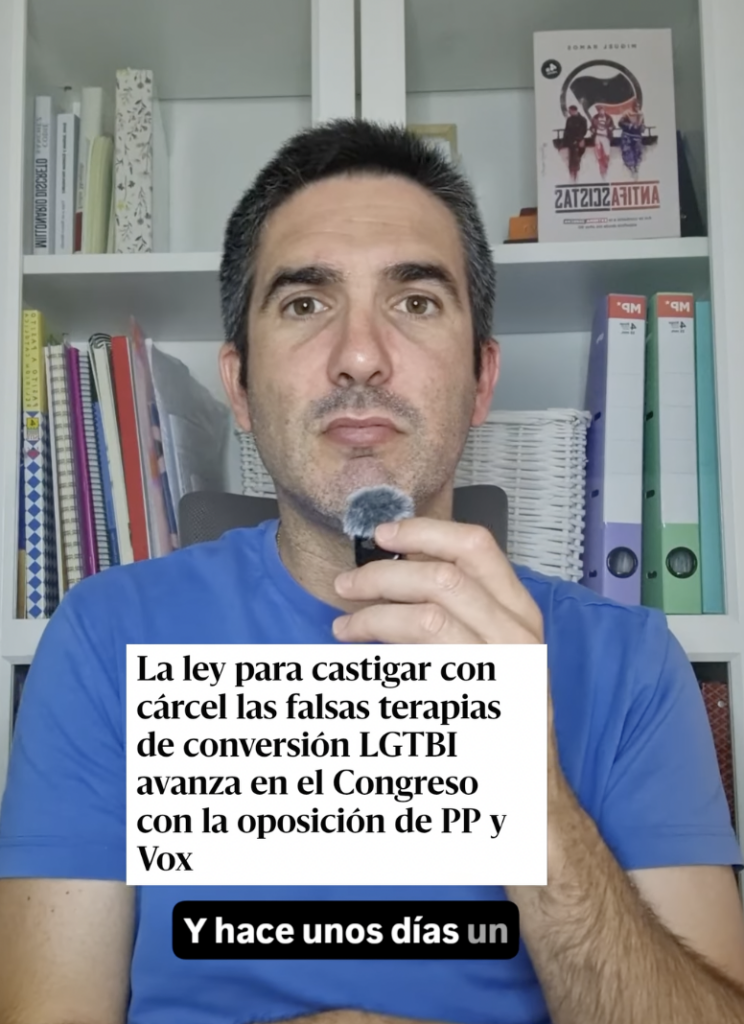
Abascal’s remarks have returned to the spotlight after Congress approved reforms to the Criminal Code that will make conversion therapies aimed at changing or suppressing a person’s sexual orientation or gender identity punishable by up to two years in prison.
The legislation passed with the support of 178 MPs, while Vox voted against it and the People’s Party (PP) abstained.
Posting the resurfaced clip on Instagram, Solas questioned how Vox could claim to defend LGBT people while opposing legislation designed to criminalise conversion therapies.
He also noted that the PP had similarly opposed making the practice a criminal offence in Madrid.
While Vox has increasingly framed itself as the party willing to defend gay people from what it describes as imported homophobia, it has also repeatedly sought to roll back LGBT legislation.
The party has campaigned to repeal Spain’s LGBT and transgender laws, attempted to remove regional protections for LGBT people in several autonomous communities, and has criticised what it calls ‘gender ideology’ in schools.
LGBT organisations have long argued that these positions undermine Vox’s attempts to portray itself as a defender of the community.
Supporters of the party, meanwhile, argue that opposing specific legislation does not mean opposing gay rights, and that protecting citizens from religious extremism and defending traditional views on family policy are separate issues.