A minor earthquake measuring 2.4 on the Richter scale was recorded on the Costa del Sol on Saturday evening.
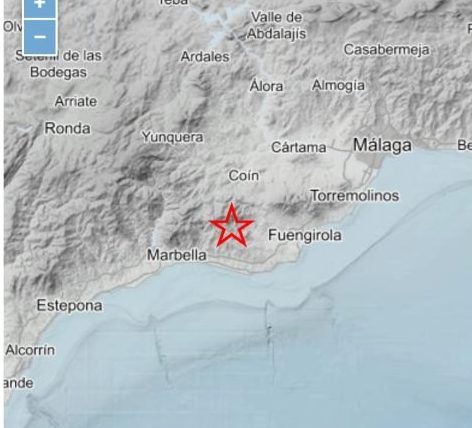
The epicentre was in the area around Ojen, which neighbours Marbella to the north, according to updated information from Spain’s National Geographic Institute (IGN).
The tremor struck at 7.21pm (mainland Spain time), with the epicentre at a depth of 13km.
The movement was lightly felt in some parts of the Costa del Sol and the Guadalhorce Valley.
The IGN reported that the earthquake was of low intensity and that no personal injuries or material damage have been recorded.
Low-magnitude seismic activity is relatively common in Malaga province, which lies in a zone of moderate seismic activity linked to the Alboran Sea.
It comes after a small quake in the Axarquia town of Iznate on December 10 measured 2.5 on the Richter scale shortly after 10am.
Although minor, the quake came only five days after the much stronger 4.8-magnitude event centred off Fuengirola at the start of December’s first holiday weekend.
That tremor, which occurred 77km deep and reached intensity level 3, was felt across large parts of the Costa del Sol.
The province has experienced several small quakes in recent weeks, but the Fuengirola event was the most significant in years.
Just days earlier, on December 1, another 3.2-magnitude quake was registered off Estepona.
The episodes are part of the ongoing seismic behaviour that is typical of a region situated between the African and Eurasian tectonic plates.
Malaga lies close to the Alboran Fault, a complex system of active faults beneath the Alboran Sea.
This geological setup makes the region prone to occasional tremors, even if large earthquakes are uncommon.
The Alboran Fault, which includes major structures such as the Averroes and Carboneras faults, is capable of generating significant earthquakes and even tsunamis.
Small seismic movements are recorded ‘daily’, although most are too weak to be felt.