
Ceuta’s spiralling migration crisis is threatening to become a public health emergency after dozens of soldiers reportedly contracted scabies, doctors warned of a ‘real risk of an epidemic’ and more than 100 migrants began a hunger strike.
Around 30 soldiers serving with the General Command of Ceuta are understood to have contracted scabies after being deployed during the mass arrival of migrants from Morocco on July 30.
The Spanish Troops and Sailors Association (ATME) has also reported possible infections among members of the Regulares military units stationed in the autonomous city.
It comes as the president of Ceuta’s Medical Association, Enrique Roviralta, described the health situation on Monday as a ‘ticking time bomb’ and warned there was a ‘real risk of an epidemic’.
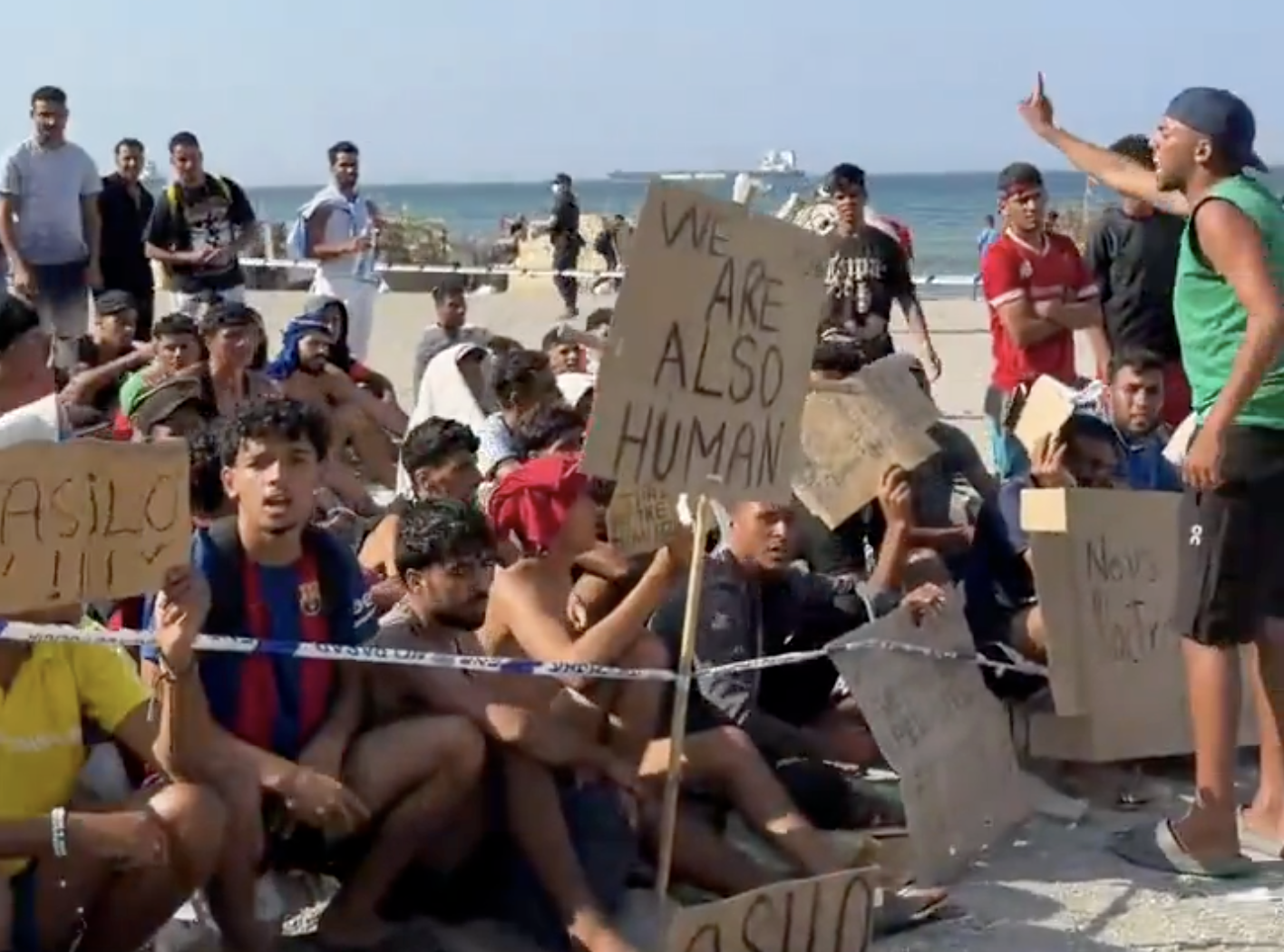
Meanwhile, more than 100 Moroccan migrants who have been camped on a beach since crossing the border have launched a hunger strike, demanding asylum and refusing to return to Morocco.
Soldiers reportedly infected
The reported scabies outbreak among military personnel has yet to be officially confirmed by the Ministry of Defence.
However, around 30 members of the General Command are understood to have been affected, while ATME said it had received information suggesting several soldiers from the Regulares had also contracted the highly contagious skin condition.
The association has now demanded that Defence clarify exactly how many infections have been confirmed, which units are affected and whether there is an epidemiological link between the cases.
It also wants to know whether contact-tracing and health surveillance protocols have been activated to prevent further infections among personnel still deployed in Ceuta.
ATME said troops involved in the prolonged operation must be provided not only with the equipment needed to carry out their duties but also with adequate health protection.
The reports come amid mounting concern about infectious diseases among the thousands of migrants who have entered Ceuta since late July.
Doctors warn of ‘real risk of epidemic’
Roviralta issued his stark warning on Monday, just a day after Health Minister Monica García travelled to Ceuta and insisted that its healthcare system was under pressure but had not collapsed.
The head of the city’s Medical Association openly disagreed with that assessment.

‘The doctors disagree with that opinion,’ Roviralta said, arguing that the system was functioning largely because healthcare workers were absorbing an extraordinary increase in demand without a corresponding increase in permanent resources.
Garcia revealed on Sunday that some 5,800 migrants had received medical treatment in Ceuta over the previous 15 days.
Around 3,500 were treated by primary healthcare services and another 2,300 at Ceuta University Hospital.
At the height of the crisis, an extraordinary 1,149 patients were treated in just 24 hours. The figure has since fallen, but between 200 and 400 people are still requiring treatment each day.
Doctors are particularly concerned about the potential spread of infectious diseases.
Cases of gastroenteritis, scabies and tuberculosis have been detected among migrants, many of whom have spent days living in overcrowded areas or makeshift camps with limited access to adequate sanitation.
‘This is a ticking time bomb,’ Roviralta warned.
Julian Dominguez, head of Preventive Medicine at Ceuta University Hospital, has already confirmed an outbreak of gastroenteritis as well as isolated cases of tuberculosis and scabies.
Health Minister Garcia has sought to reassure residents, saying the epidemiological risk to the general population remains low and is considered moderate among the migrant population itself.
She also warned against automatically associating migration with disease.
But Ceuta’s Medical Association is calling for much stronger measures, including temporarily reopening the city’s former military hospital or establishing a field hospital.
It also wants healthcare workers to be sent from mainland Spain so the response does not continue to depend on already stretched local staff.
The association has questioned whether the temporary recruitment of around 60 additional healthcare professionals until the end of August will be sufficient.
Migrants launch hunger strike
Against that increasingly tense backdrop, more than 100 migrants camped at Trampolin beach have now begun a hunger strike demanding asylum in Spain.
The group has been living there since crossing from Morocco on July 30.
One of the migrants, a man named Youssef, said the hunger strike began on Sunday after they had spent around 18 days waiting for their situation to be resolved.
Carrying signs identifying themselves as Moroccans and declaring that they do not want to return home, the migrants said they would continue their protest until they are transferred elsewhere.
‘We don’t want any problems, we just want to get out of here,’ Youssef said.
He appealed directly to Ceuta president Juan Jesus Vivas, Spanish Prime Minister Pedro Sanchez and King Felipe VI, while complaining that no authority had visited the group.
The migrants have constructed makeshift shelters on the beach, where they say they are enduring intense heat during the day and colder conditions at night.
Youssef insisted they did not want to ‘bother’ local residents and said they hoped the situation would be resolved before children return to school in the coming weeks.
1,500 emergency places
The Spanish government is now dramatically expanding emergency accommodation in an effort to move migrants out of precarious conditions.
Inclusion, Social Security and Migration Minister Elma Saiz announced on Monday that 1,500 additional temporary humanitarian places would be made available immediately.
The facilities will be spread across four locations, comprising the vehicle holding area at Loma del Colmenar, equestrian facilities, the former football pitch at the Caballeria military barracks and an area known as El Guano.
The Health Ministry is also sending specialists in epidemiological control and preventive medicine to work alongside Ceuta’s existing health authorities.
Around 60 temporary healthcare workers brought in as reinforcements are due to remain until August 31.
The government insists the hospital still has substantial spare capacity, with around half of its beds reportedly available, and García said there had been no need to cancel staff holidays or bring in emergency healthcare teams from other Spanish regions.