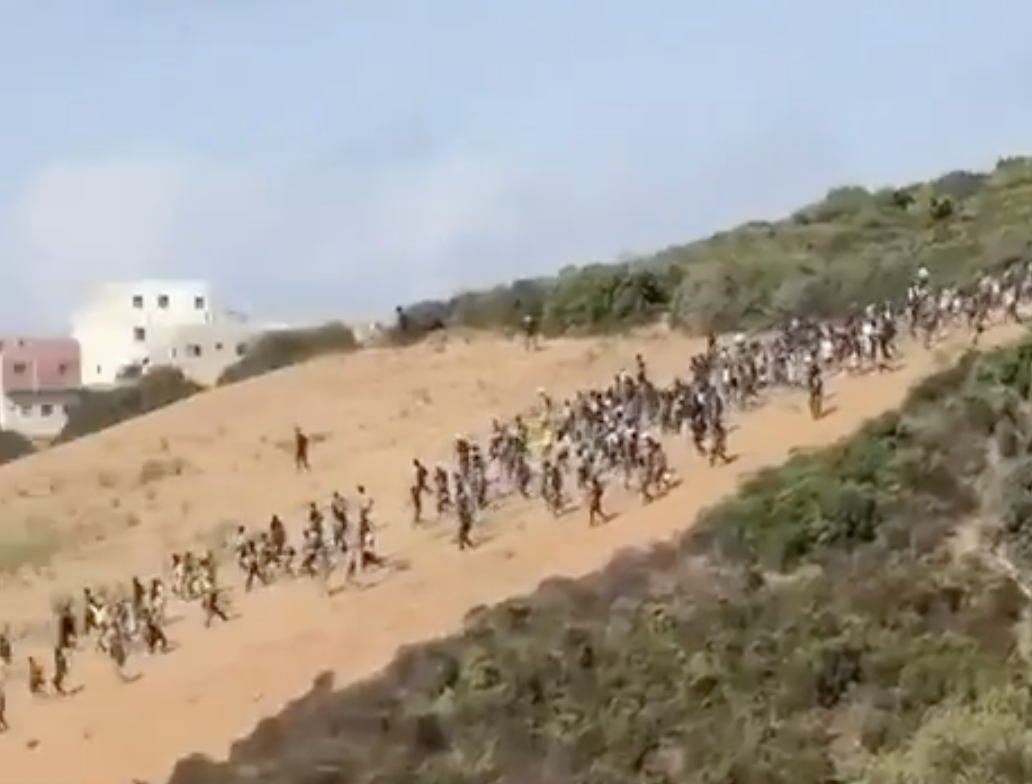

Hundreds of migrants have been prevented from attempting to enter Ceuta after Morocco launched a major security operation in response to calls for a new mass crossing into the Spanish enclave.
Moroccan authorities said 294 people were intercepted on Saturday, including 248 sub-Saharan Africans and 46 Moroccan nationals, after messages circulated on social media encouraging people to head towards the border.
The mobilisation had raised fears of a repeat of the extraordinary events of July 30, when tens of thousands of people crossed into Ceuta, overwhelming the small Spanish territory and triggering a political and humanitarian crisis that continues more than two weeks later.
This time, however, Morocco effectively sealed off approaches to the border.
Hundreds of members of the country’s Auxiliary Forces and Gendarmerie were deployed on land, while the Royal Moroccan Navy sent six fast boats to patrol the coastline.
Drones were used for surveillance and identification from the air, while helicopters were also reported to have been deployed.
Moroccan forces had additionally reinforced the area around the Tarajal breakwater with barbed wire and razor wire during the preceding days.
The operation concentrated particularly around Fnideq, known in Spanish as Castillejos, immediately south of Ceuta, where groups hoping to reach the Spanish territory had reportedly gathered.
Moroccan authorities have also arrested 61 people accused of using social media to incite or promote Saturday’s attempted mass crossing.
Security was dramatically reinforced on the Spanish side too, with additional police and Guardia Civil officers deployed around the frontier and Spanish military personnel and armoured vehicles positioned near Tarajal.
The Sindicato Unificado de Policía (SUP) welcomed the fact that another mass crossing had been prevented, but warned that Saturday’s events demonstrated the extent to which Ceuta’s security can depend on Morocco.
‘Spain needs cooperation with Morocco, but cooperation cannot mean dependence,’ the union said.
It added that the security of Ceuta and Melilla, and therefore part of the European Union’s external frontier, cannot be dependent exclusively on the willingness or ability of a third country to act.
The SUP is demanding additional officers for immigration and border control, forensic policing, intelligence and public security following the July 30 crisis.
Although Saturday’s feared surge failed to materialise, the situation inside Ceuta remains highly contentious.
There are conflicting estimates of how many of those who entered on July 30 remain in the city.
Interior Minister Fernando Grande-Marlaska has put the number at around 5,000, while Ceuta president Juan Jesus Vivas estimates between 8,000 and 11,000 remain.