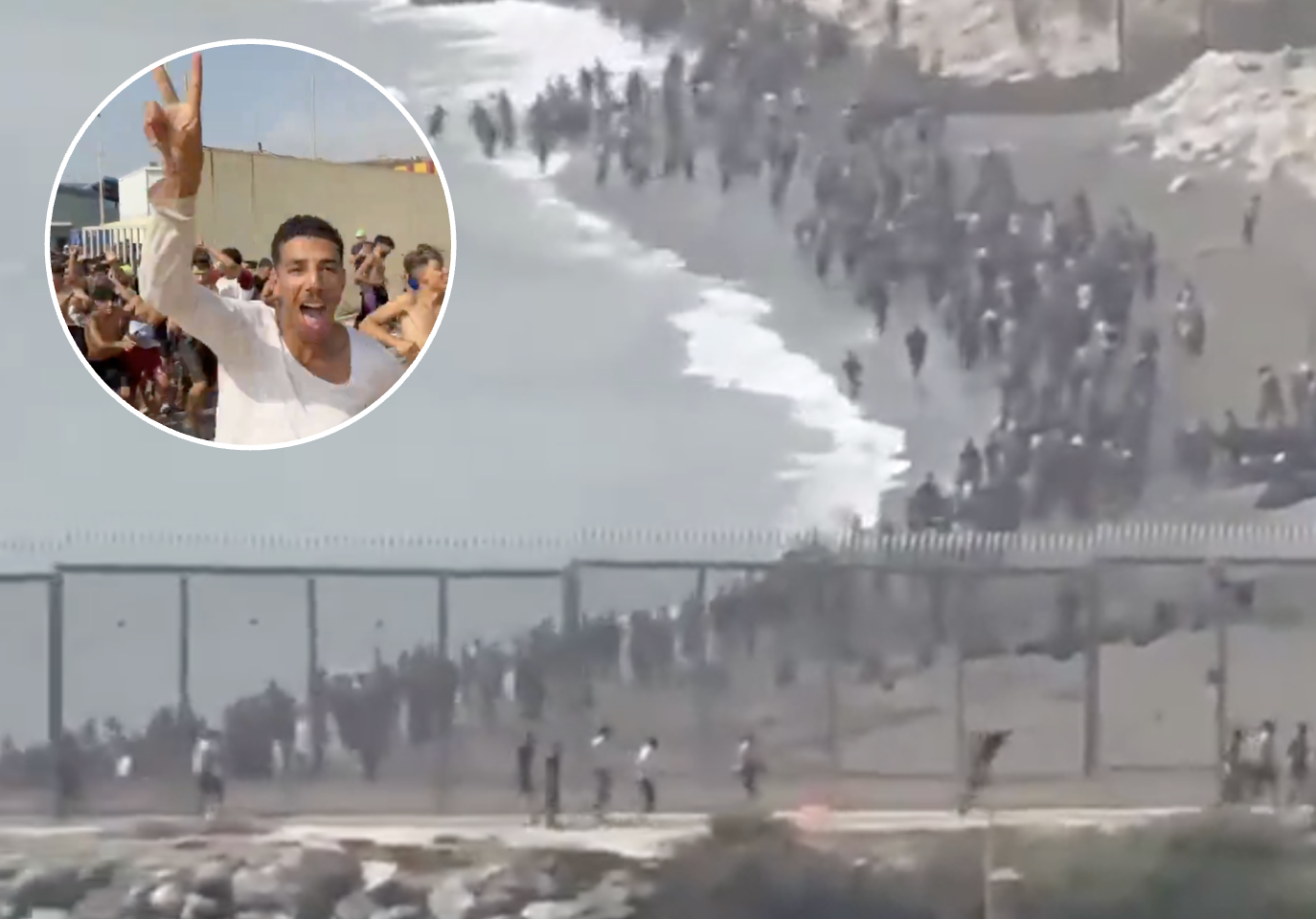

The death toll from last week’s unprecedented migrant crisis in Ceuta has risen to 88, according to the local government.
The majority of the bodies were pulled from the waters surrounding the Tarajal breakwater, with most victims believed to have drowned while trying to reach the Spanish enclave.
Ceuta president Juan Jesus Vivas said the corpses have been transferred to a former Military Hospital for identification and forensic examinations.
The Unified Association of the Civil Guard (AUGC) has suggested the final death toll could exceed 100.
Meanwhile, Moroccan authorities have separately reported recovering 11 bodies on their own coastline.
Speaking on Monday, Vivas said between 3,000 and 5,000 migrants remain in Ceuta, four days after an estimated 80,000 people crossed from Morocco during the largest border crisis in the city’s history.
‘The situation is not what it was on Thursday and Friday, but we are still far from normality,’ he said, describing how the city’s ‘integrity was violated’ by an influx almost equal to Ceuta’s entire population.
He added that his government had already been increasingly concerned in the days leading up to the crisis, after 1,800 to 2,000 people had been entering the city by sea each day, and argued that exceptional national security measures should have been introduced earlier.
The city is also continuing to struggle with an unprecedented number of unaccompanied children.
Ceuta’s councillor for the Presidency and Governance, Alberto Gaitan, said the city is currently caring for 862 migrant minors, despite having facilities designed for just 29.
He described the system as operating at 2,872% of its intended capacity, warning that more children could still emerge after being sheltered by private individuals.
Meanwhile, Ceuta’s Temporary Immigrant Stay Centre (CETI), which has capacity for around 600 people, remains completely full.
Gaitan said around 1,000 migrants are currently camped outside the centre because there is no space available inside, describing the situation as ‘very difficult’.
The crisis has also prompted judicial action.
Judge Maria Tardon of Spain’s National Court has requested an urgent report from the Policia Nacional to determine whether the mass crossings were coordinated by an organised criminal network.
The investigation follows a complaint lodged by the political party Iustitia Europa, which alleges offences including facilitating illegal immigration, human trafficking, organised crime and crimes against the security of the Spanish state.
Before deciding whether the National Court has jurisdiction over the case, the judge has asked investigators to establish whether the crossings formed part of a coordinated operation and whether those responsible can be identified.