
Voters heading to the polls in Cadiz on May 17 will find an unfamiliar name on the ballot paper alongside the usual heavyweights of the PP, PSOE and Vox.
The Partido Andalusi, founded just three years ago in Algeciras, is making its first bid in regional elections with a platform rooted in what it describes as ‘Islamic humanism’ – and an eye-catching proposal to ‘normalise’ Arabic as a ‘historic language’ of Andalucia.
It marks a symbolic entry into a crowded race in Cadiz, where 16 candidacies have been registered and 15 parliamentary seats are up for grabs.
From fringe to ballot paper
The party is led in Cadiz by Dris Mohamed Amar, one of its founders, who previously stood in the 2023 municipal elections in Algeciras.
On that occasion, the party secured just 327 votes – 0.77% – falling well short of representation.
Despite that modest debut, the group has doubled down on its ideological project, which it says draws inspiration from Blas Infante – widely considered the father of Andalucian identity – combined with principles of equality, democracy and cultural pluralism.
One of its founders is Alejandro Delmas Infante, grandson of Blas Infante, although the party itself refers to Andalucia as a ‘matria’ rather than ‘patria’.
Controversial proposals
Beyond language, the Partido Andalusi has floated a series of proposals that have already sparked political backlash.

At a local level, it has called for Ramadan lighting displays in Algeciras similar to those seen in Ceuta and Melilla, as well as the use of the town’s bullring for Eid celebrations. It has also previously advocated for the construction of an Islamic cemetery.
More broadly, its programme includes the idea that Ceuta and Melilla should become part of Andalucia – despite never having belonged to the autonomous community – and frames this within a wider ambition to recover what it calls the ‘Andalusi nation’ on both sides of the Strait of Gibraltar.
The party also argues that Andalucia should reclaim ownership of the historical legacy of Al-Andalus, which it claims has been ‘appropriated’ by Morocco, positioning itself as neither strictly Spanish nor Moroccan but distinctly ‘Andalusi’.
Its core objectives
According to its own programme, the Partido Andalusi frames its project as a response to what it sees as a failing global model.
It argues the current Western system is ‘unsustainable at a planetary level’, claiming it would require ‘the resources of seven Earths’ to maintain current consumption levels.
The party links this to global inequality, citing wars, support for authoritarian regimes and resource exploitation as drivers of poverty and mass migration.
The group also criticises what it calls ‘massive and irresponsible consumption’, arguing that food waste in developed countries could instead be used to tackle hunger elsewhere.
At its core, the party says its worldview rests on four pillars: ‘freedom, justice, solidarity and humanism’.
It advocates for a society where economic barriers do not prevent access to education or personal development, and where social systems enable individuals to ‘realise themselves humanly and scientifically’.
Among its more striking proposals is the idea of criminalising ‘lies and false propaganda’ in politics, arguing that both leaders and voters must be held accountable for tolerating misinformation.
The party also places strong emphasis on humanist values, calling for ‘deep respect’ between people of different ethnicities and beliefs, warning that without it society risks ‘losing its human sensitivity and rational essence’.
Political reaction
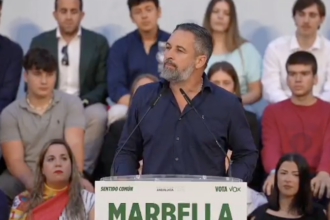
The emergence of the party has not gone unnoticed. Vox has already attacked its proposals, warning of what it describes as the ‘Islamisation’ of Andalucia.
The debut of the Partido Andalusi comes in a province where traditional parties still dominate. In the last regional elections in 2022, the PP won eight seats in Cadiz, followed by the PSOE with three, Vox with two, and Adelante Andalucia and Por Andalucia with one each.
Whether the new formation can convert its ideological message into votes remains to be seen, but its presence on the ballot ensures that, at the very least, it will add a new and controversial dimension to this year’s race.
Read more Andalucia news at the Spanish Eye.