In the heart of Castilla-La Mancha lies a city so stunning and historic that it was declared a UNESCO World Heritage Site in 1996.
Cuenca sits perched dramatically above the gorges of the Jucar and Huecar rivers, and in winter, it takes on an almost storybook quality.
Although the area has been inhabited since prehistoric times, Cuenca as we know it today began as a Muslim settlement, strategically positioned on a rocky spur.
Following its conquest by Christian forces under Alfonso VIII in 1177, the city grew rapidly in importance.
Royal titles followed over the centuries, cementing Cuenca’s status as a loyal and strategically significant city within the Crown of Castile.
The UNESCO designation recognises not only the city’s extraordinary setting, but also the preservation of its medieval urban layout, defensive structures and an architectural legacy that spans from the 12th to the 18th century.
With a municipal area covering more than 900 square kilometres and a population of just over 50,000, Cuenca feels both compact and expansive.
The city is clearly divided into two halves: the historic old town, dramatically elevated above the river gorge, and the newer districts that stretch southwards across flatter ground.
Most of Cuenca’s landmarks are found in the old town, where the city’s most iconic sight instantly captures attention: the Casas Colgadas. Seemingly clinging to the cliff edge, these medieval houses have become Cuenca’s defining image.
Today, they are home to the Spanish Abstract Art Museum, a striking contrast between contemporary creativity and centuries-old architecture.
Just a short walk away stands the Torre de Mangana, a clock tower that has marked time for the city since the 16th century, rising above what was once the Arab citadel and later the Jewish quarter.
Nearby, the Cathedral of Santa Maria and San Julian, begun shortly after the Christian conquest, is widely regarded as one of the earliest examples of Gothic architecture in Spain.
At the northern edge of the historic centre lie the remains of the old Arab castle and fragments of the medieval walls. Though little survives of the fortress itself, sections of stonework and gateways still hint at Cuenca’s former defensive strength.
Cuenca is a city best appreciated from its viewpoints. Miradors such as San Miguel, El Rey or the Huecar gorge offer sweeping panoramas that feel timeless.
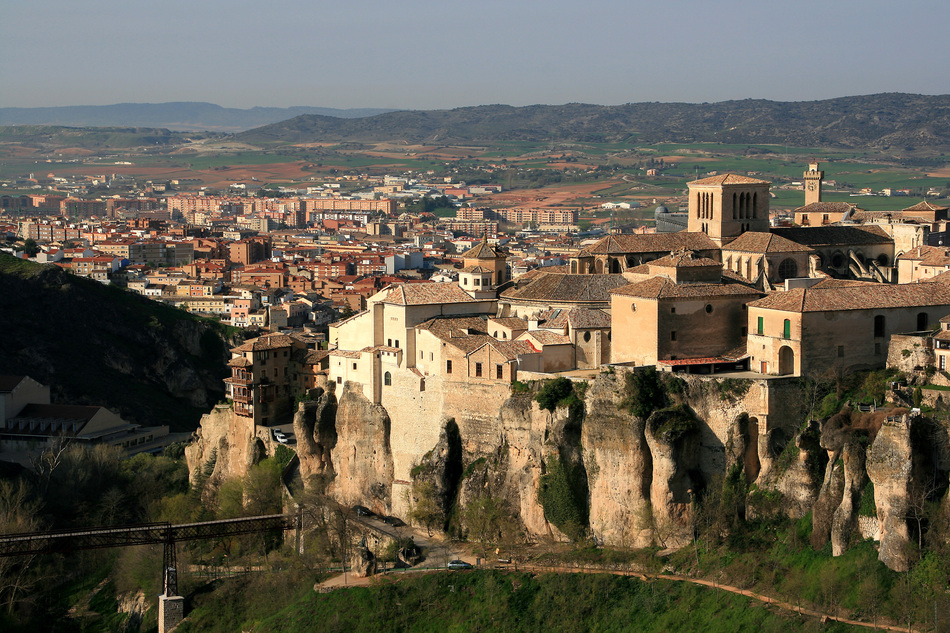
Among them, the Puente de San Pablo stands out. Originally built in stone in the 16th century and later reconstructed in iron at the start of the 20th, the bridge is a striking example of Eiffel-style engineering and provides one of the most unforgettable views of the hanging houses and cliffs.
Beyond the historic centre, nature is never far away. Footpaths along the Jucar river lead through quiet woodland and dramatic rock formations, allowing visitors to step seamlessly from medieval streets into serene natural surroundings.